FTC Safeguards Rule Training Requirements: Building a Human-Ready Written Information Security Plan

Subscribe to newsletter
KEY TAKEAWAYS
- The FTC Safeguards Rule requires every covered non-bank financial institution to provide security awareness training to all personnel, updated as necessary to reflect the risks identified in its risk assessment.
- Training forms one of nine required elements of a written information security plan. Unlike several other provisions, it applies to institutions of every size, including those holding data on fewer than 5,000 consumers.
- Since May 13, 2024, any acquisition of unencrypted customer information affecting 500 or more consumers must be reported to the FTC no later than 30 days after discovery.
- With the human element present in 62% of breaches, leading institutions treat training as one component of a continuous, individual-level measurement of human risk rather than as an annual compliance exercise.
The FTC Safeguards Rule training requirements are frequently summarized as a single obligation to train staff. The regulation is considerably more specific. It requires that training be grounded in a documented risk assessment, revised as that risk evolves, and supported by qualified security personnel whose own expertise is maintained and verified. For mortgage lenders, automobile dealers, tax preparers, consumer finance companies, and the managed service providers that support them, the requirement amounts to a mandate to identify, measure, and reduce human risk across the organization.
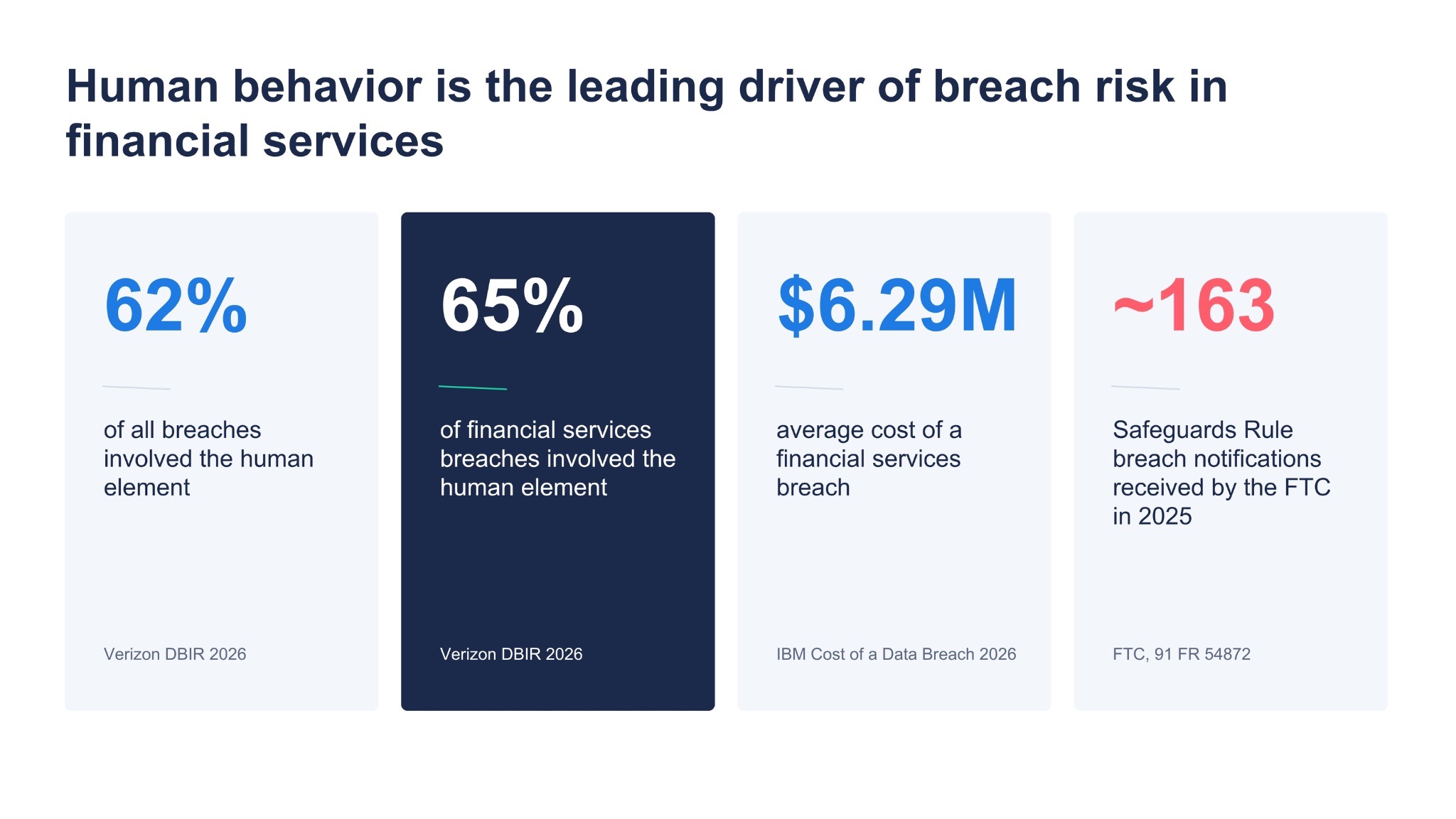
The business case for doing so is substantial. The Verizon 2026 Data Breach Investigations Report identified the human element in 62% of all breaches and in 65% of breaches within financial services. IBM's Cost of a Data Breach Report 2026 places the average cost of a financial services breach at $6.29 million and the average United States breach at $11.5 million. This article sets out what the rule requires, how training integrates with the written information security plan, and how institutions can demonstrate effective management of human risk to regulators, insurers, and boards of directors.
What is the FTC Safeguards Rule?
The FTC Safeguards Rule (16 CFR Part 314) is a federal regulation that requires non-bank financial institutions to develop, implement, and maintain a written information security program to protect customer information. The rule was issued under the Gramm-Leach-Bliley Act of 1999, which is why it is also referred to as the GLBA Safeguards Rule, and it is enforced by the Federal Trade Commission.
The original rule took effect in 2003 and was largely principles-based. In 2021, the FTC substantially revised it to introduce prescriptive requirements, including the designation of a Qualified Individual, multi-factor authentication, encryption, penetration testing, a written incident response plan, and annual reporting to the board. The majority of these provisions became enforceable on June 9, 2023. A subsequent amendment, effective May 13, 2024, introduced an obligation to notify the FTC of qualifying security events.
- The written information security plan at the core of the rule
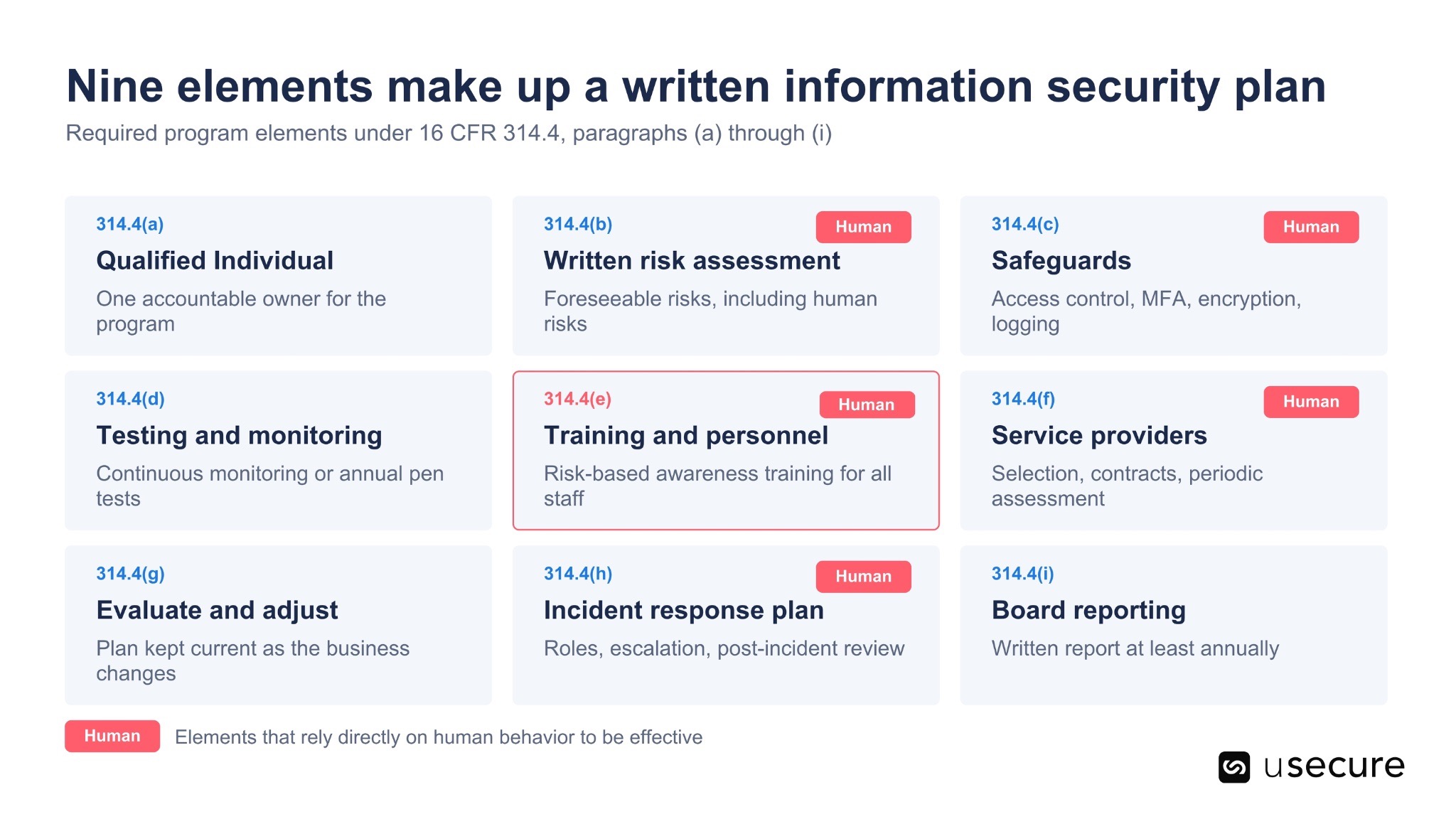
Every requirement in the rule is anchored in a single governing document: the written information security plan. The regulation refers to it as an information security program, and it is commonly abbreviated as a WISP. The plan must be appropriate to the institution's size and complexity, the nature and scope of its activities, and the sensitivity of the customer information it maintains. Section 314.4 specifies nine elements the plan must contain.
Who does the FTC Safeguards Rule apply to?
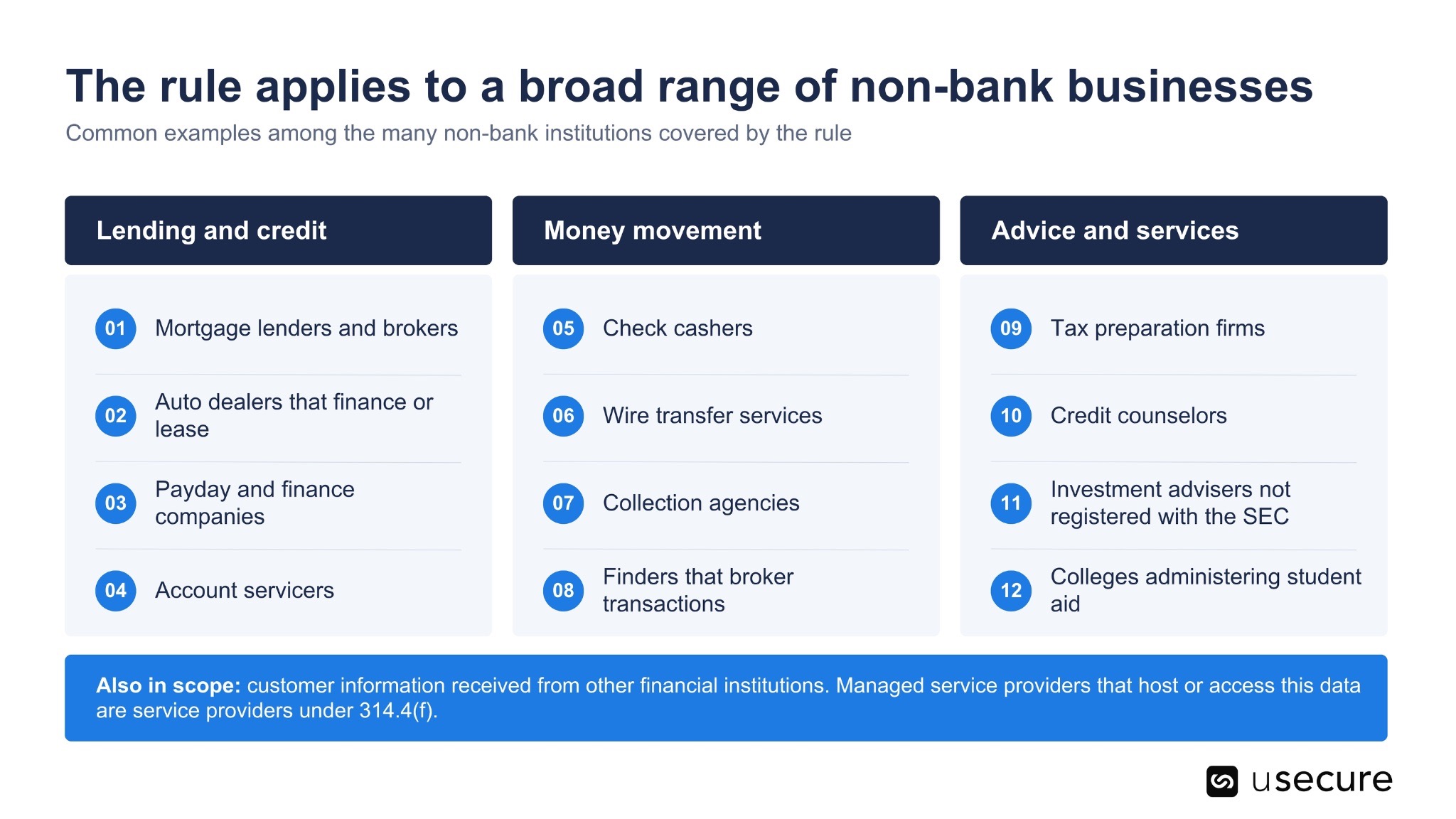
The FTC Safeguards Rule applies to all financial institutions within the FTC's jurisdiction, meaning businesses significantly engaged in financial activities that are not banks, federally insured credit unions, or entities supervised by another federal financial regulator. The scope is considerably broader than many organizations anticipate, and a significant number of covered businesses do not regard themselves as financial institutions.
- The 5,000-consumer exemption and its limitations
Section 314.6 exempts institutions that maintain customer information on fewer than 5,000 consumers from four provisions: the written risk assessment, annual penetration testing and semiannual vulnerability assessments, the written incident response plan, and the Qualified Individual's annual report to the board. All other requirements continue to apply. A small tax practice or independent dealership must therefore still designate a Qualified Individual, implement multi-factor authentication and encryption, oversee its service providers, and train its personnel.
- Implications for managed service providers
Many covered institutions outsource information technology and security operations. The rule permits this arrangement but holds the institution accountable for selecting capable service providers, requiring appropriate safeguards by contract, and assessing those providers on an ongoing basis. Managed service providers that support dealerships, lenders, and tax practices are increasingly expected to demonstrate their own human risk controls, as the compromise of a single technician account can expose an entire client portfolio.
Does the FTC Safeguards Rule require employee training?
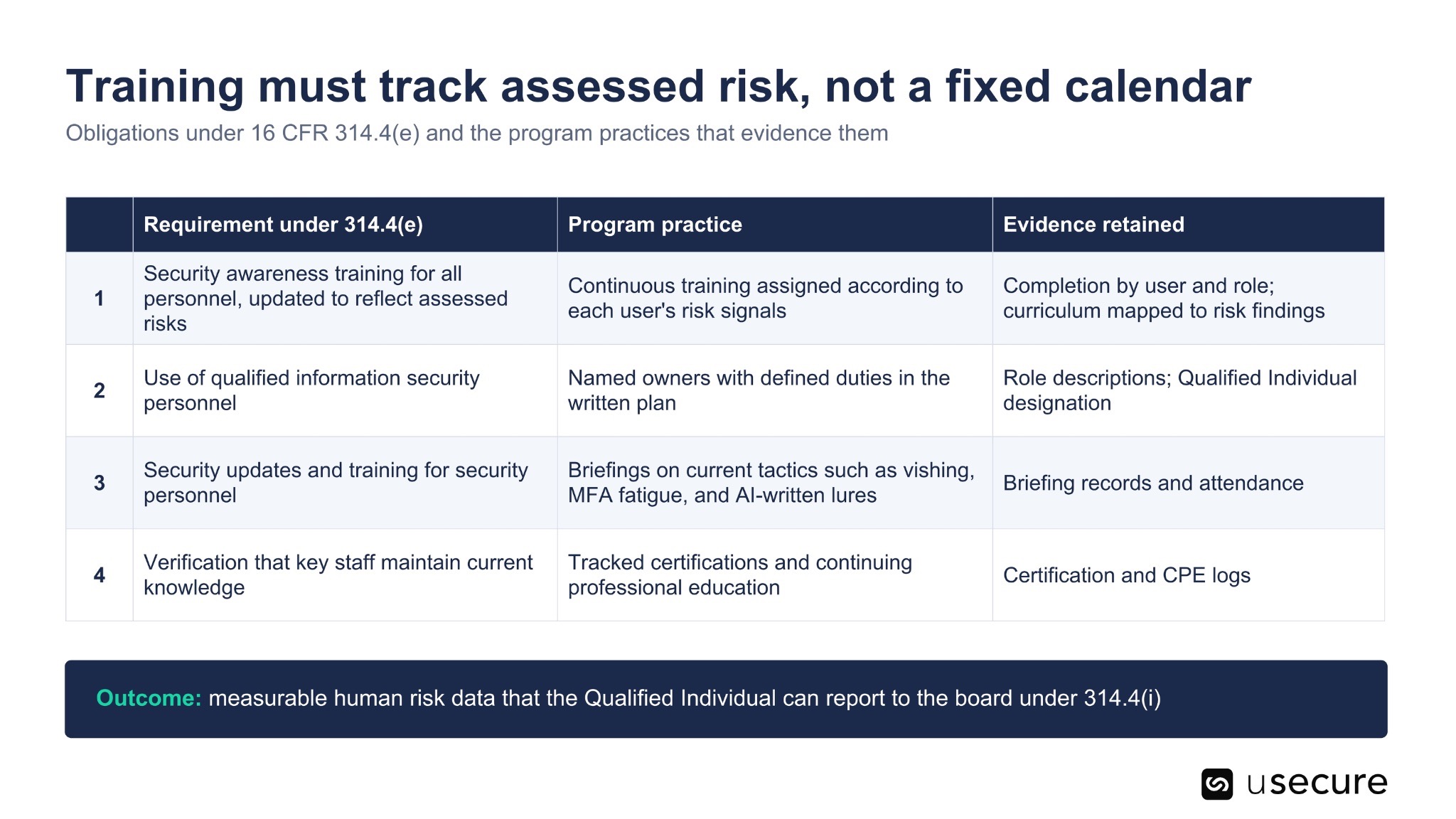
Section 314.4(e) requires covered institutions to provide all personnel with security awareness training that is updated as necessary to reflect the risks identified by the risk assessment. It further requires the use of qualified information security personnel, the provision of security updates and training to those personnel, and verification that key security staff maintain current knowledge of evolving threats and countermeasures. As 314.4(e) is not among the provisions waived under the 5,000-consumer exemption, the training requirement applies to every covered institution irrespective of size.
- The four obligations contained in 314.4(e)
- Risk-linked training and the limitations of annual programs
The most consequential element of the requirement is the explicit link between training and the risk assessment. Where an assessment identifies that loan officers are being targeted by voice phishing, or that finance managers are approving unsolicited multi-factor authentication prompts, the rule anticipates that training will address those specific behaviors. A single generic module, delivered annually and unchanged since procurement, is difficult to reconcile with that standard.
Human Risk Intelligence addresses this gap by shifting the focus from activity-based metrics to risk-based outcomes. It consolidates training performance, phishing simulation results, identity hygiene indicators such as multi-factor authentication enrollment and password health, dark web credential exposure, and policy acknowledgment into a unified, individual-level view of risk. Training is then allocated based on where risk resides, and its effect is measured over time. This approach mirrors the cycle the Safeguards Rule describes: assess, train, verify, and adjust.
- Recommended scope of Safeguards Rule training
The rule does not prescribe a curriculum; content should therefore be derived from the institution's risk assessment. For most non-bank financial institutions in 2026, an appropriate program will address the following topics:- Recognition of phishing, smishing, and voice phishing that impersonates lenders, dealers, vendors, or internal IT support.
- Rejection of unsolicited multi-factor authentication prompts and verification of help desk and account recovery requests.
- Handling, retention, and disposal of nonpublic personal information, including the two-year disposal requirement in 314.4(c)(6).
- Acceptable use of generative AI tools in relation to customer data.
- Immediate internal reporting of suspected incidents, given that the FTC notification period begins when any employee becomes aware of an event.
- Role-specific modules for personnel with privileged access or direct access to loan, tax, or credit records.
- Evidencing compliance to auditors and examiners
Training satisfies the rule only to the extent that it can be demonstrated. Institutions should retain completion records by user and role, the risk assessment findings that informed the curriculum, phishing simulation trends including reporting rates, records of remedial training assigned to repeat offenders, and the Qualified Individual's annual board report describing changes in human risk over the period. These records also respond directly to the questions cyber insurers now raise during underwriting.
Administrative, technical, and physical safeguards
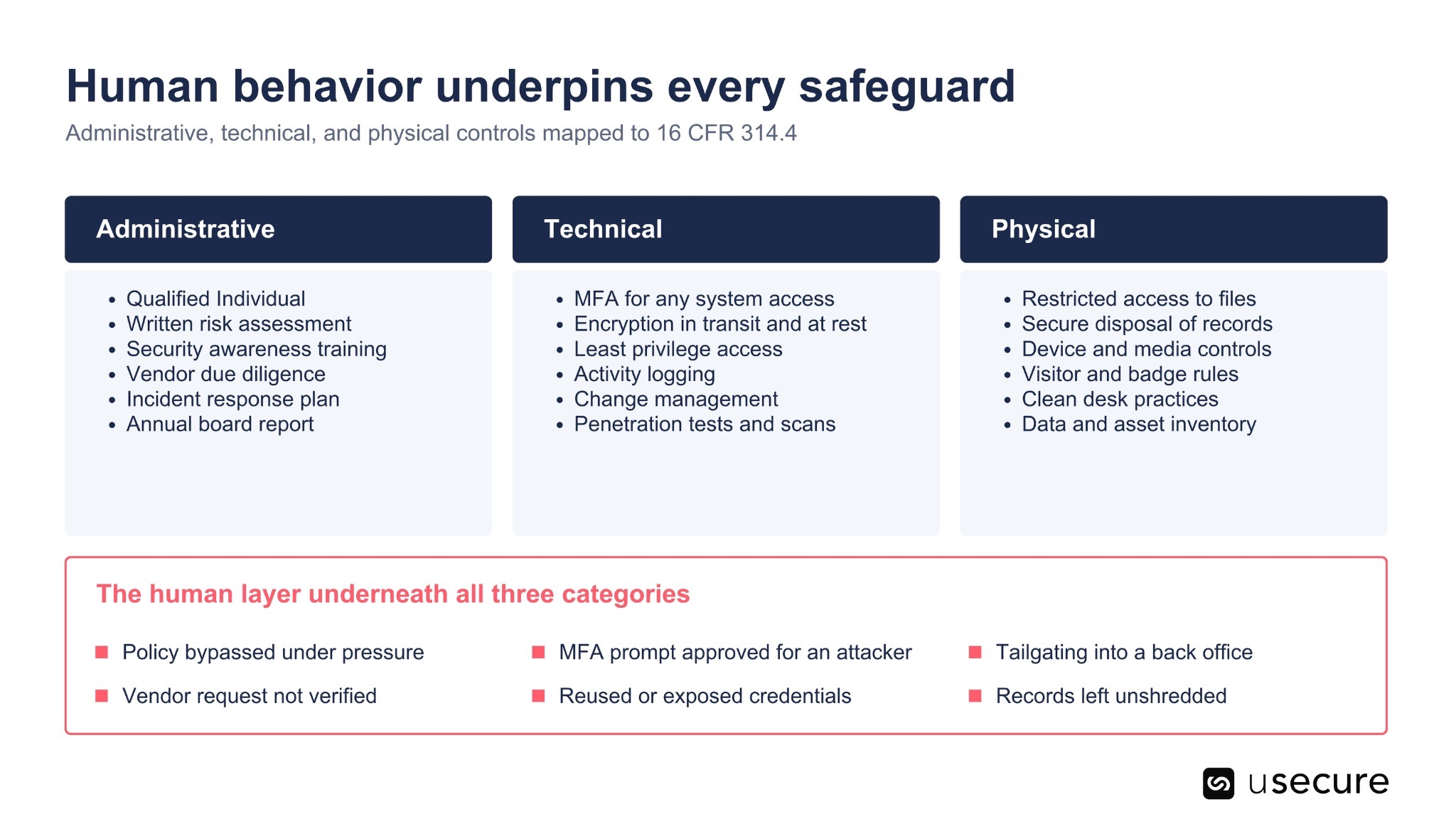
The GLBA Safeguards Rule requires a combination of administrative, technical, and physical safeguards to protect the security, confidentiality, and integrity of customer information. Administrative safeguards encompass policies, personnel, and governance; technical safeguards encompass system-level controls; and physical safeguards protect the facilities and devices on which information resides. The effectiveness of each category depends on consistent human behavior.
- Technical requirements with a human dimension
Several technical safeguards in 314.4(c) are effective only when users act as intended. Multi-factor authentication is required for any individual accessing any information system unless the Qualified Individual has approved an equivalent control in writing; nevertheless, MFA fatigue attacks rely on users approving prompts they did not initiate. Activity logging and the monitoring of authorized users are required precisely because legitimate accounts represent the most common path to customer data. Access controls must adhere to the principle of least privilege, which in turn requires active oversight to identify, for example, a former loan processor who retains access to the origination system. - Toxic combinations in non-bank financial institutions
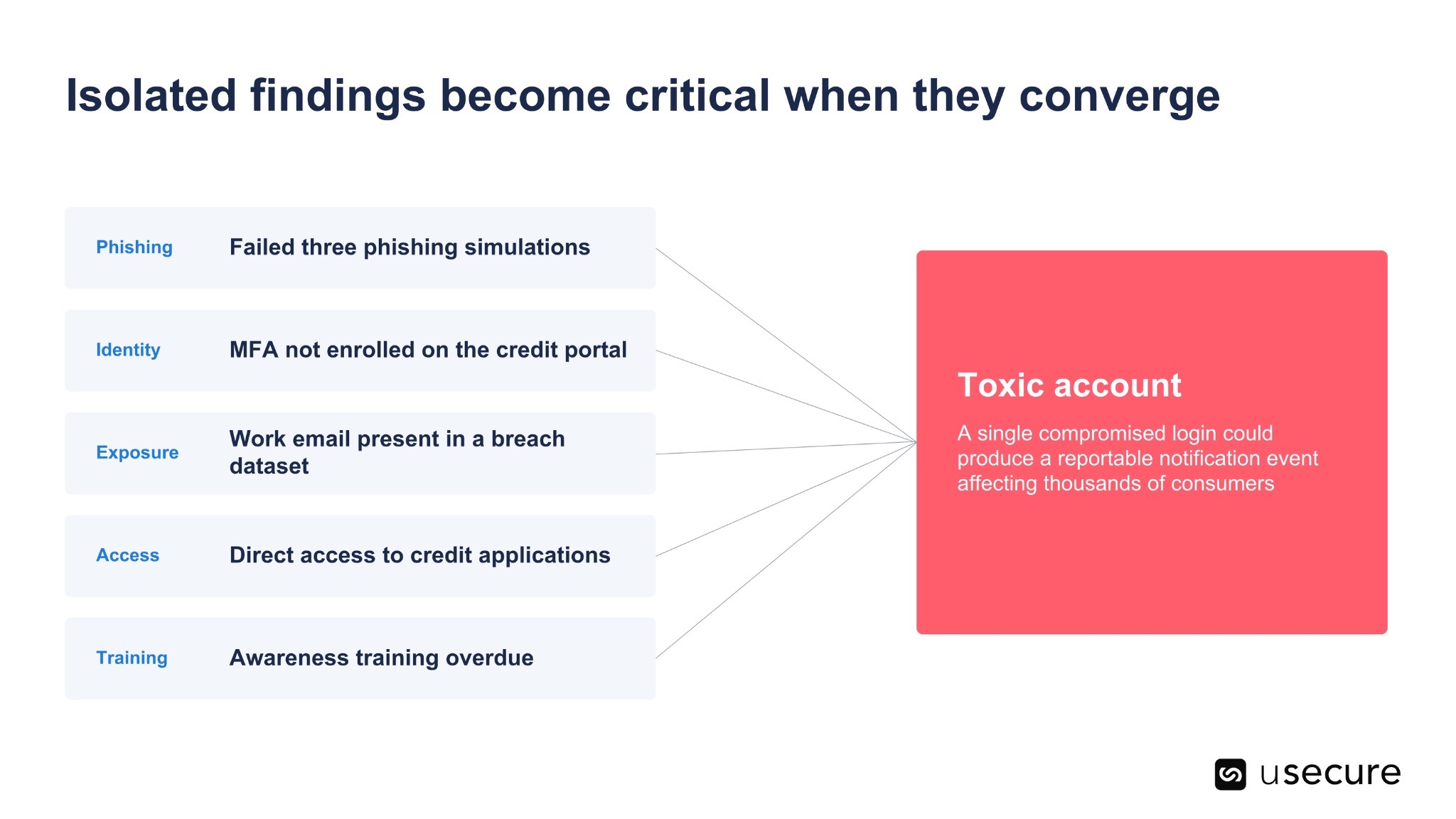
In isolation, a failed phishing simulation, an incomplete multi-factor authentication enrollment, or an exposed password each represents a manageable finding. When these conditions coexist on a single account with access to customer records, they create a high-probability, high-impact attack path. Human Risk Intelligence defines this convergence as a toxic combination. Identifying and reducing toxic combinations provides a Qualified Individual with materially more insight than a course completion rate.
Reporting breaches to the FTC within 30 days
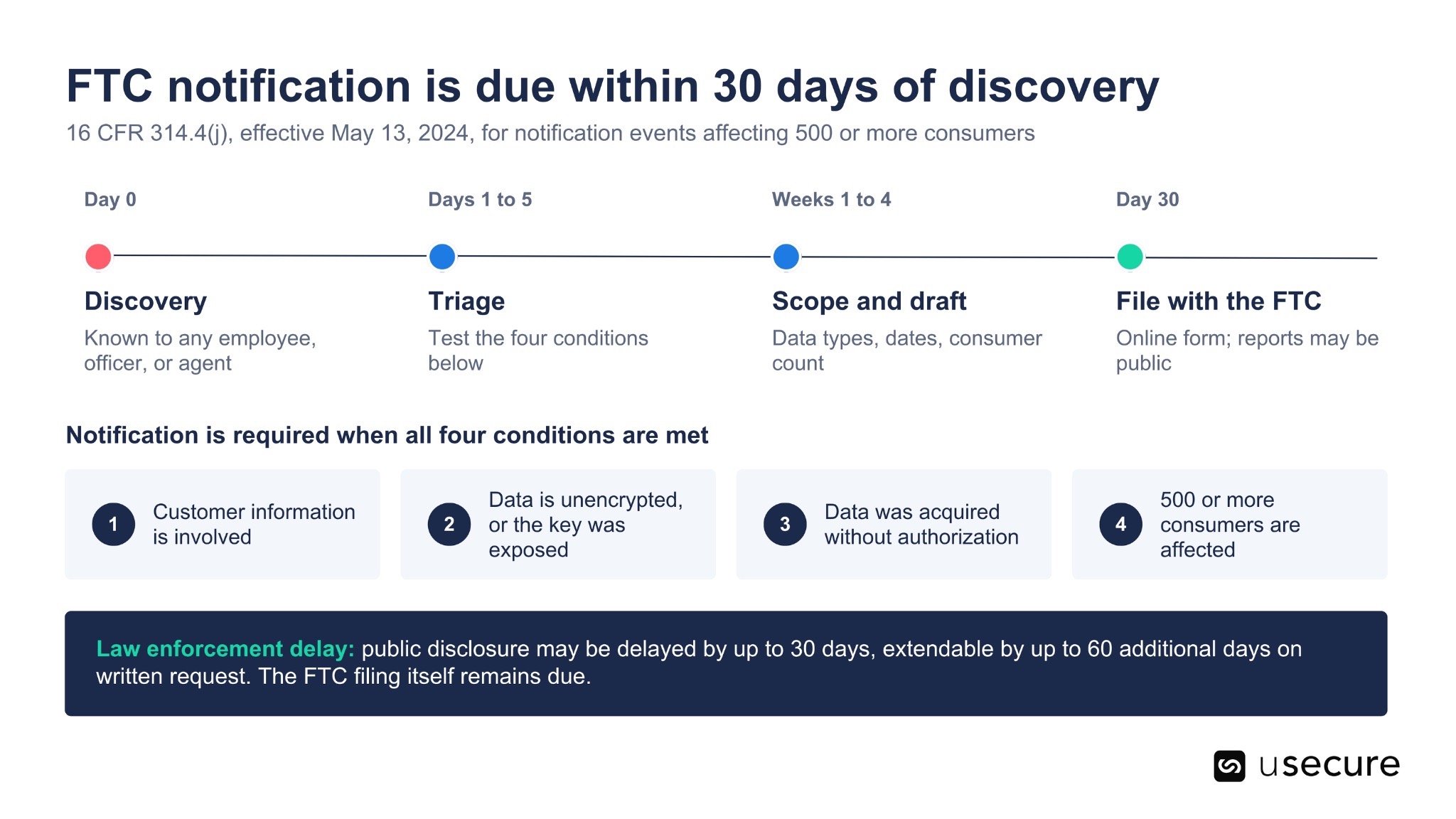
Since May 13, 2024, covered financial institutions have been required to notify the FTC as soon as possible, and no later than 30 days after discovery, of any notification event involving the information of at least 500 consumers. A notification event is defined as the acquisition of unencrypted customer information without the authorization of the individual to whom the information pertains. Encrypted information is treated as unencrypted where the encryption key has also been accessed without authorization.
Two aspects of this requirement make it a matter of human risk. First, an event is deemed discovered on the first day on which it is known to any employee, officer, or agent of the institution other than the person committing the breach. An employee who observes suspicious activity but does not report it may therefore have already initiated the notification period. Second, the FTC has indicated that reports may be made public, which elevates the reputational as well as the legal significance of an accurate and complete filing.
- Required contents of the FTC notice
The electronic notification form requires the institution's name and contact information, a description of the types of information involved, the date or date range of the event where determinable, the number of consumers affected or potentially affected, a general description of the event, and confirmation of whether a law enforcement official has requested a delay. According to the FTC's August 2026 Paperwork Reduction Act notice, the Commission received approximately 163 breach notifications in 2025, the first full calendar year in which the requirement was in force.
What are the penalties for violating the FTC Safeguards Rule?
The FTC generally enforces the Safeguards Rule through administrative complaints resolved by consent orders, and a violation of such an order may result in civil penalties of up to $53,088 per violation, with each day of continued noncompliance potentially treated as a separate violation. In 2026, the FTC confirmed that its 2025 penalty levels would remain unchanged for the year. In practice, the most significant financial exposure frequently arises from litigation, state enforcement, and the direct costs of a breach.
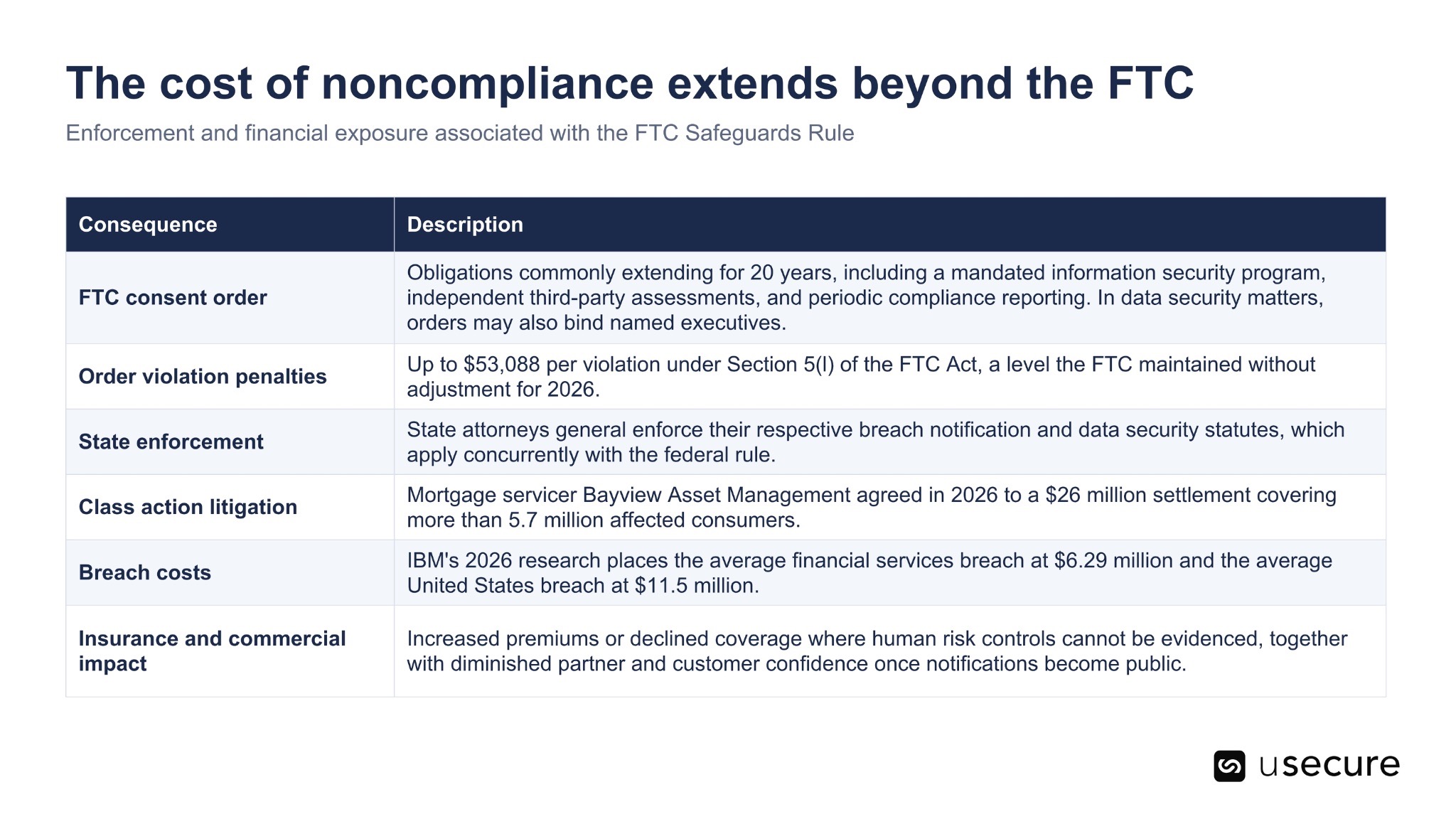
For boards of directors, the conclusion is clear. The investment required to document and measure human risk is modest relative to the cost of a 20-year consent order, a public notification, and the litigation that typically follows. A Qualified Individual who can demonstrate a declining human risk score and a reduction in toxic combinations is in a substantially stronger position than one who can present only course completion rates.
FTC Safeguards Rule checklist
Download our 20-point FTC Safeguards Rule checklist to assess whether your written information security plan, training program, and notification process would withstand scrutiny from the FTC, insurers, or auditors. Award one point for each documented control and compare your total against the four readiness tiers.
From training records to Human Risk Intelligence
Compliance with the FTC Safeguards Rule training requirements cannot be demonstrated through completion certificates alone. The rule requires covered institutions to understand their human risk, train against it, verify the results, and report on progress to leadership, all within a written information security plan that evolves alongside the business. Incidents over the past year, ranging from a dealership vendor compromise affecting millions of consumers to social engineering intrusions at a national mortgage lender, confirm that threat actors are already targeting the human layer of non-bank financial services with considerable precision.
FAQs
- How frequently does the FTC Safeguards Rule require security awareness training?
The rule does not prescribe a fixed frequency. It requires security awareness training that is updated as necessary to reflect the risks identified in the institution's risk assessment. Accordingly, training content should be revised whenever the risk profile changes. A static annual course is unlikely to satisfy that standard on its own, whereas continuous, risk-driven training supported by documented completion records provides a more defensible position.
- Are small financial institutions exempt from the FTC Safeguards Rule training requirements?
No. Institutions that maintain customer information on fewer than 5,000 consumers are exempt from four provisions: the written risk assessment, annual penetration testing and semiannual vulnerability assessments, the written incident response plan, and the annual written report to the board. The security awareness training requirement in 16 CFR 314.4(e) applies to all covered institutions regardless of size.
- What is a written information security plan under the GLBA Safeguards Rule?
A written information security plan, frequently referred to as a WISP or written information security program, is the documented program that every covered financial institution must develop, implement, and maintain. It must be appropriate to the institution's size, complexity, and activities, and it must address the nine elements set out in 16 CFR 314.4, ranging from the designation of a Qualified Individual to staff training and annual reporting to the board.
- Is FTC notification required when encrypted customer data is stolen?
Generally, no. The reporting obligation applies to unencrypted customer information. However, the rule treats encrypted information as unencrypted where the encryption key has also been accessed by an unauthorized party. If that condition is met and 500 or more consumers are involved, the 30-day FTC notification requirement applies.
- Which roles require specialized Safeguards Rule training?
All personnel must receive security awareness training. In addition, the rule requires that information security personnel receive security updates and training sufficient to address relevant risks, and that the institution verify that key security personnel maintain current knowledge of changing threats and countermeasures. Roles with elevated exposure, such as loan officers, finance and insurance managers, and staff with privileged access, warrant supplementary role-based training.
BOOK A DEMO
See Human Risk Intelligence in action
A 30-minute walkthrough of how to cut human risk across your users, tailored to MSPs and IT teams.
Subscribe to newsletter

Related posts
Explore more insights, updates, and resources from usecure.

HIPAA Training Requirements (2026): Who Needs It, How Often, and What to Cover

Cumplimiento de la ISO/IEC 27001: cómo la Human Risk Intelligence (HRI) aporta las evidencias medibles que exigen los auditores
See effortless human risk intelligence in action
Book a demo to see how usecure reduces human risk for IT teams and MSPs, or start a free trial to explore the platform yourself.

