Pax8 Beyond EMEA Day 2: Visibility before intelligence

Subscribe to newsletter
Day 2 at Pax8 Beyond EMEA came down to one word: visibility.
What can partners actually see, control and prove to their customers as they move into managed intelligence? Our Chief Sales Officer, Nihil Morjaria, brought that question to life with a simple scenario.
Picture it. A phishing simulation goes out on a Tuesday morning and two employees click the link. In a standard report, they look exactly the same: same result, same risk rating, same refresher training.

But they're not the same at all. The first has standard access and a good track record in past simulations. The second has privileged access to sensitive systems, credentials that are already out there and a habit of failing phishing tests.
If all you can see is the click, you can't tell those two apart, let alone know which one to worry about first. That's a visibility problem, and as it turned out, it was the thread running through the whole day.
"Security awareness was just the start. Managed intelligence providers can't run on click rates and completion stats. Now, MIPs need to know which people carry the most risk, why, and what to fix first. That's Human Risk Intelligence, and it's becoming the standard every MIP will be measured against."
Nihil Morjaria, usecure Chief Sales Officer.
Pax8: visibility is the price of trust
The big announcement of the day came from Pax8 Global CEO Scott Chasin.
His argument: time is the thing small businesses are shortest on. His answer: AI coworkers that take work off their plate. To make that happen, he launched 8os, an operating system for deploying and governing AI coworkers, and 8bot, the first AI coworker built to run on it. Attendees received early access, with general availability expected at the start of 2027.
Later on, in a partner discussion with Pax8 EMEA CEO Harald Nuij, Chasin was clear about what it'll take. Customers will only trust managed intelligence if their MSP has the visibility and control to stand behind it.
We couldn't agree more. But it raises a fair question: visibility of what, exactly? And is technology alone enough?
People are part of the picture
Two sessions on the trust track suggested it isn't.
'Cybersecurity 2030' looked ahead to a world of deepfakes and AI agents with real authority, and asked what human oversight should look like. The advice was refreshingly practical: put clear limits on what agents can do, keep audit trails, and start now. 'Patch Tuesday for Humans' came at it from another angle, asking leaders to keep their people's skills as up to date as their systems.
Here’s the thing. Governing an AI coworker doesn’t give you a complete view of the people using it. They’re the ones giving it instructions, signing off its actions and acting on what it produces. You need to understand their risk too.
Clicks tell you what happened. Context tells you who to worry about.
Back to our two-employee scenario. A standard awareness report tracks activity: who clicked, who reported, who finished their training. Useful, but it treats every click the same.
Add some context and the picture looks very different. One click came from a low-risk user. The other came from someone whose privileged access and exposed credentials make them a much juicier target. When identity risks like these stack up on one person, we call it a toxic combination, and it's exactly what attackers go looking for.
Awareness training still matters, and Human Risk Intelligence (HRI) builds on it. Awareness training asks what someone did. HRI asks who's most at risk across the business and what you should do about it first.
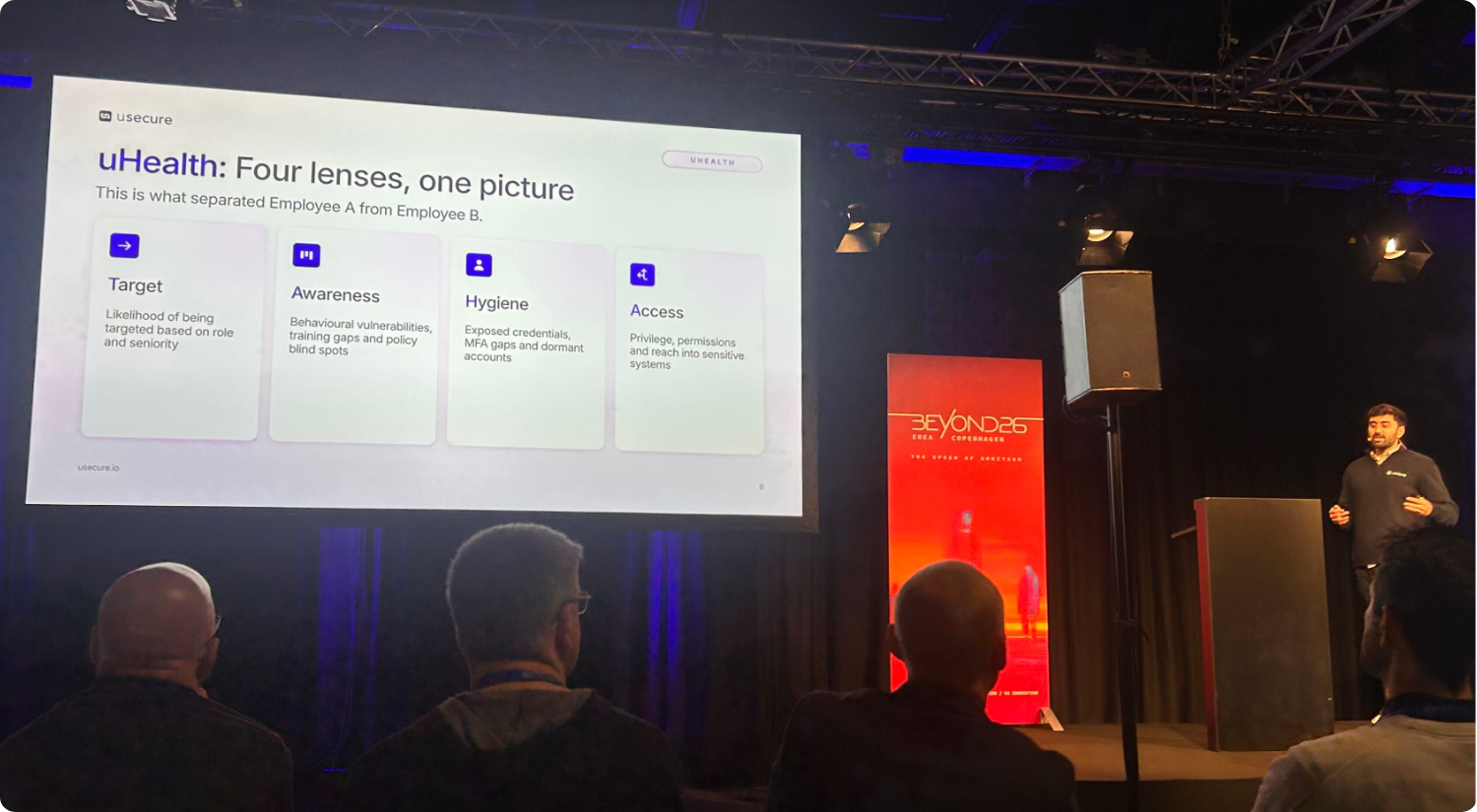
That’s the idea behind uHealth, the newest part of the usecure platform. It brings together four lenses on each person’s risk, which we call the TAHA framework:
- Target: how their role and seniority affect their likelihood of being targeted.
- Awareness: behavioural vulnerabilities, training gaps and policy blind spots.
- Hygiene: exposed credentials, MFA gaps and dormant accounts.
- Access: privileges, permissions and access to sensitive systems.
Put them together and you can see where risk is piling up, fix the right things first and check it's actually working.
For clients, that's a lot more useful than yet another list of problems. They get a short set of prioritised fixes and proof that things are getting better. One line from our session sums up what clients want from their MSP:
"Tell me what improved. Show me the evidence. Help me pass the review."
Partners clearly wanted to hear more. The conversation followed us back to the expo floor, and uHealth kept our booth busy.
Be your own 'Customer Zero'
Pax8 President and Chief Commerce Officer Nick Heddy challenged partners to clear out the culture, process and technology debt holding them back, and to change how they run their own business while helping customers change theirs. "You learn it while you teach it," he said. "You run on it while you sell it."
The partners on Nuij's 'Leading with AI' panel, who are already making the jump to managed intelligence, said much the same. Become Customer Zero (use your own business as the first customer for whatever you plan to sell), bring the whole team with you, and start with customer problems, not technology.
Human risk is a great place to start:
- Look at your own team first. Before you offer clients visibility of their human risk, check your own: who has privileged access, whose credentials are exposed and who keeps falling for the same simulations.
- Stop looking at clicks on their own. Before you decide who needs attention, put each simulation result next to what you know about that person's access and exposed credentials.
- Build your quarterly business reviews (QBRs) around what clients really want to know: what’s improved, how you can prove it, and what needs attention next.
The visibility gap
Pax8 is building the visibility and control partners need to govern AI coworkers, and that's a big deal. But AI coworkers don't work alone. They sit alongside people who have access, sign things off and, being human, get things wrong now and then.
Managed intelligence will only ever be as trustworthy as the people around it. You can't manage what you can't see, and that has to include them.
A proud end to the day
To top off the day, we were proud to receive Pax8's EMEA Collaboration Award. For us, it recognises the work we've put into partnering with Pax8 and its teams across EMEA.
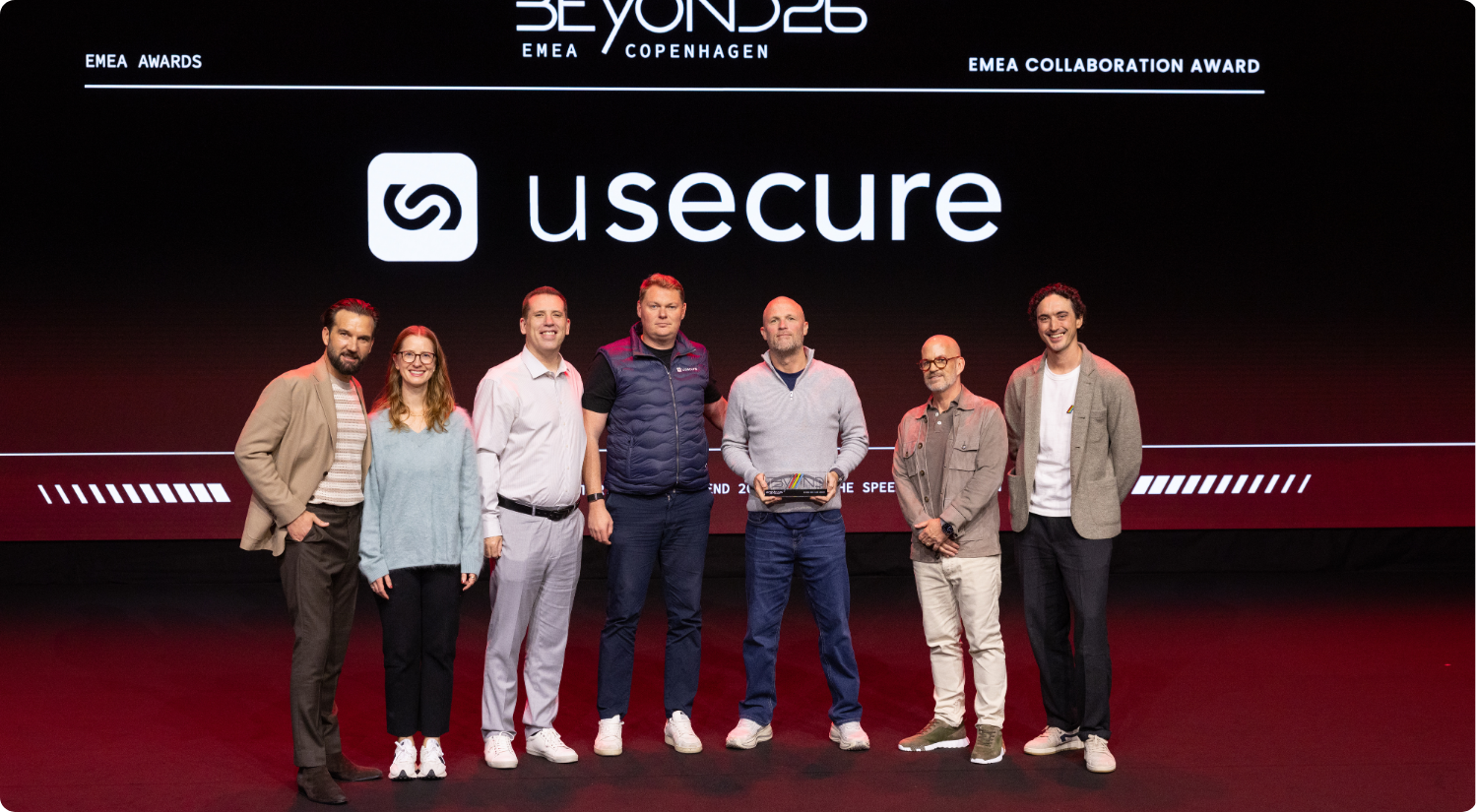
For MSPs, collaboration isn't a nice-to-have. When the vendors you rely on work closely with Pax8, you get smoother onboarding, better support and fewer gaps between buying a solution and actually taking it to clients. Thank you to Pax8, and to every partner who made it happen.
Want to see your clients' human risk in context? Request a free MSP NFR or book a tailored demo at usecure.io/for-msp.
BOOK A DEMO
See Human Risk Intelligence in action
A 30-minute walkthrough of how to cut human risk across your users, tailored to MSPs and IT teams.
Subscribe to newsletter

Related posts
Explore more insights, updates, and resources from usecure.
Pax8 Beyond EMEA Day 3: Governed AI needs governed users


See effortless human risk intelligence in action
Book a demo to see how usecure reduces human risk for IT teams and MSPs, or start a free trial to explore the platform yourself.

