The Managed Intelligence Provider (MIP) era starts with people


Subscribe to newsletter
Picture a 60-person accountancy firm. On paper, its finance director looks like any other user: training completed, a couple of phishing clicks, nothing alarming.
Look through a different lens and the picture changes. They hold a senior finance role attackers love to target. They've failed two phishing simulations this quarter. Their credentials have turned up in a third-party breach, there's an MFA gap on one account, and they can approve payments. Individually, none of that would set off alarms.
Together, it's a toxic combination waiting to be exploited.
Now imagine walking into that client's next quarterly business review (QBR) and saying:
"We found your single biggest human risk, fixed it, and here's the evidence."
That's Human Risk Intelligence (HRI) in action.
Across roughly 90 sessions at Pax8 Beyond EMEA 2026 in Copenhagen, one word kept coming up: trust.
Here's why we think HRI is one of the best ways for MSPs and MIPs to earn it.

Why now: the road to managed intelligence
If Copenhagen had one big message, it was that MSPs are becoming MIPs: providers that deliver intelligence and outcomes, not just managed technology. Pax8 backed that up with 8os and 8bot, its new platform for deploying and governing AI coworkers. Attendees got early access, with general availability expected at the start of 2027.
The commercial case is just as clear. Pax8 Co-Founder and Chief Strategy Officer Ryan Walsh pointed out that SMBs are now outspending enterprises on IT for the first time, while MSP readiness to guide them on governed AI is falling sharply. That's a gap waiting for someone to fill it.
But the event was equally clear that AI raises the stakes for people. The 'Cybersecurity 2030' session explored deepfakes, AI agents acting with real authority and the future of human oversight. Its advice to MSPs was to prepare now, with defined limits and audit trails built around identity and authority.
Our take: every AI coworker you deploy will sit next to people who can still be phished, fooled by a deepfake or tempted to paste client data into an unapproved tool. Managed intelligence that ignores the human layer has a very obvious blind spot.
Visibility has to include people
In a partner discussion with Pax8 EMEA CEO Harald Nuij, Pax8 Global CEO Scott Chasin set out the condition for managed intelligence to succeed: partners need the visibility and control to earn customer trust.
We'd add one thing. That visibility has to include people.
Security awareness was the start. It built the habits and training programmes MSPs rely on today, and it still matters. But most human risk reporting still stops at activity: who clicked, who completed their training, who reported a phish. It treats every click the same.
HRI builds on awareness training by adding context. Where awareness asks what someone did, HRI asks who is most at risk across the business, why, and what should happen first.
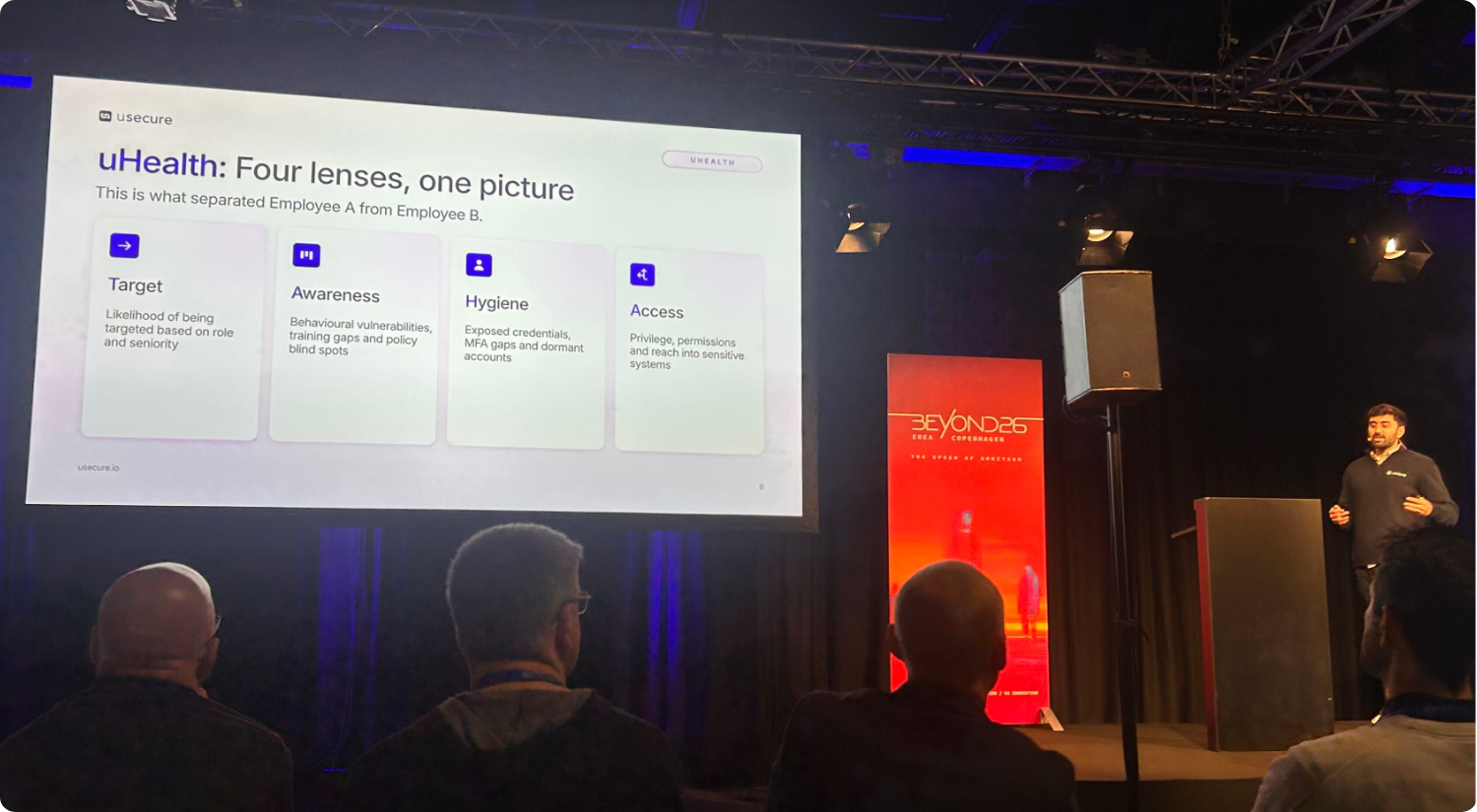
At usecure, that's what uHealth does. It looks at each person's risk through four lenses, which we call the TAHA framework:
- Target: how their role and seniority affect their likelihood of being targeted.
- Awareness: behavioural vulnerabilities, training gaps and policy blind spots.
- Hygiene: exposed credentials, MFA gaps and dormant accounts.
- Access: privileges, permissions and access to sensitive systems.
Hygiene and Access matter more than ever. CrowdStrike's keynote at Beyond showed how attackers exploit trusted tools and identities to move from endpoints into cloud and SaaS environments. Exposed credentials and excessive privilege are exactly where they start.
uHealth connects those signals, surfaces the riskiest people, prioritises what to fix and tracks whether it's working. Here's how the shift looks in practice.
Security awareness training
- Asks: what did the user do?
- Measures: clicks, completions and reports.
- Gives clients: a report of activity.
- Sounds like: "Here's your click rate."
Human Risk Intelligence
- Asks: who is most at risk, and what should happen first?
- Measures: behaviour, credential exposure and access, combined.
- Gives clients: a prioritised list of fixes, with evidence.
- Sounds like: "Here's your biggest risk, and here's what we did about it."
HRI doesn't replace awareness training. It includes everything awareness training delivers, then adds the context you need to act on it, turning you from an awareness provider into a trusted risk advisor.
Want to see your own team through the TAHA lens? Start with a free MSP NFR.
A MIP-sized opportunity
By the end of Beyond, Pax8's conclusion was simple: customers want trusted guidance, not more alerts. HRI delivers exactly that. Clients don't need another dashboard full of red. They need someone to tell them where to focus, and HRI gives you a short list of prioritised fixes in place of a long list of problems.
It transforms your QBRs too. One line from our own Beyond breakout sums up what clients want from their MSP:
"Tell me what improved. Show me the evidence. Help me pass the review."
HRI gives you all three, in language business leaders understand.
And human risk never stands still. The 'Patch Tuesday for Humans' session made the case for treating people's skills like technology maintenance, and the same logic applies to risk. People join, change roles, pick up new AI tools and get caught up in new breaches, which makes HRI a continuous service with visible value every quarter. As AI adoption grows, it opens the next conversation as well: with uPolicy, our simplified policy management tool, you can roll out clear AI policies across your client base and keep them current.
Taking HRI to your clients
Who to pitch first. Start where the stakes are obvious: clients in regulated industries, anyone facing an audit or cyber insurance renewal, and businesses rolling out Copilot or other AI tools.
How to open the conversation. Try something like: "We can already tell you who clicked. Now we can tell you who matters most, and what we're doing about it." It reframes security from a cost line into business guidance, which is exactly where a MIP wants to be.
What to bring. Your own results. The partners on Pax8's 'Leading with AI' panel advised becoming Customer Zero: using your own business as the first customer for anything you plan to sell. Run uHealth on your own team first, and you'll walk into client meetings with a real example of what HRI uncovers, told from experience rather than a slide.
Why partners choose usecure
uHealth is the first Human Risk Intelligence (HRI) layer behind the world's safest workforces, built to take MSPs beyond click rates and into real risk intelligence. In Copenhagen, it was the clear point of interest from our breakout, and that interest carried straight through to our booth.
It sits inside one connected platform alongside uLearn for adaptive awareness training, uPhish for phishing simulations, uPolicy for policy management, and uBreach for breach monitoring. The signals and the fixes live side by side, so you're not stitching together data from separate tools, and every action you take feeds straight back into the risk picture.
It's built for MSPs, at scale. More than 2,200 partners trust usecure to protect over 16,000 organisations in 40+ countries.
Because HRI builds on the awareness training you already deliver, there's no rip-and-replace. You can grow existing client relationships rather than start from scratch. And our partnership approach has been recognised: we were proud to receive Pax8's EMEA Collaboration Award at Beyond EMEA 2026.

Getting started
- Be your own Customer Zero. Request a free NFR and run uHealth on your own team.
- Pick two or three pilot clients where the stakes are obvious.
- Find and fix the toxic combinations, then track the change.
- Take the results to your next QBR and build it into your ongoing service.
The intelligence era starts with people
Pax8 spent three days making a strong case for trust in technology. We'd add the other half: trust in people.
Managed intelligence will only ever be as trustworthy as the humans around it. The MSPs and MIPs who can see that layer clearly, explain it simply and reduce it measurably will be the ones clients trust most. We'd love to help you become one of them.
Ready to lead the intelligence era? Request a free MSP NFR or book a tailored demo.
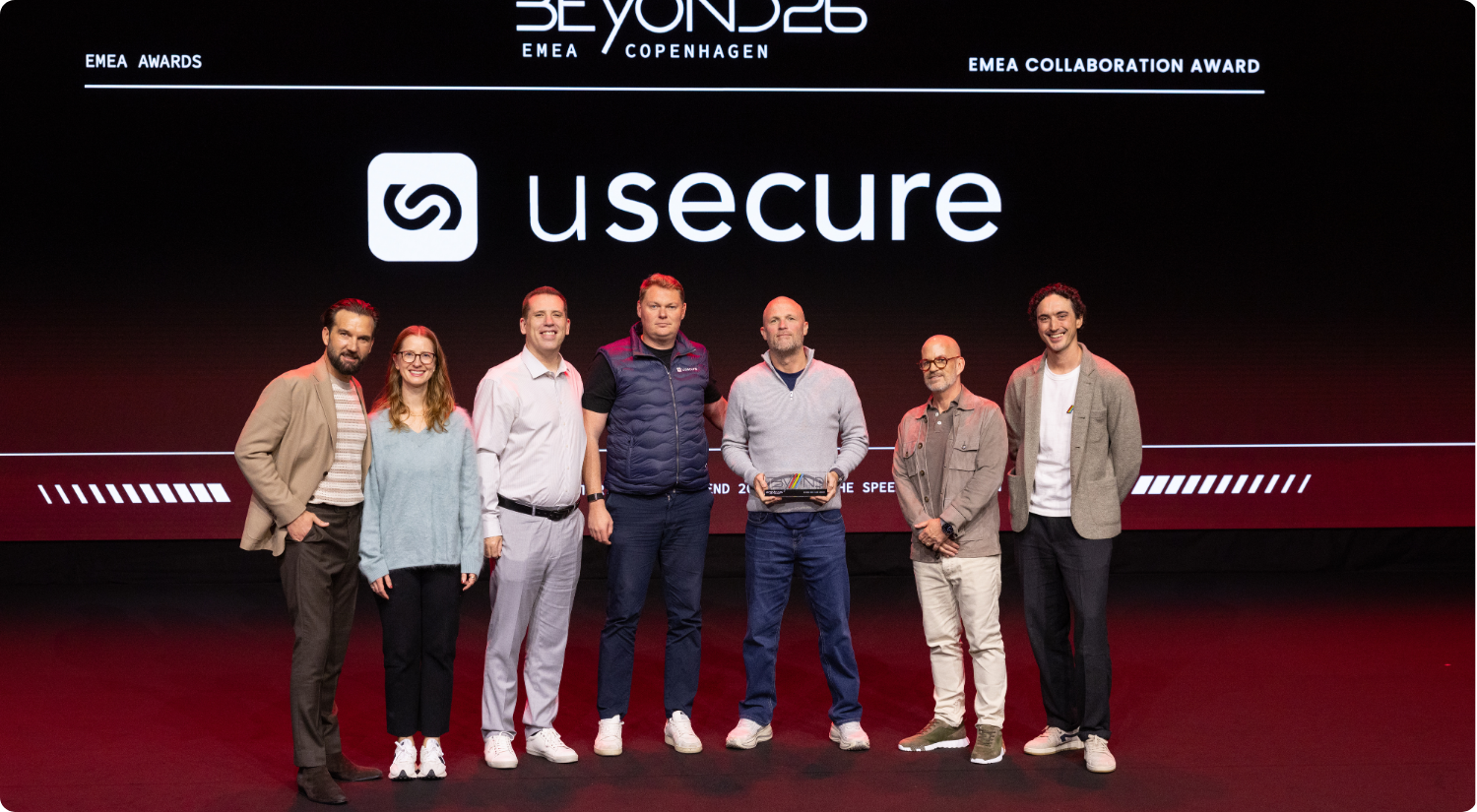
Want the full story from Copenhagen? Read our recaps of Day 1, Day 2 and Day 3.
BOOK A DEMO
See Human Risk Intelligence in action
A 30-minute walkthrough of how to cut human risk across your users, tailored to MSPs and IT teams.
Subscribe to newsletter

Related posts
Explore more insights, updates, and resources from usecure.

Pax8 Beyond EMEA Day 1: Culture before code
See effortless human risk intelligence in action
Book a demo to see how usecure reduces human risk for IT teams and MSPs, or start a free trial to explore the platform yourself.

