EU AI Act: AI literacy As a Legal Requirement

Published on
August 19, 2026
Read time
5 mins

EU AI Act: AI literacy As a Legal Requirement

Published on
August 19, 2026
Read time
5 mins
Category
5 min read

EU AI Act: AI literacy As a Legal Requirement

Published on
19 Aug 26

Table of contents

Subscribe to newsletter

By clicking Sign Up you're confirming that you agree with our Terms and Conditions.
Thank you! Your submission has been received!
Oops! Something went wrong while submitting the form.

The EU AI Act makes AI literacy a legal requirement. Under Article 4, providers and deployers of AI systems must take measures to ensure employees and others using AI on their behalf have sufficient skills, knowledge, and understanding to use it responsibly. The requirement has applied since February 2, 2025, and is not limited to organizations using high-risk AI. What counts as sufficient AI literacy depends on a person’s role, experience, and exposure to AI. For organizations, compliance means providing appropriate, role-based education and being able to demonstrate the measures taken to manage AI-related human risk.

In January 2024, a finance employee at global engineering firm Arup joined what appeared to be an ordinary video call with the company's CFO and several senior colleagues. Every face and every voice on that call was generated by artificial intelligence. Over the course of a single day, the employee authorized 15 wire transfers totaling more than $25 million to accounts controlled by fraudsters. No malware was involved. No firewall was breached. One employee made a single judgment call, in good faith, based on what he saw and heard.

That decision illustrates exactly the type of risk the EU AI Act's AI literacy requirement is designed to address. The requirement entered into force before many organizations had even finished developing their generative AI usage policies.

Article 4 does not simply address algorithms. It addresses people, specifically their ability to understand, recognize, question, and respond appropriately to AI when it appears in their work. That AI might be an approved tool on a company laptop, or it might be a synthetic voice on the other end of an urgent phone call.

For compliance teams, this represents unfamiliar territory. Much of the EU AI Act resembles traditional product safety regulation, with requirements covering documentation, risk classification, and conformity assessments. Article 4 looks different. It is much closer to something security awareness teams will immediately recognize because, at its core, it establishes a legal requirement for managing human risk in an AI-enabled workplace.

What the EU AI Act Actually Requires

The EU AI Act is built around a risk-based framework, and most of the requirements that dominate headlines sit within it. Systems considered to pose unacceptable risk, including social scoring and certain manipulative or exploitative practices, are prohibited outright. High-risk systems, such as those used in recruitment, credit scoring, or critical infrastructure, are subject to the most demanding obligations, including documentation, risk classification, conformity assessments, and ongoing monitoring. Systems presenting limited risk carry lighter obligations, largely centered on transparency, while systems considered minimal risk fall outside most of the regulation's requirements.
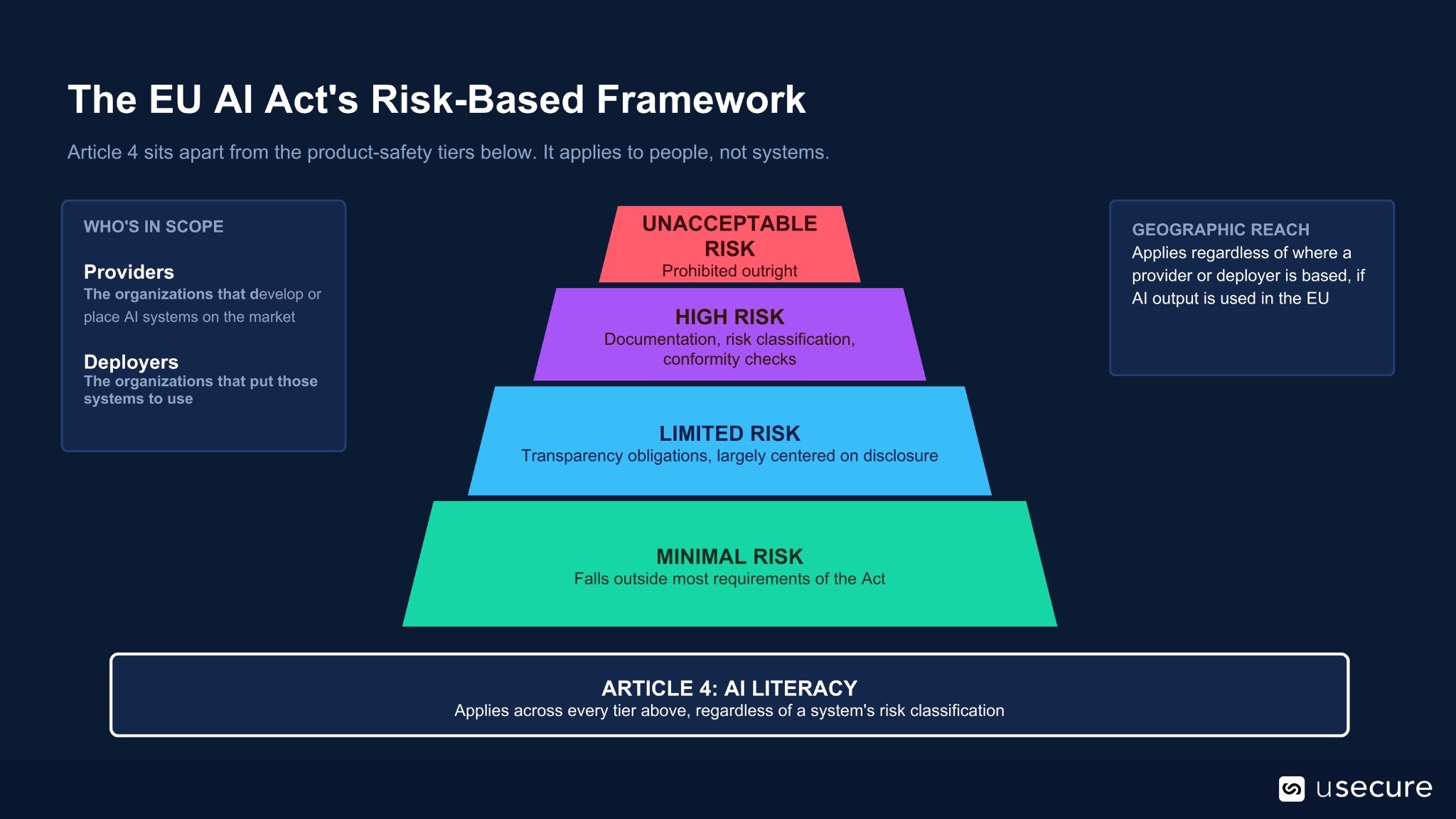
The Act applies to providers, the organizations that develop or place AI systems on the market, and deployers, the organizations that put those systems to use, regardless of where either is based. An organization outside the EU can fall within scope simply because its AI system's output is used within the EU market.

Article 4 sits apart from this product-safety architecture. Rather than regulating a system's design or classification, it regulates the people who operate it. Providers and deployers of AI systems must take measures to ensure a sufficient level of AI literacy among their staff and other individuals who operate AI systems on their behalf. The regulation defines AI literacy as the skills, knowledge, and understanding needed to make informed decisions about the deployment and use of AI, while recognizing both the opportunities it presents and the potential harm it can cause.

Crucially, the obligation is not limited to high-risk AI systems. It applies when an organization acts as a provider or deployer of an AI system, which means its relevance extends well beyond organizations developing advanced or regulated AI technologies. In 2026, with AI embedded across a growing range of workplace tools and business processes, that potentially brings a significant proportion of organizations operating in or serving the EU market within scope.

Two further details are particularly important. First, the obligation is not limited to employees on the company payroll. Article 4 also refers to other people dealing with the operation and use of AI systems on an organization's behalf, which can include contractors and other third parties depending on their role and the circumstances.

Second, the required level of AI literacy is contextual rather than uniform. Organizations are expected to consider factors such as a person's technical knowledge, experience, education, and training, as well as the context in which the AI system will be used and the people or groups who may be affected by it. In practice, sufficient AI literacy for a marketing coordinator using an AI writing assistant may look very different from the literacy required of a developer working directly with AI models, and different again from that required of an executive responsible for deciding where and how AI is deployed.

Timeline: What's Already in Force

Confusion over timing has become a compliance risk in its own right. The following sequence reflects where things currently stand.

•       August 1, 2024: The EU AI Act enters into force.

•       February 2, 2025: Article 4's AI literacy obligation becomes applicable, alongside prohibitions on a limited set of AI practices, including social scoring and certain manipulative or exploitative systems. This made AI literacy one of the first active obligations under the Act.

•       Late 2025: The European Commission proposes a Digital Omnibus package intended to simplify aspects of the Act's implementation. The proposals include changes to the timelines for certain high-risk AI system requirements, with some deadlines potentially moving as far as December 2027.

•       August 2, 2026: National competent authorities assume broader enforcement responsibilities under the Act.

•       Through 2027: The Act's remaining obligations continue to take effect on a phased timeline.
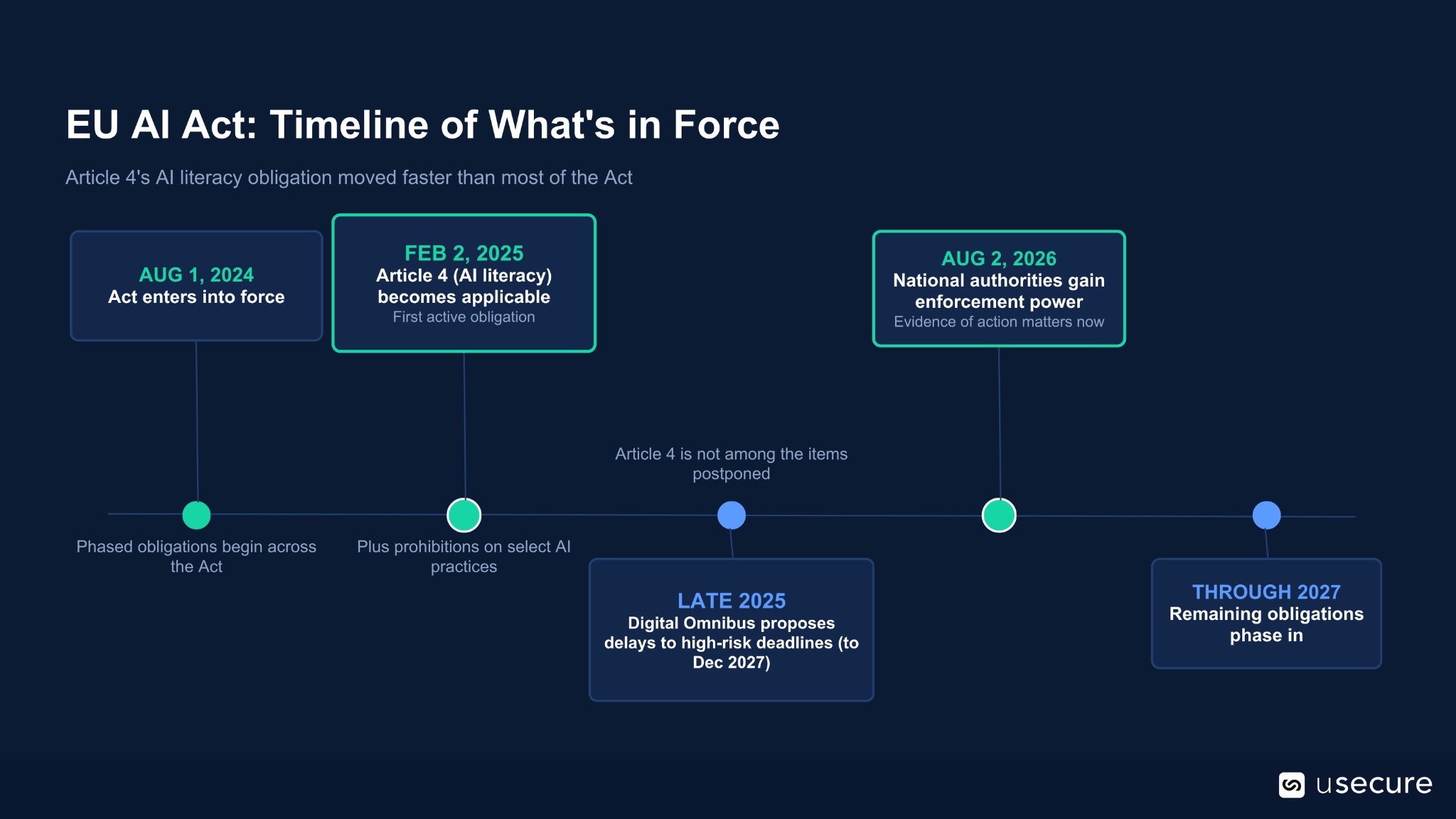
As headlines focused on the Digital Omnibus delays, some organizations deprioritized their AI literacy programs along with other AI Act initiatives. That interpretation misses an important distinction. Article 4 sits within Chapter I of the regulation, not the provisions governing high-risk AI systems in Chapter III. Its AI literacy obligation became applicable on February 2, 2025, and was not among the requirements whose application was proposed for postponement.

The regulatory direction has also shifted toward a more practical, proportionate approach to AI literacy. Rather than treating compliance as a requirement to demonstrate that every individual has achieved a prescribed level of knowledge, the focus is on the measures organizations take to develop and support appropriate AI literacy based on roles, risks, and context.

Enforcement is the next critical milestone. From August 2, 2026, national competent authorities assume broader enforcement responsibilities under the Act. This makes the ability to demonstrate what an organization has actually done increasingly important. Compliance teams should therefore focus not only on delivering appropriate AI literacy measures, but also on documenting those measures, their intended audiences, and the reasoning behind them.

There is also a broader legal risk to consider. Where inadequate AI literacy contributes to harmful or noncompliant use of AI, the absence of appropriate training and governance measures could become relevant to regulatory scrutiny or civil litigation. Organizations may need to demonstrate that they took reasonable, proportionate steps to prepare employees and other relevant personnel for the AI risks associated with their roles.

Ultimately, the question is unlikely to be whether an organization can prove that every employee is “AI literate.” The more practical question, and the one that is considerably harder to avoid, is this: What measures did you actually take?

Why This Is a Human Risk Problem, Not Just a Training Problem

Security teams have spent the past decade making the case that people, not infrastructure alone, represent one of the most significant attack surfaces in modern organizations. Article 4 brings that same human risk principle into the regulatory conversation around artificial intelligence. That distinction matters because an AI literacy program designed as a one-time compliance exercise, such as a single onboarding video or an annual presentation, is unlikely to address either the intent of the requirement or the reality of how employees use AI at work.

The scale of that challenge is already becoming clear in workforce data. Employees have adopted generative AI at a pace that has often exceeded their organizations' ability to establish the policies, controls, and oversight needed to govern its use effectively.

The gap is not simply about whether employees are using AI. It is also about whether organizations have meaningful visibility into that use. One widely cited 2026 industry survey found a significant disconnect between executive confidence and employee-reported behavior. Roughly three-quarters of executives believed they had a clear understanding of how AI was being used across their organizations, while employee-reported data suggested that actual organizational visibility was substantially lower.

That disconnect creates a fundamental governance problem. Leadership may believe AI use is understood and controlled while employees are experimenting with tools, sharing information, and making AI-assisted decisions outside established processes.

Article 4 brings this human element into sharper focus. Effective AI literacy requires organizations to move beyond assumptions about what their workforce knows and toward demonstrable measures that build appropriate knowledge, judgment, and awareness. The objective is not simply to prove that training was delivered. It is to ensure that people can recognize AI-related risks, make informed decisions, and respond appropriately when those risks appear in their day-to-day work.

This is precisely the gap that Human Risk Intelligence was designed to address in phishing and social engineering, and the same principle now applies directly to AI. Knowing which employees have completed a training course provides a compliance record. Knowing which employees can actually recognize a synthetic voice, identify an AI-generated invoice, or detect an unsanctioned AI tool entering their workflow provides a meaningful risk signal.

That distinction matters. Completion data can demonstrate that training was delivered, but it does not demonstrate that employees can apply what they have learned when faced with a real-world threat. Understanding how people recognize, respond to, and manage AI-related risks provides organizations with a clearer picture of their actual exposure.

It is the difference between an AI literacy program that demonstrates compliance on paper and one that can withstand meaningful regulatory and operational scrutiny.

Anatomy of an AI-Enabled Attack

The Arup case was not an isolated event. It has become a reference point for a growing category of AI-enabled fraud that security researchers report is now targeting hundreds of companies each day. Reported losses can be significant, with average losses at large enterprises reaching hundreds of thousands of dollars per incident and individual cases in the UK financial sector reportedly exceeding £20 million. The attack pattern is remarkably consistent, and understanding how it works is itself an important form of AI literacy.
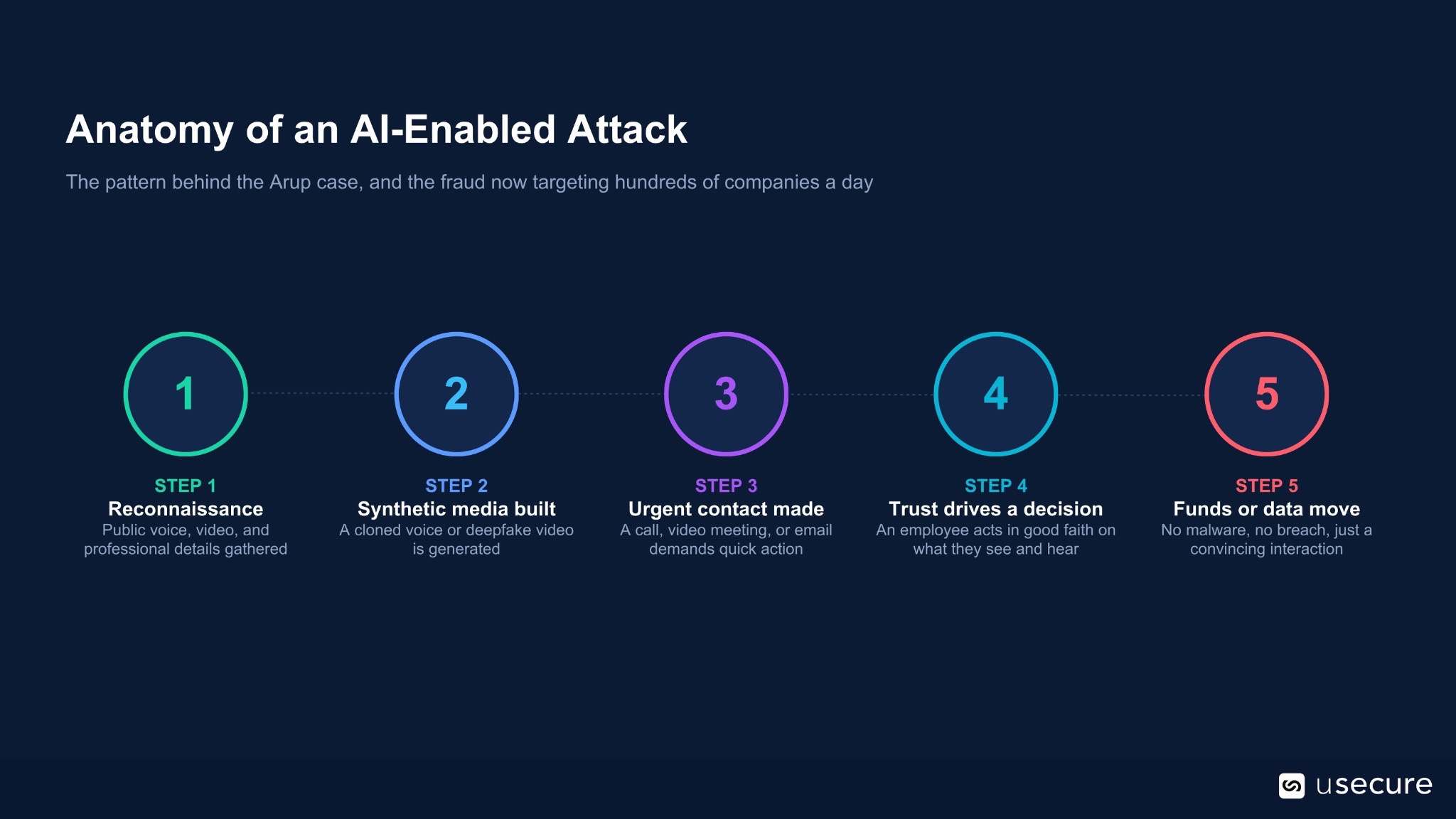
The concerning finding across multiple 2026 industry reports is that traditional security awareness training, often built around identifying poor grammar, suspicious links, or mismatched sender addresses, does not translate effectively to these attacks. Many familiar warning signs simply do not exist in a convincing deepfake video call or a cloned voicemail that appears to come from a finance director.

The capability Article 4 requires organizations to develop is therefore different from the phishing awareness covered by many existing training programs. Employees need the judgment and practical skills to question convincing digital interactions, recognize when AI may be involved, and follow appropriate verification procedures even when the person they appear to see or hear is someone they know and trust.

Generic AI fraud is only part of the threat. Targeted campaigns are also emerging against specific professions and industries. In one documented case, AI-generated emails were reportedly sent to approximately 800 accounting firms and incorporated accurate state registration information to increase their credibility. The campaign achieved a reported click rate of 27 percent, several times higher than typical phishing benchmarks.

What Sufficient Literacy Actually Looks Like

Because Article 4 takes a proportional and contextual approach, organizations should not assume that a single training module will adequately address the needs of every employee. The European Commission's guidance points toward an approach that considers factors such as technical knowledge, experience, training, the context in which AI is used, and the people who may be affected. In practice, this lends itself naturally to role-based AI literacy.

Employees using AI tools in their day-to-day work need practical knowledge of issues such as data handling, hallucinations, appropriate verification, and the use of approved tools. Technical teams require a deeper understanding of model behavior, limitations, governance, and the risks associated with developing, integrating, or configuring AI systems. Leaders and decision-makers need sufficient literacy to evaluate organizational exposure, make informed deployment decisions, and understand their own role in AI-related risk.
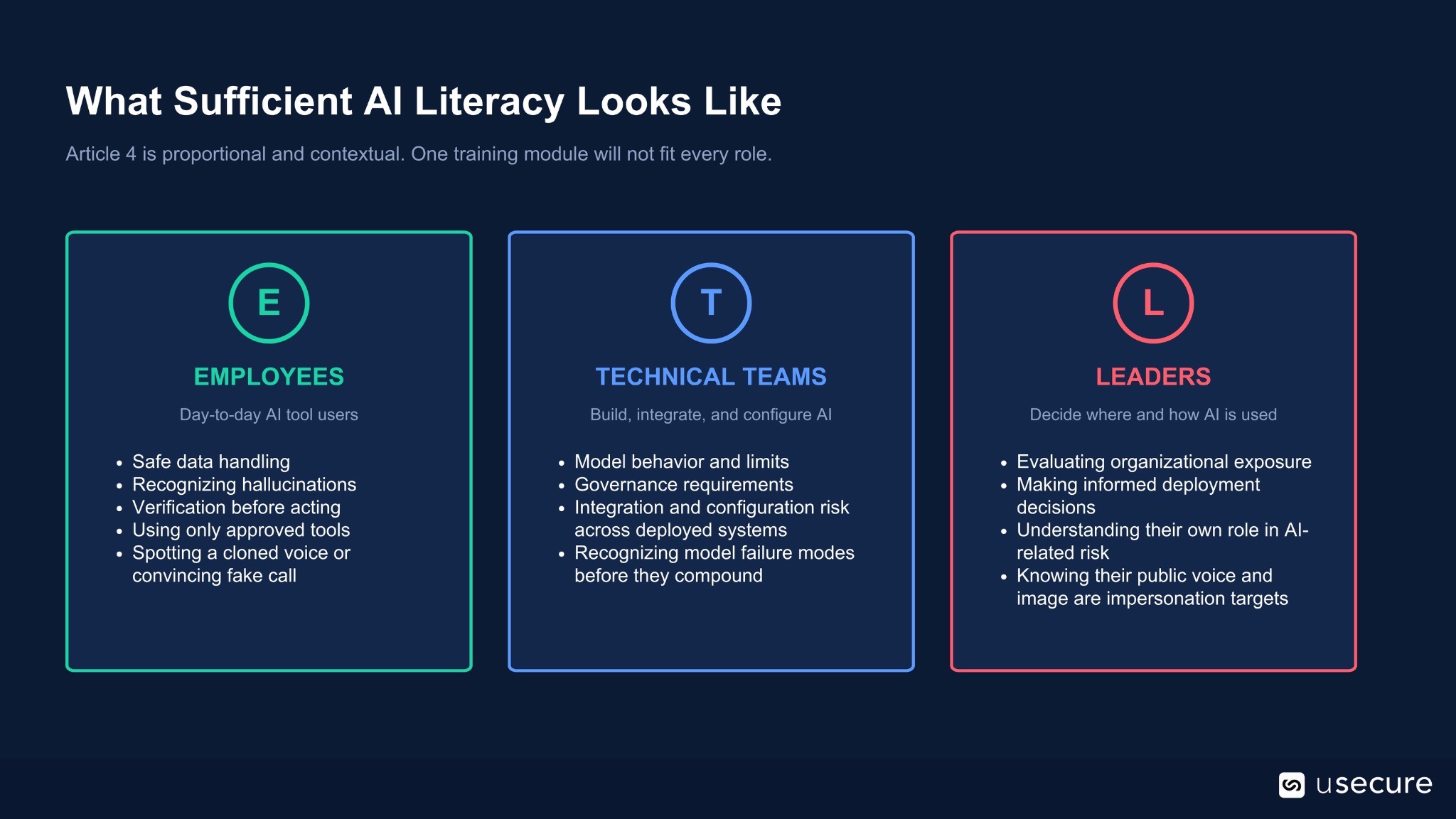
That leadership tier deserves particular attention. Industry research into shadow AI suggests that senior leaders can be significant users of unapproved AI tools while also representing some of the organization's most valuable impersonation targets. Their publicly available voices, images, videos, and professional information can provide attackers with the raw material needed to create highly convincing synthetic communications. An AI literacy program that focuses exclusively on frontline employees while leaving senior leadership outside its scope risks overlooking both the regulatory context and the organization's actual exposure.

From Training Records to Human Risk Intelligence

The European Commission's guidance on AI literacy emphasizes that organizations should take measures appropriate to their circumstances rather than treating AI literacy as a one-time exercise. For compliance teams, this points toward an approach that is already familiar from mature security awareness programs: ongoing development, documentation, and measurement rather than reliance on a completion certificate alone. In practice, a defensible AI literacy program should look less like a static training library and more like a Human Risk Intelligence practice extended to a new category of threat. Organizations can test employees against scenarios that reflect the situations they may actually encounter, from a cloned voice requesting an urgent payment to an AI-generated email that incorporates accurate internal or professional information. The objective is to understand how people respond when confronted with a realistic situation, not simply what they can recall in a quiz.

This means measuring behaviors that provide meaningful evidence of risk. Does an employee verify an unusual payment request through a trusted second channel? Do they report an unfamiliar AI tool rather than quietly incorporating it into their workflow? Do senior leaders understand that their publicly available video, voice, and personal information can be used to create convincing impersonations?

Tracked over time, these behavioral signals provide a more meaningful view of AI literacy than training completion data alone. They show not only that an organization has provided education, but also that it is actively developing, testing, and reinforcing the judgment employees need to manage AI-related risks. When a regulator asks, “What measures did you take?” That evidence can provide a far stronger answer than a completion certificate alone.

Building a Program That Would Survive a Regulator's Question

Organizations that take Article 4 seriously, rather than treating it as another item in a compliance checklist, should build their AI literacy programs around a small set of consistent practices.

•      Map who is actually in scope
Identify the employees, contractors, and other relevant third parties who operate or use AI systems on the organization's behalf. The scope should reflect how AI is actually used across the business, not simply who has access to an approved chatbot.

•      Tailor content to role and exposure
A finance team exposed to deepfake payment fraud requires different AI literacy than a marketing team using an AI writing assistant. Both require a different level of knowledge from executives responsible for approving AI deployments and managing organizational risk.

•      Simulate today's threats, not yesterday's
Voice cloning, deepfake video calls, and AI-generated business email compromise require realistic scenarios of their own. Repurposing a traditional phishing template is unlikely to prepare employees for threats in which familiar warning signs may no longer be present.

•      Document measures continuously
Maintain clear records of the measures taken, when they were implemented, who they covered, and what outcomes they produced. A defensible approach to Article 4 depends on an organization's ability to demonstrate sustained and proportionate action, not simply prove that a training module was assigned.

•      Close the loop with real behavior
Use employee behavior during simulations and real incidents to continuously improve the program. The objective is to turn AI literacy into a measurable and evolving indicator of human risk rather than a static record of training completion.

None of this belongs to a single department. Legal and compliance teams are responsible for interpreting regulatory requirements and helping define the organization's obligations. Security teams understand the evolving threat landscape and the scenarios employees need to recognize. Learning, HR, IT, and business leaders may also have important roles in ensuring that AI literacy reaches the right people and reflects how AI is actually used.

Bringing those disciplines together into a measurable, defensible, and continuously updated view of human risk is where Human Risk Intelligence becomes particularly valuable. Organizations that have already developed this capability to strengthen resilience against phishing and social engineering are well positioned to extend the same principles to AI-related risk.

Turn AI Literacy Into Measurable Human Risk Intelligence

usecure helps organizations move beyond one-time AI training with continuous, role-based literacy programs informed by real behavioral data. Build measurable AI resilience that supports regulatory compliance while preparing employees for the AI-enabled threats they are actually facing. Learn more about Human Risk Intelligence or book a demo to see how it can support a stronger cyber insurance position.

Subscribe to newsletter

BOOK A DEMO

See usecure in action

A 30-minute walkthrough of how to cut human risk across your users, tailored to MSPs and IT teams.

Get a Demo

Subscribe to newsletter

By clicking Sign Up you're confirming that you agree with our Terms and Conditions.
Thank you! Your submission has been received!
Oops! Something went wrong while submitting the form.

The EU AI Act makes AI literacy a legal requirement. Under Article 4, providers and deployers of AI systems must take measures to ensure employees and others using AI on their behalf have sufficient skills, knowledge, and understanding to use it responsibly. The requirement has applied since February 2, 2025, and is not limited to organizations using high-risk AI. What counts as sufficient AI literacy depends on a person’s role, experience, and exposure to AI. For organizations, compliance means providing appropriate, role-based education and being able to demonstrate the measures taken to manage AI-related human risk.

In January 2024, a finance employee at global engineering firm Arup joined what appeared to be an ordinary video call with the company's CFO and several senior colleagues. Every face and every voice on that call was generated by artificial intelligence. Over the course of a single day, the employee authorized 15 wire transfers totaling more than $25 million to accounts controlled by fraudsters. No malware was involved. No firewall was breached. One employee made a single judgment call, in good faith, based on what he saw and heard.

That decision illustrates exactly the type of risk the EU AI Act's AI literacy requirement is designed to address. The requirement entered into force before many organizations had even finished developing their generative AI usage policies.

Article 4 does not simply address algorithms. It addresses people, specifically their ability to understand, recognize, question, and respond appropriately to AI when it appears in their work. That AI might be an approved tool on a company laptop, or it might be a synthetic voice on the other end of an urgent phone call.

For compliance teams, this represents unfamiliar territory. Much of the EU AI Act resembles traditional product safety regulation, with requirements covering documentation, risk classification, and conformity assessments. Article 4 looks different. It is much closer to something security awareness teams will immediately recognize because, at its core, it establishes a legal requirement for managing human risk in an AI-enabled workplace.

What the EU AI Act Actually Requires

The EU AI Act is built around a risk-based framework, and most of the requirements that dominate headlines sit within it. Systems considered to pose unacceptable risk, including social scoring and certain manipulative or exploitative practices, are prohibited outright. High-risk systems, such as those used in recruitment, credit scoring, or critical infrastructure, are subject to the most demanding obligations, including documentation, risk classification, conformity assessments, and ongoing monitoring. Systems presenting limited risk carry lighter obligations, largely centered on transparency, while systems considered minimal risk fall outside most of the regulation's requirements.

The Act applies to providers, the organizations that develop or place AI systems on the market, and deployers, the organizations that put those systems to use, regardless of where either is based. An organization outside the EU can fall within scope simply because its AI system's output is used within the EU market.

Article 4 sits apart from this product-safety architecture. Rather than regulating a system's design or classification, it regulates the people who operate it. Providers and deployers of AI systems must take measures to ensure a sufficient level of AI literacy among their staff and other individuals who operate AI systems on their behalf. The regulation defines AI literacy as the skills, knowledge, and understanding needed to make informed decisions about the deployment and use of AI, while recognizing both the opportunities it presents and the potential harm it can cause.

Crucially, the obligation is not limited to high-risk AI systems. It applies when an organization acts as a provider or deployer of an AI system, which means its relevance extends well beyond organizations developing advanced or regulated AI technologies. In 2026, with AI embedded across a growing range of workplace tools and business processes, that potentially brings a significant proportion of organizations operating in or serving the EU market within scope.

Two further details are particularly important. First, the obligation is not limited to employees on the company payroll. Article 4 also refers to other people dealing with the operation and use of AI systems on an organization's behalf, which can include contractors and other third parties depending on their role and the circumstances.

Second, the required level of AI literacy is contextual rather than uniform. Organizations are expected to consider factors such as a person's technical knowledge, experience, education, and training, as well as the context in which the AI system will be used and the people or groups who may be affected by it. In practice, sufficient AI literacy for a marketing coordinator using an AI writing assistant may look very different from the literacy required of a developer working directly with AI models, and different again from that required of an executive responsible for deciding where and how AI is deployed.

Timeline: What's Already in Force

Confusion over timing has become a compliance risk in its own right. The following sequence reflects where things currently stand.

•       August 1, 2024: The EU AI Act enters into force.

•       February 2, 2025: Article 4's AI literacy obligation becomes applicable, alongside prohibitions on a limited set of AI practices, including social scoring and certain manipulative or exploitative systems. This made AI literacy one of the first active obligations under the Act.

•       Late 2025: The European Commission proposes a Digital Omnibus package intended to simplify aspects of the Act's implementation. The proposals include changes to the timelines for certain high-risk AI system requirements, with some deadlines potentially moving as far as December 2027.

•       August 2, 2026: National competent authorities assume broader enforcement responsibilities under the Act.

•       Through 2027: The Act's remaining obligations continue to take effect on a phased timeline.

As headlines focused on the Digital Omnibus delays, some organizations deprioritized their AI literacy programs along with other AI Act initiatives. That interpretation misses an important distinction. Article 4 sits within Chapter I of the regulation, not the provisions governing high-risk AI systems in Chapter III. Its AI literacy obligation became applicable on February 2, 2025, and was not among the requirements whose application was proposed for postponement.

The regulatory direction has also shifted toward a more practical, proportionate approach to AI literacy. Rather than treating compliance as a requirement to demonstrate that every individual has achieved a prescribed level of knowledge, the focus is on the measures organizations take to develop and support appropriate AI literacy based on roles, risks, and context.

Enforcement is the next critical milestone. From August 2, 2026, national competent authorities assume broader enforcement responsibilities under the Act. This makes the ability to demonstrate what an organization has actually done increasingly important. Compliance teams should therefore focus not only on delivering appropriate AI literacy measures, but also on documenting those measures, their intended audiences, and the reasoning behind them.

There is also a broader legal risk to consider. Where inadequate AI literacy contributes to harmful or noncompliant use of AI, the absence of appropriate training and governance measures could become relevant to regulatory scrutiny or civil litigation. Organizations may need to demonstrate that they took reasonable, proportionate steps to prepare employees and other relevant personnel for the AI risks associated with their roles.

Ultimately, the question is unlikely to be whether an organization can prove that every employee is “AI literate.” The more practical question, and the one that is considerably harder to avoid, is this: What measures did you actually take?

Why This Is a Human Risk Problem, Not Just a Training Problem

Security teams have spent the past decade making the case that people, not infrastructure alone, represent one of the most significant attack surfaces in modern organizations. Article 4 brings that same human risk principle into the regulatory conversation around artificial intelligence. That distinction matters because an AI literacy program designed as a one-time compliance exercise, such as a single onboarding video or an annual presentation, is unlikely to address either the intent of the requirement or the reality of how employees use AI at work.

The scale of that challenge is already becoming clear in workforce data. Employees have adopted generative AI at a pace that has often exceeded their organizations' ability to establish the policies, controls, and oversight needed to govern its use effectively.

The gap is not simply about whether employees are using AI. It is also about whether organizations have meaningful visibility into that use. One widely cited 2026 industry survey found a significant disconnect between executive confidence and employee-reported behavior. Roughly three-quarters of executives believed they had a clear understanding of how AI was being used across their organizations, while employee-reported data suggested that actual organizational visibility was substantially lower.

That disconnect creates a fundamental governance problem. Leadership may believe AI use is understood and controlled while employees are experimenting with tools, sharing information, and making AI-assisted decisions outside established processes.

Article 4 brings this human element into sharper focus. Effective AI literacy requires organizations to move beyond assumptions about what their workforce knows and toward demonstrable measures that build appropriate knowledge, judgment, and awareness. The objective is not simply to prove that training was delivered. It is to ensure that people can recognize AI-related risks, make informed decisions, and respond appropriately when those risks appear in their day-to-day work.

This is precisely the gap that Human Risk Intelligence was designed to address in phishing and social engineering, and the same principle now applies directly to AI. Knowing which employees have completed a training course provides a compliance record. Knowing which employees can actually recognize a synthetic voice, identify an AI-generated invoice, or detect an unsanctioned AI tool entering their workflow provides a meaningful risk signal.

That distinction matters. Completion data can demonstrate that training was delivered, but it does not demonstrate that employees can apply what they have learned when faced with a real-world threat. Understanding how people recognize, respond to, and manage AI-related risks provides organizations with a clearer picture of their actual exposure.

It is the difference between an AI literacy program that demonstrates compliance on paper and one that can withstand meaningful regulatory and operational scrutiny.

Anatomy of an AI-Enabled Attack

The Arup case was not an isolated event. It has become a reference point for a growing category of AI-enabled fraud that security researchers report is now targeting hundreds of companies each day. Reported losses can be significant, with average losses at large enterprises reaching hundreds of thousands of dollars per incident and individual cases in the UK financial sector reportedly exceeding £20 million. The attack pattern is remarkably consistent, and understanding how it works is itself an important form of AI literacy.

The concerning finding across multiple 2026 industry reports is that traditional security awareness training, often built around identifying poor grammar, suspicious links, or mismatched sender addresses, does not translate effectively to these attacks. Many familiar warning signs simply do not exist in a convincing deepfake video call or a cloned voicemail that appears to come from a finance director.

The capability Article 4 requires organizations to develop is therefore different from the phishing awareness covered by many existing training programs. Employees need the judgment and practical skills to question convincing digital interactions, recognize when AI may be involved, and follow appropriate verification procedures even when the person they appear to see or hear is someone they know and trust.

Generic AI fraud is only part of the threat. Targeted campaigns are also emerging against specific professions and industries. In one documented case, AI-generated emails were reportedly sent to approximately 800 accounting firms and incorporated accurate state registration information to increase their credibility. The campaign achieved a reported click rate of 27 percent, several times higher than typical phishing benchmarks.

What Sufficient Literacy Actually Looks Like

Because Article 4 takes a proportional and contextual approach, organizations should not assume that a single training module will adequately address the needs of every employee. The European Commission's guidance points toward an approach that considers factors such as technical knowledge, experience, training, the context in which AI is used, and the people who may be affected. In practice, this lends itself naturally to role-based AI literacy.

Employees using AI tools in their day-to-day work need practical knowledge of issues such as data handling, hallucinations, appropriate verification, and the use of approved tools. Technical teams require a deeper understanding of model behavior, limitations, governance, and the risks associated with developing, integrating, or configuring AI systems. Leaders and decision-makers need sufficient literacy to evaluate organizational exposure, make informed deployment decisions, and understand their own role in AI-related risk.

That leadership tier deserves particular attention. Industry research into shadow AI suggests that senior leaders can be significant users of unapproved AI tools while also representing some of the organization's most valuable impersonation targets. Their publicly available voices, images, videos, and professional information can provide attackers with the raw material needed to create highly convincing synthetic communications. An AI literacy program that focuses exclusively on frontline employees while leaving senior leadership outside its scope risks overlooking both the regulatory context and the organization's actual exposure.

From Training Records to Human Risk Intelligence

The European Commission's guidance on AI literacy emphasizes that organizations should take measures appropriate to their circumstances rather than treating AI literacy as a one-time exercise. For compliance teams, this points toward an approach that is already familiar from mature security awareness programs: ongoing development, documentation, and measurement rather than reliance on a completion certificate alone. In practice, a defensible AI literacy program should look less like a static training library and more like a Human Risk Intelligence practice extended to a new category of threat. Organizations can test employees against scenarios that reflect the situations they may actually encounter, from a cloned voice requesting an urgent payment to an AI-generated email that incorporates accurate internal or professional information. The objective is to understand how people respond when confronted with a realistic situation, not simply what they can recall in a quiz.

This means measuring behaviors that provide meaningful evidence of risk. Does an employee verify an unusual payment request through a trusted second channel? Do they report an unfamiliar AI tool rather than quietly incorporating it into their workflow? Do senior leaders understand that their publicly available video, voice, and personal information can be used to create convincing impersonations?

Tracked over time, these behavioral signals provide a more meaningful view of AI literacy than training completion data alone. They show not only that an organization has provided education, but also that it is actively developing, testing, and reinforcing the judgment employees need to manage AI-related risks. When a regulator asks, “What measures did you take?” That evidence can provide a far stronger answer than a completion certificate alone.

Building a Program That Would Survive a Regulator's Question

Organizations that take Article 4 seriously, rather than treating it as another item in a compliance checklist, should build their AI literacy programs around a small set of consistent practices.

•      Map who is actually in scope
Identify the employees, contractors, and other relevant third parties who operate or use AI systems on the organization's behalf. The scope should reflect how AI is actually used across the business, not simply who has access to an approved chatbot.

•      Tailor content to role and exposure
A finance team exposed to deepfake payment fraud requires different AI literacy than a marketing team using an AI writing assistant. Both require a different level of knowledge from executives responsible for approving AI deployments and managing organizational risk.

•      Simulate today's threats, not yesterday's
Voice cloning, deepfake video calls, and AI-generated business email compromise require realistic scenarios of their own. Repurposing a traditional phishing template is unlikely to prepare employees for threats in which familiar warning signs may no longer be present.

•      Document measures continuously
Maintain clear records of the measures taken, when they were implemented, who they covered, and what outcomes they produced. A defensible approach to Article 4 depends on an organization's ability to demonstrate sustained and proportionate action, not simply prove that a training module was assigned.

•      Close the loop with real behavior
Use employee behavior during simulations and real incidents to continuously improve the program. The objective is to turn AI literacy into a measurable and evolving indicator of human risk rather than a static record of training completion.

None of this belongs to a single department. Legal and compliance teams are responsible for interpreting regulatory requirements and helping define the organization's obligations. Security teams understand the evolving threat landscape and the scenarios employees need to recognize. Learning, HR, IT, and business leaders may also have important roles in ensuring that AI literacy reaches the right people and reflects how AI is actually used.

Bringing those disciplines together into a measurable, defensible, and continuously updated view of human risk is where Human Risk Intelligence becomes particularly valuable. Organizations that have already developed this capability to strengthen resilience against phishing and social engineering are well positioned to extend the same principles to AI-related risk.

Turn AI Literacy Into Measurable Human Risk Intelligence

usecure helps organizations move beyond one-time AI training with continuous, role-based literacy programs informed by real behavioral data. Build measurable AI resilience that supports regulatory compliance while preparing employees for the AI-enabled threats they are actually facing. Learn more about Human Risk Intelligence or book a demo to see how it can support a stronger cyber insurance position.

Subscribe to newsletter

Subscribe to newsletter

By clicking Sign Up you're confirming that you agree with our Terms and Conditions.
Thank you! Your submission has been received!
Oops! Something went wrong while submitting the form.

Discover how professional services firms reduce human risk with usecure

See how IT teams in professional services use usecure to protect sensitive client data, maintain compliance, and safeguard reputation — without disrupting billable work.

Related posts

Explore more insights, updates, and resources from usecure.