ASOS Data Breach: The Secondary Attacks Your Workforce Should Expect Next

Table of contents
Subscribe to newsletter
KEY TAKEAWAYS
- The breach started with a human, not a hack. An attacker impersonated a trusted contact, obtained an employee's login, and used valid credentials to reach third party platforms. No security control was broken along the way.
- The stolen data powers the next wave of attacks. Names, contact details, dates of birth, and shopping history give criminals what they need for convincing phishing, smishing, and voice scams, and many of the targets are also your employees.
- Verify the request, not the channel. Organizations that measure human behavior across email, text, and voice, enforce independent verification for sensitive requests, and reward fast reporting will feel far less of the aftermath.
The ASOS data breach began when an attacker impersonated a trusted-contact and persuaded an employee to disclose their login credentials. The stolen customer data, including names, contact details, dates of birth, and shopping behavior, is now raw material for targeted phishing, smishing, and impersonation scams. Some affected customers may also work for your orgznisation. The real lesson is not about one retailer: it is that human risk sits at both ends of a modern breach, and it needs to be measured and managed as such.
What Happened in the ASOS Data Breach?
In early October 2026, attackers used a stolen employee login to reach third party platforms that ASOS uses to communicate with customers, then took customer data and announced the breach through the retailer's own app. Customers heard about it from the criminals before they heard from ASOS.
On October 6, app users received a notification titled "ASOS hacked," addressed to the company's data protection officer and IT team, that claimed a full compromise of its Snowflake instance and threatened a leak. ASOS confirmed the incident in a London Stock Exchange filing, and its share price fell more than 10% in a single trading session.
Two days later, ASOS said the breach began when an unauthorized party impersonated a trusted contact to obtain an employee's login credentials. The company said names and contact details were accessed, but not payment card data or account passwords, and the UK Information Commissioner's Office confirmed it had been notified. Several points remain open. ASOS has not disclosed how many customers are affected, so its total customer base should not be read as a victim count. Snowflake has said its own platform was not breached, which is consistent with attackers logging in with valid stolen credentials rather than breaking the platform itself. The attackers reportedly gave ASOS two weeks to make contact and asked for a ransom to delete the data.
How Did the Attackers Get in?
The attackers got in by deceiving a human, not by defeating a security control. ASOS has said the intruder impersonated a trusted contact to obtain an employee's work login, then used those credentials to access the platforms ASOS uses to message customers. Every technical step after that ran on valid credentials.
This technique is called pretexting: using a believable story, often built over several messages or calls, to make an unusual request feel routine. Verizon's 2026 Data Breach Investigations Report highlights the growing prevalence of pretexting built around impersonation, ongoing conversations, and trust manipulation.
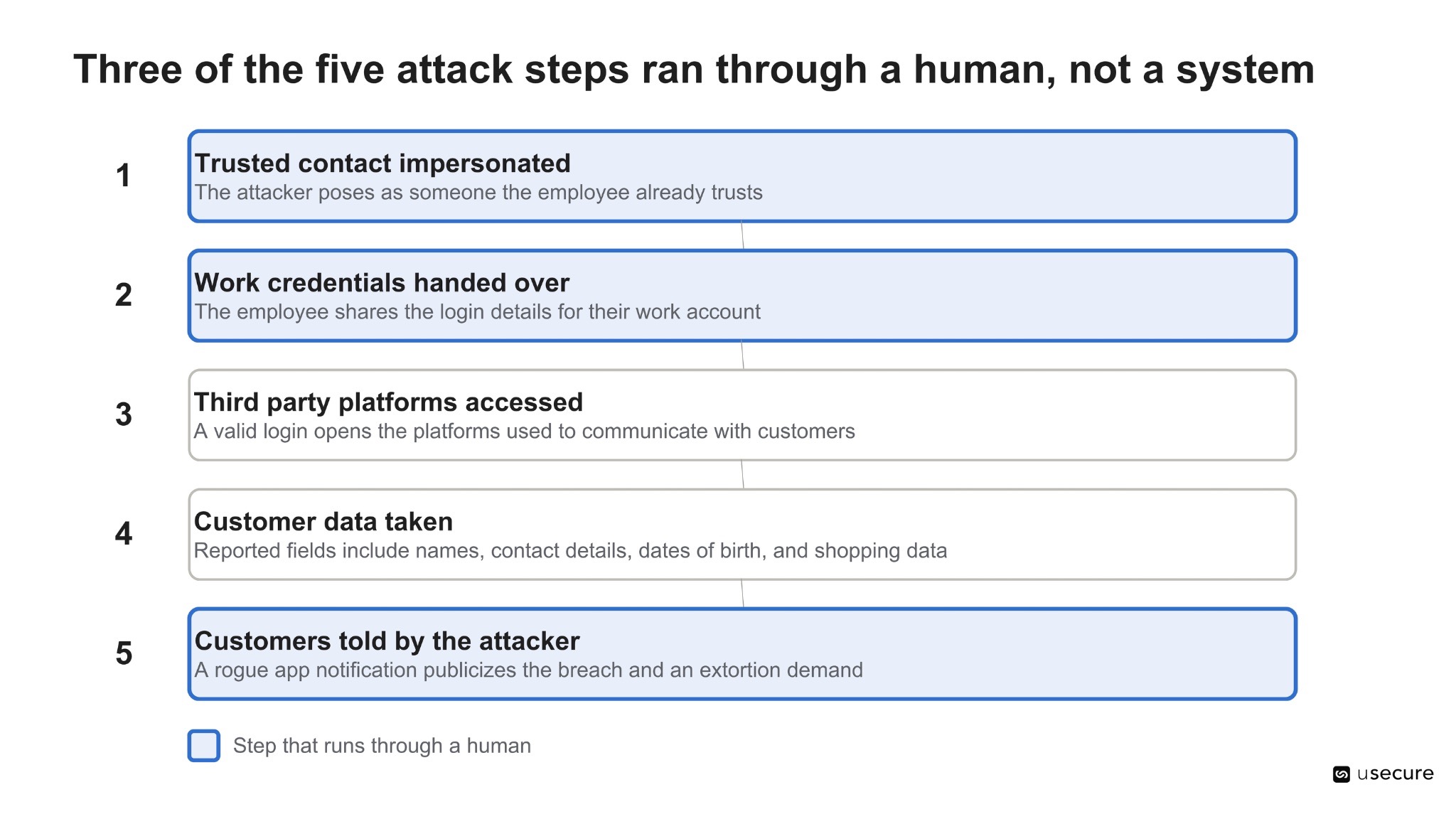
The attack depended on two moments of human trust: the employee who believed the request, and the customers who saw a message arrive through an app they trust.
Trusted contact attacks work because they borrow a relationship that already exists, such as a colleague, a supplier, an agency, or an IT support desk. Filters that inspect a message cannot see that the relationship itself is being spoofed, especially when the approach arrives by phone, chat, or a collaboration tool rather than email. That is why the most effective defense is a workforce that verifies requests through a second, known channel, every time, regardless of how familiar the sender seems.
What Secondary Attacks Should Organisations Expect?
Expect targeted phishing, smishing, voice scams, and identity fraud that use the stolen ASOS data to sound credible. A secondary attack is the wave that follows a breach, where criminals use what was taken to deceive the humans it describes.
The value of this data is in its detail. Pieter Arntz, senior malware intelligence researcher at Malwarebytes, observed that exposure of a retail marketing platform could reveal a detailed customer picture, from browsing and buying habits to location and loyalty status. Records reportedly include customer numbers, dates of birth, and account start dates, while other coverage citing the BBC lists home addresses, phone numbers, and notes on site searches.
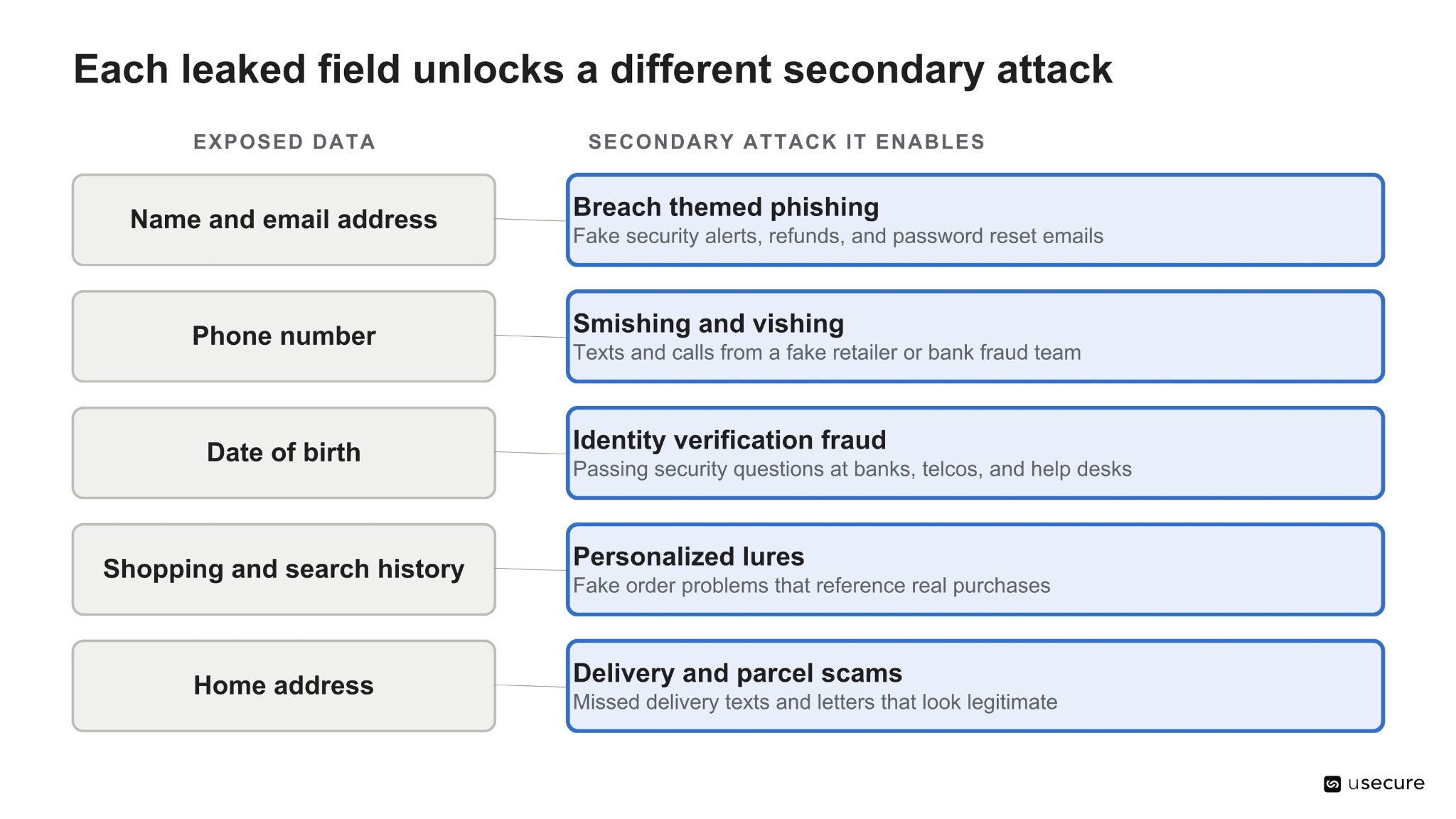
No single field is dangerous on its own; combined, they let an attacker sound like a real retailer, bank, or courier that already knows you.
Secondary attacks tend to arrive in three phases:
- The news cycle. Breach-themed lures appear while the story is in the headlines: fake "confirm your account" emails, bogus compensation offers, and fake support numbers.
- The personalization phase. Attackers mine the data for detail, such as a recent order or a birthday, to build messages that feel specific and therefore safe.
- The long tail. Stolen records are traded and merged with data from other breaches. If the attackers follow through on their leak threat, the data reaches a far wider pool of criminals.
Artificial intelligence makes every phase cheaper and more convincing. The FBI's 2025 Internet Crime Report recorded more than 22,000 complaints involving artificial intelligence, with nearly $900 million in associated losses.
Why is this a Workforce Problem, Not Just a Customer Problem?
The ASOS data breach is a workforce problem because the humans who receive these secondary attacks are also your employees, contractors, and clients. A retailer with a customer base the size of ASOS's almost certainly counts members of your workforce among its customers, and attackers do not stop at the boundary between personal and professional life.
Personal exposure becomes business exposure in three common ways. Employees read personal texts and emails on the same phones that hold their work apps and multifactor authentication prompts. A convincing "fraud team" call can end with remote access software installed on a work laptop. And a personal account taken over through a password reset can become a starting point for impersonating that employee to colleagues.
What Should Employees Watch for Right Now?
Employees should treat any unexpected message that mentions ASOS, an order, a refund, or a data breach as suspicious until it is verified independently. Security teams can share the guidance below as it stands.
Warning signs of a breach-related scam
- A message that references the breach and asks you to "confirm," "secure," or "verify" your account through a link.
- An offer of compensation, vouchers, or a refund that requires you to log in or provide card details.
- A call or text from a "fraud team" that already knows your name, date of birth, or a recent purchase, and uses that knowledge to sound legitimate.
- Any request for a one-time passcode, a password, or remote access to your device. Legitimate retailers and banks do not ask for these.
- A sense of urgency or secrecy, such as a deadline, a threat of account closure, or an instruction not to tell anyone.
What to do instead
- Do not use the links, phone numbers, or reply options in the message. Go to the official website or app directly.
- If a caller claims to be from a retailer or bank, hang up and call back on the number printed on your card or the official site.
- Change your password if you reused your ASOS password elsewhere, and turn on multifactor authentication where it is available. ASOS has said passwords were not accessed, but reuse is a risk in every breach.
- Report anything suspicious that reaches a work device or work account to your security team straight away, even if you did not click. Early reports help stop campaigns targeting colleagues.
- Remember that a familiar sender or an official app is not proof of safety. Verify the request, not the channel.
Human Risk Sits at Both Ends of the Breach
The ASOS data breach started with one deceived employee and will continue through every customer, and every employee, who receives a convincing follow-up message. Human risk sits at both ends of the incident: at the point of entry and at the point of impact.
The numbers point the same way. The human element appeared in 62% of breaches in Verizon's 2026 DBIR, third parties in 48%, and 41% of social engineering breaches used channels beyond email. Organizations that measure how their workforce responds across every channel, enforce verification as a rule, and reward fast reporting will feel far less of the aftermath than those that wait for the next headline.
Frequently Asked Questions
- Was ASOS payment card data stolen?
ASOS has said payment card information and account passwords were not accessed. Names, contact details, and other profile data were, and reporting indicates dates of birth and shopping information were also exposed. - Was Snowflake hacked in the ASOS breach?
Snowflake has said its platform was not breached. ASOS has said the attackers used credentials stolen from an employee to access third-party platforms, which means valid logins were misused rather than the platform being broken. - How many customers were affected by the ASOS breach?
ASOS has not disclosed a figure. Its total customer base should not be treated as the number of affected customers. - What is a secondary attack after a data breach?
A secondary attack uses data stolen in a breach to make a later scam more convincing. Common examples are breach themed phishing emails, smishing texts, fake fraud team calls, and identity verification fraud. - How can organizations protect employees from breach related scams? Measure how employees respond to realistic lures across email, text, and voice, make independent verification mandatory for sensitive requests, and make reporting suspicious messages fast and easy. Human Risk Intelligence brings these signals together so teams can focus on the humans and roles most at risk.
BOOK A DEMO
See Human Risk Intelligence in action
A 30-minute walkthrough of how to cut human risk across your users, tailored to MSPs and IT teams.
Subscribe to newsletter

Discover how professional services firms reduce human risk with usecure
See how IT teams in professional services use usecure to protect sensitive client data, maintain compliance, and safeguard reputation — without disrupting billable work.
Related posts
Explore more insights, updates, and resources from usecure.