usecure lance uHealth, le produit qui définit le Human Risk Intelligence (HRI)

.png)
Table of contents
Subscribe to newsletter
uHealth établit une nouvelle référence en matière de cyber-risque humain : non plus des signaux dispersés dans des outils cloisonnés, mais une intelligence connectée autour de chaque identité.
Manchester, Royaume-Uni, le 4 août 2026 : usecure annonce aujourd’hui le lancement de uHealth, le produit qui donne vie au Human Risk Intelligence (HRI) pour les fournisseurs de services managés (MSP) et les équipes IT internes.
uHealth connecte les données de sensibilisation de la plateforme usecure aux signaux d’identité, d’accès et d’hygiène de sécurité issus de Microsoft 365 et Google Workspace. Il analyse la façon dont ces signaux se combinent autour de chaque identité pour montrer où le risque se concentre, ce qui l’alimente et quelles actions doivent être menées en priorité.
Ce lancement ne se résume pas à l’ajout d’une capacité de sécurité supplémentaire. Il installe le Human Risk Intelligence comme une nouvelle catégorie : une manière connectée de comprendre, de prioriser et de réduire le cyber-risque qui entoure les collaborateurs.
Les organisations produisent déjà des données précieuses grâce à la formation de sensibilisation à la sécurité, aux simulations de phishing, à la surveillance des identifiants exposés, aux contrôles d’identité et à la gestion des accès. Mais ces signaux vivent généralement dans des outils et des tableaux de bord séparés.
Les équipes voient alors des faiblesses isolées, sans comprendre comment elles interagissent ni quelles combinaisons représentent le risque le plus urgent.
uHealth transforme ces données cloisonnées en Human Risk Intelligence.
Du Human Risk Management au Human Risk Intelligence
Le Human Risk Management aide les organisations à réduire le risque via des activités telles que la formation de sensibilisation, les simulations de phishing, la gestion des politiques internes et la surveillance des fuites de données.
Le Human Risk Intelligence s’appuie sur ces fondations.
Il connecte les signaux produits par ces activités aux données plus larges d’identité, d’hygiène et d’accès. Les équipes disposent ainsi du contexte nécessaire pour comprendre le risque qui entoure chaque personne, et pas seulement pour savoir si elle a terminé sa formation ou échoué à une simulation de phishing.
uHealth est le produit conçu pour cette nouvelle étape. Il évalue le risque humain à travers quatre piliers connectés :
- Target Value : le degré d’attractivité d’une personne pour un attaquant, selon des facteurs tels que le rôle, le niveau hiérarchique, la visibilité et l’influence.
- Awareness : la capacité de la personne à reconnaître les cybermenaces et à y réagir, mesurée par ses résultats en formation et en phishing.
- Hygiene : la présence de faiblesses telles que des identifiants exposés, des mots de passe obsolètes ou l’absence d’authentification multifacteur (MFA), qui augmentent la probabilité de compromission.
- Access : la mesure dans laquelle les privilèges, applications et niveaux d’accès de la personne aggravent l’impact potentiel si son identité est compromise.
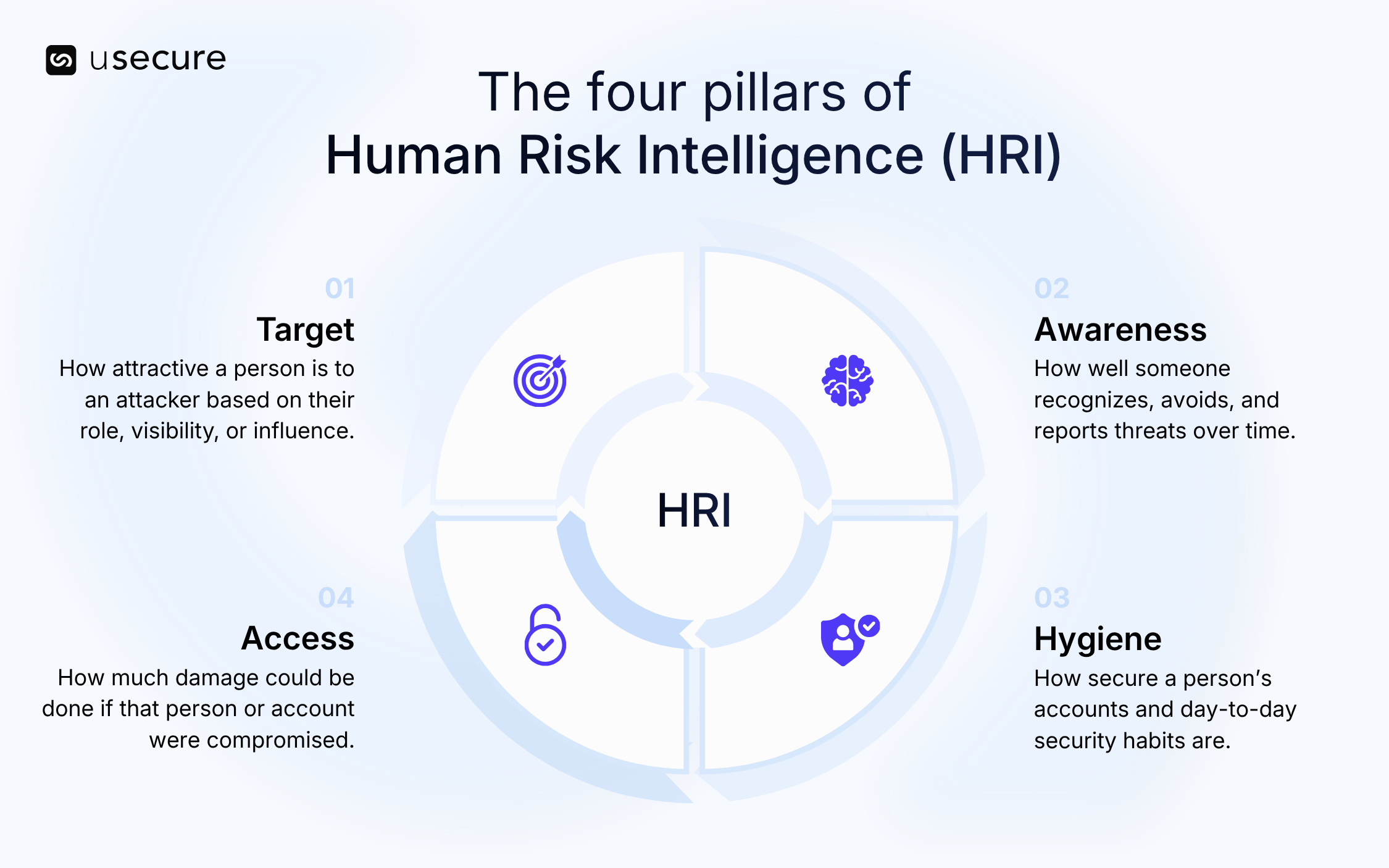
Ensemble, ces piliers offrent une vision connectée de la probabilité, de l’impact potentiel et du contexte global du cyber-risque humain.
Toxic Combinations : les risques que les signaux isolés dissimulent
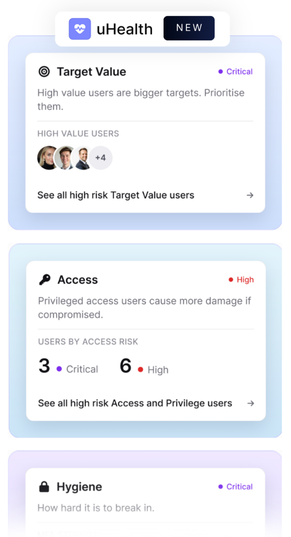
Un signal isolé raconte rarement toute l’histoire.
Un utilisateur du service financier disposant d’accès élevés, sans MFA, avec un mot de passe obsolète et des identifiants exposés présente un risque très différent de celui d’une personne ne cumulant qu’une seule de ces faiblesses.
Prises séparément, ces faiblesses paraissent gérables. Prises ensemble, elles révèlent une identité particulièrement attractive pour un attaquant et particulièrement dommageable en cas de compromission.
uHealth identifie ces Toxic Combinations et expose des risques prioritaires qui resteraient invisibles, dispersés entre des outils et des jeux de données distincts.
Il aide ensuite les équipes à décider de la suite : activer le MFA, réinitialiser des identifiants exposés, revoir des accès devenus inutiles ou déclencher une action de sensibilisation ciblée auprès d’une personne précise.
Les équipes peuvent suivre l’évolution du risque après ces actions et passer du simple reporting d’activité à la priorisation, à la réduction du risque et à la preuve des progrès réalisés.
Des priorités plus claires pour les équipes IT et sécurité
Pour les équipes IT et sécurité internes, uHealth offre une vision plus complète du risque qui entoure leurs collaborateurs et leurs identités.
Les équipes peuvent utiliser uHealth pour :
- Identifier les personnes et les identités qui nécessitent une attention immédiate.
- Prioriser la remédiation sur la sensibilisation, les identifiants, les contrôles d’identité et les accès.
- Vérifier si ces actions améliorent réellement la posture de risque de l’organisation.
Le reporting du risque humain dépasse ainsi les activités réalisées et les indicateurs isolés. Les équipes savent plus clairement quoi corriger, comment coordonner l’action et comment démontrer des progrès mesurables à la direction, aux auditeurs et aux autres parties prenantes.
Une nouvelle opportunité de managed intelligence pour les MSP
Pour les MSP, uHealth transforme le Human Risk Intelligence en un service client différenciant et scalable.
Les partenaires peuvent utiliser uHealth pour :
- Évaluer et comparer le risque humain sur l’ensemble des environnements clients.
- Convertir des constats priorisés en revues d’activité trimestrielles (QBR) et en plans de remédiation étayés par des preuves.
- Démontrer une valeur continue tout en identifiant de nouveaux besoins clients et de nouvelles opportunités de services.
Au lieu de ne rendre compte que du taux de complétion des formations ou des résultats de phishing, les MSP peuvent montrer à leurs clients où le risque se concentre, expliquer ce qui l’alimente et recommander les actions les plus impactantes.
Les MSP dépassent ainsi la simple gestion d’activités de sécurité pour devenir des Managed Intelligence Providers : des partenaires qui s’appuient sur une intelligence connectée pour orienter les décisions, démontrer les résultats et renforcer des relations clients durables.
« La formation de sensibilisation des utilisateurs reste souvent en arrière-plan, mais uHealth renverse complètement cette logique. Nous voyons ce qui a été réalisé, ce qui est en cours et ce qui est prévu ensuite, ce qui nous donne un point de repère clair pour nos réunions de suivi et une bien meilleure visibilité sur les progrès », déclare Conor Murphy, Engineering Delivery Manager chez Rio IT.
Définir le Human Risk Intelligence
« Le risque humain a été géré via des activités séparées et mesuré dans des tableaux de bord séparés pendant bien trop longtemps », explique Charles Preston, CEO et fondateur de usecure. « Résultat : beaucoup de données, mais pas assez de clarté sur ce qui compte vraiment.
« uHealth change la donne. C’est le produit qui donne vie au Human Risk Intelligence. Il connecte le contexte entourant chaque personne afin que les organisations puissent voir où le risque s’accumule, agir de façon ciblée et prouver qu’il diminue. »
uHealth est le produit phare de la stratégie Human Risk Intelligence de usecure et la couche d’intelligence au cœur de l’évolution de sa plateforme. Il réunit Target Value, Awareness, Hygiene et Access dans une vue connectée, pour relier les risques dispersés, résoudre ce qui restait invisible et prouver ce qui a changé.
De nouvelles capacités continueront d’enrichir l’intelligence disponible dans uHealth. Mais le Human Risk Intelligence n’est pas une orientation future pour usecure : il est disponible dès aujourd’hui pour les MSP et les équipes IT internes.
À propos de usecure
usecure est la plateforme de Human Risk Intelligence pour les MSP et les équipes IT internes, et la couche d’intelligence qui sécurise les environnements de travail les plus sûrs au monde. La plateforme combine formation de sensibilisation adaptative, simulations de phishing, gestion des politiques internes, surveillance des identifiants exposés et Human Risk Intelligence connectée pour aider les organisations à comprendre, prioriser et réduire le cyber-risque humain.
usecure accompagne plus de 2 200 MSP et 16 000 organisations dans plus de 40 pays. Pour en savoir plus : usecure.io.
Contact presse
Jordan Daly, Chief Marketing Officer, jordan@usecure.io.
BOOK A DEMO
See Human Risk Intelligence in action
A 30-minute walkthrough of how to cut human risk across your users, tailored to MSPs and IT teams.
Subscribe to newsletter

Découvrez comment les cabinets de services professionnels réduisent le risque humain avec usecure
Découvrez comment les équipes IT des services professionnels utilisent usecure pour protéger les données sensibles de leurs clients, maintenir leur conformité et préserver leur réputation — sans perturber le travail facturable.
Related posts
Explore more insights, updates, and resources from usecure.
%20(1).png)
Human Risk Intelligence (HRI) : ce que c'est et pourquoi c'est important
.avif)
%20(1).png)
.png)