Underwriting the Human Factor: How Human Risk Intelligence Is Rewriting the Rules of Cyber Insurance

Published on
August 13, 2026
Read time
5 mins

Underwriting the Human Factor: How Human Risk Intelligence Is Rewriting the Rules of Cyber Insurance

Published on
August 13, 2026
Read time
5 mins
Category
5 min read

Underwriting the Human Factor: How Human Risk Intelligence Is Rewriting the Rules of Cyber Insurance

Published on
13 Aug 26

Table of contents

Subscribe to newsletter

By clicking Sign Up you're confirming that you agree with our Terms and Conditions.
Thank you! Your submission has been received!
Oops! Something went wrong while submitting the form.

Cyber insurers are moving beyond proof that employees have been trained. Increasingly, they want evidence that human risk is being measured and reduced. That shift is changing applications, premiums, and renewal discussions.

Cyber insurance has spent years assessing technical controls such as firewalls, endpoint protection, and backups. Now, underwriters are applying the same scrutiny to human risk - and many organizations still lack the evidence to demonstrate that it is under control.

The Insurance Market Is Asking Different Questions

Cyber insurance applications were once dominated by simple yes-or-no questions: Is a firewall in place? Are backups maintained? Is antivirus software deployed? Policies were often priced on whether controls existed, rather than how effectively they reduced risk.

That approach is changing. Rising ransomware losses, business interruption claims, and regulatory penalties have forced insurers to assess risk more rigorously. Many serious breaches begin not with a failed technical control, but with compromised credentials, social engineering, or weak identity practices.

As a result, underwriting questions are becoming more specific and behavioral. Insurers may ask how widely multifactor authentication is enforced, how phishing performance is trending, and whether dormant accounts are identified and removed. Applicants that can provide current, continuous evidence are better positioned to demonstrate effective risk management.

Why Attackers Continue to Exploit People

Security teams have significantly strengthened technical defenses. Firewalls, endpoint detection, and zero-trust architectures have all matured. In response, attackers have increasingly focused on a harder control to standardize: human judgment.

Effective social engineering is designed to appear routine. A malicious request may resemble a password reset, an invoice, or a call from a colleague. Rather than triggering suspicion, it exploits familiar behaviors and trusted processes. Recent incidents show why insurers increasingly treat this exposure as a material underwriting concern.
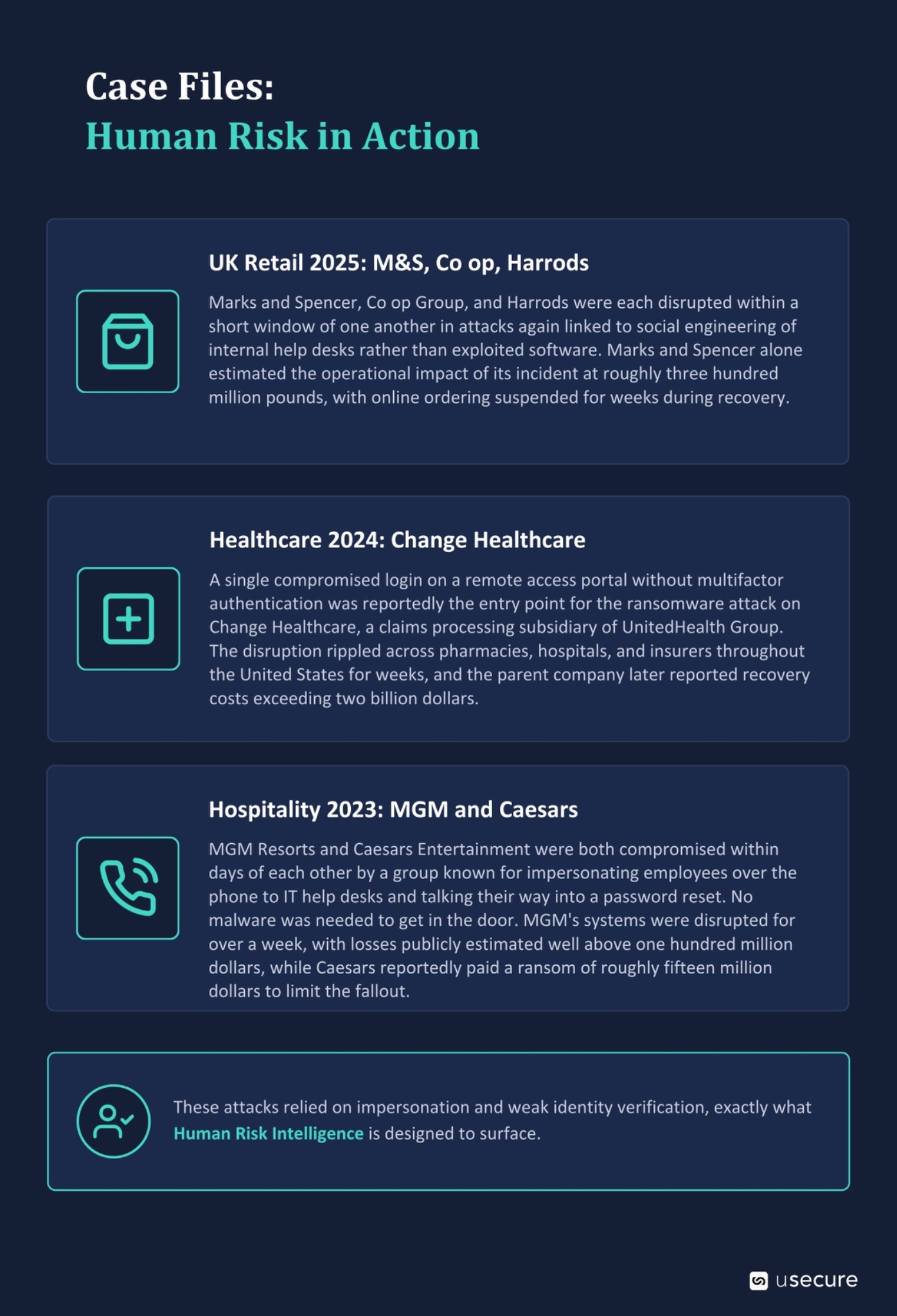
These incidents did not depend on novel exploits. They relied on convincing impersonation, weak identity verification, or compromised credentials. These are precisely the types of exposures that Human Risk Intelligence is designed to identify before they become claims.

What the Data Shows About Human Risk

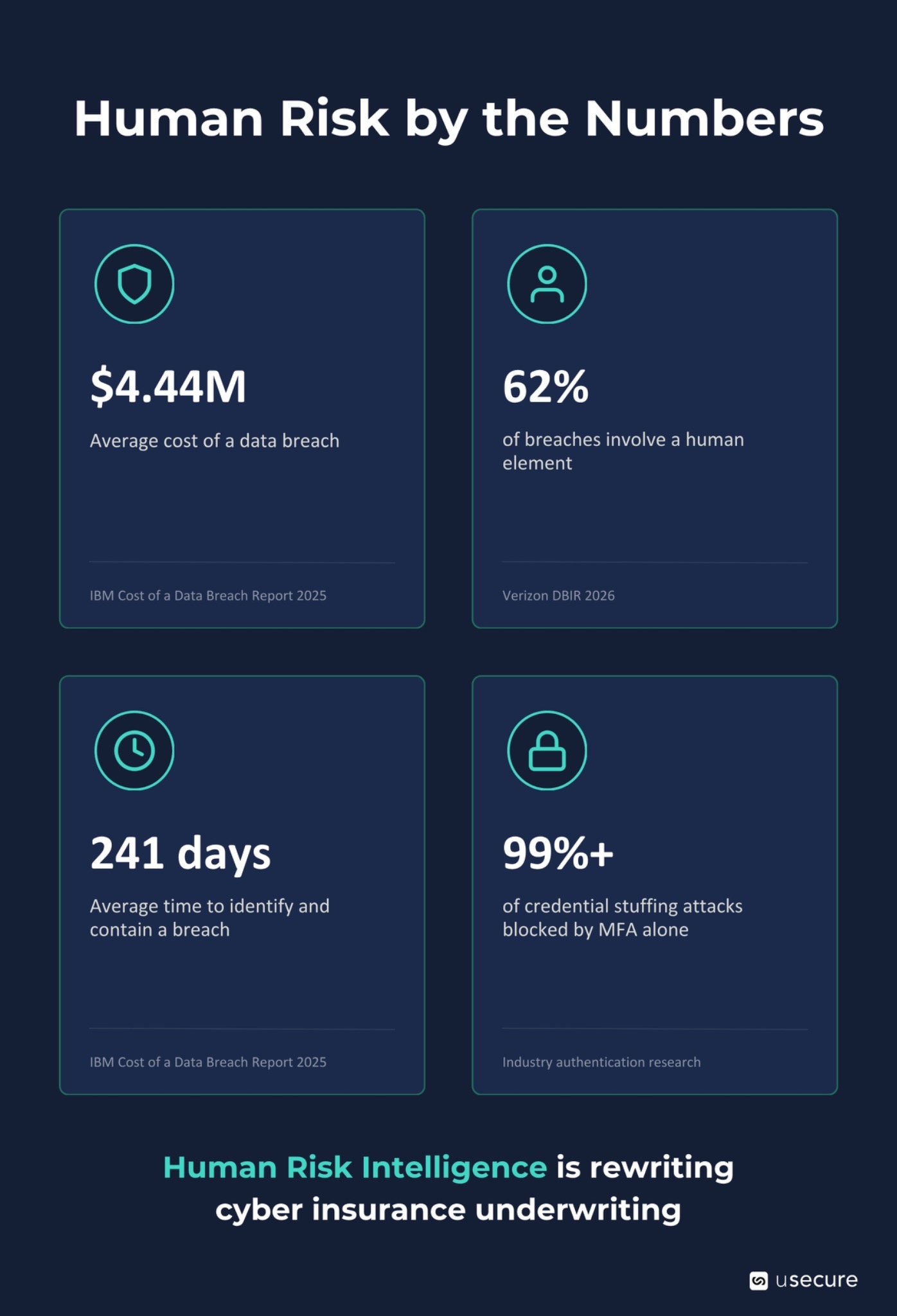
Industry research helps explain why measurable reductions in human risk are becoming more relevant to underwriting and renewal discussions. The figures below highlight the scale, persistence, and financial impact of human-related cyber exposure.

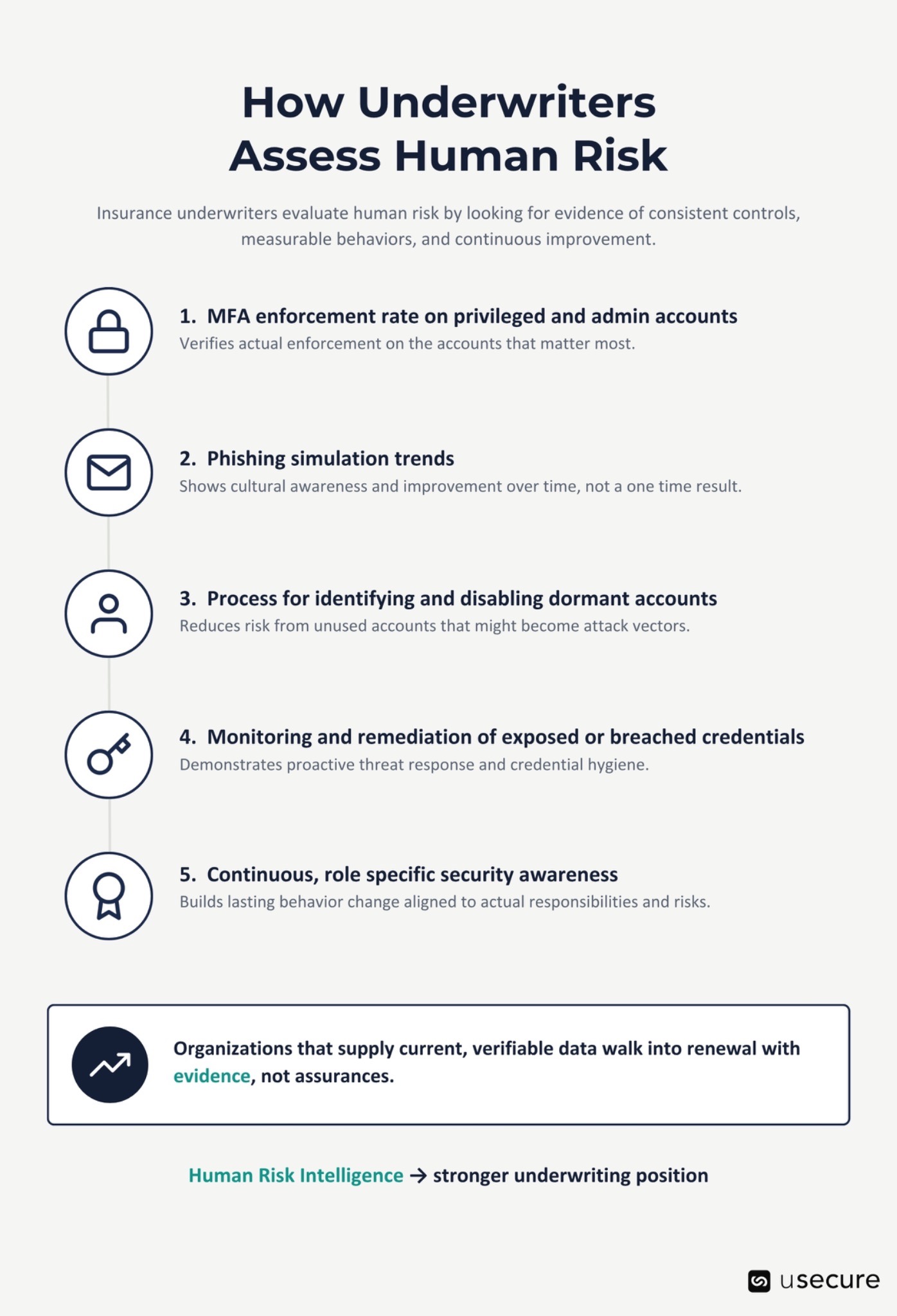
How Underwriters Assess Human Risk

Renewal questionnaires have become longer, more detailed, and more focused on behavior and identity. Underwriters increasingly want evidence of:

  • The proportion of privileged and administrative accounts with multifactor authentication actively enforced, rather than merely available
  • Phishing simulation click and reporting rates across multiple cycles, rather than a single recent result
  • Processes for identifying, reviewing, and disabling dormant accounts
  • Monitoring and remediation of exposed or breached credentials
  • Continuous, role-specific security awareness training rather than a single annual compliance exercise

Taken together, these questions amount to a practical assessment of Human Risk Intelligence, even when the term itself is not used. Organizations that can respond with current, verifiable data are better equipped to support underwriting decisions and address questions about exclusions, premiums, or social-engineering coverage.

Strengthening the Application: What Insurers Want to See

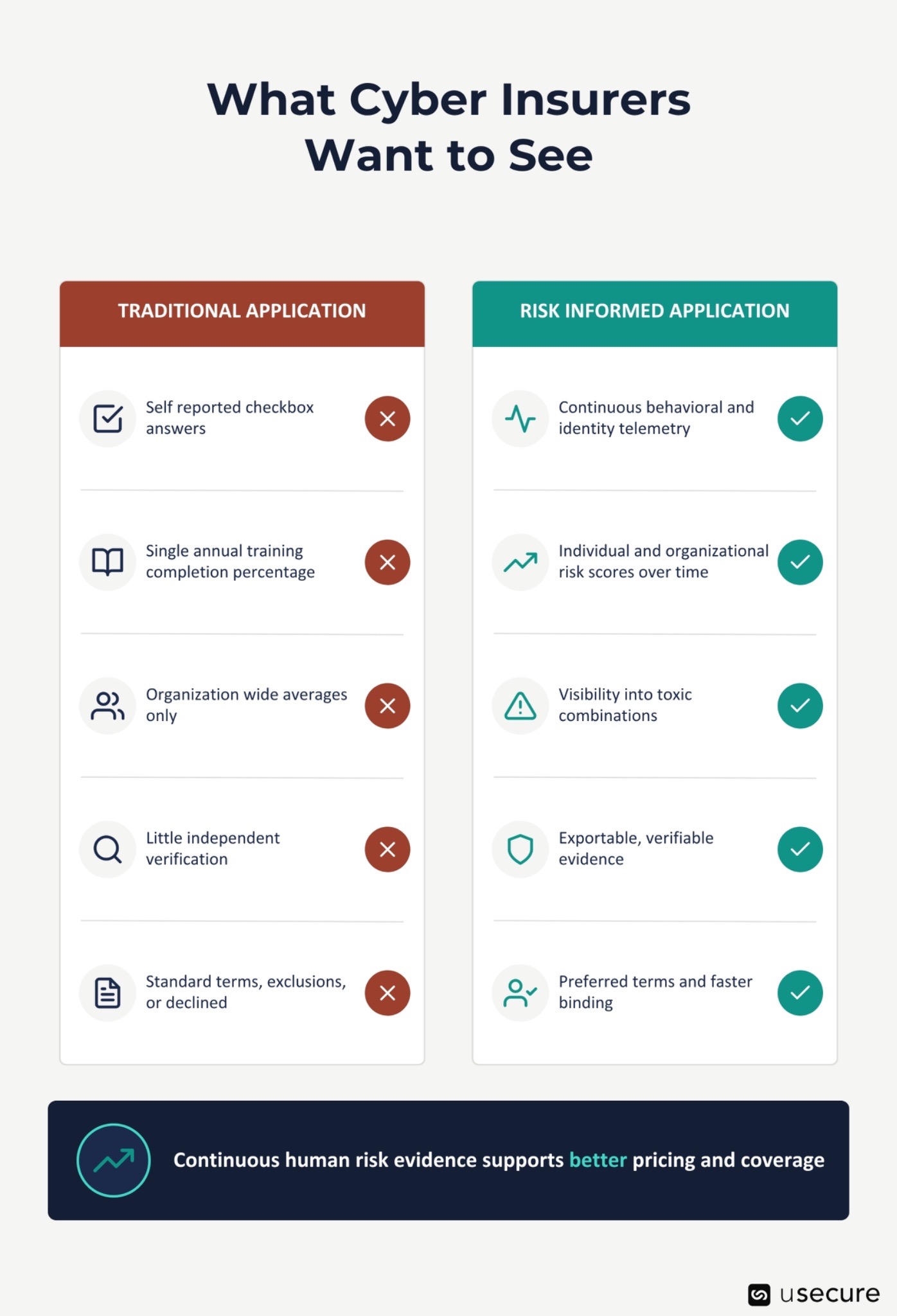
Continuous human risk evidence does more than improve the presentation of an application. It gives underwriters information they can verify - and verification supports more confident risk assessment and pricing.
Reducing Premiums Through Measurable Risk Reduction

Premium discussions are also shifting from proof of activity to proof of outcomes. Evidence that an organization has purchased training or run an annual phishing exercise is useful, but it does not show whether exposure is actually falling. Brokers are increasingly better equipped when they can demonstrate a sustained reduction in risk.
The most relevant metrics mirror those security leaders already use to assess program effectiveness:

  • A declining human risk score across departments and the organization as a whole, rather than a static training-completion rate
  • Improving phishing simulation trends, with reporting rates rising as click rates fall
  • Increasing multifactor authentication coverage for privileged and administrative accounts, rather than only company-wide averages
  • An improvement in cyber hygiene, indicating that high-probability attack paths are being closed

Improvement across these metrics can strengthen renewal discussions by replacing broad assurances with a demonstrable risk trend. It can also help insurers assess how effectively an organization is reducing the exposures most likely to drive a claim.

Supporting the Claims Process After an Incident

The value of this evidence continues after a policy is bound. Following an incident, insurers may examine whether reasonable controls were in place at the time of loss. Historical risk scores, remediation records, and a timeline of multifactor authentication coverage can provide a stronger evidential record than an annual training-completion certificate alone.

Regulatory expectations are moving in a similar direction. Under frameworks such as GDPR, penalties can reach EUR20 million or 4% of global annual turnover. A documented record of how human risk is identified and managed can therefore support not only insurance discussions, but wider governance and compliance requirements. Across these functions, the common requirement is increasingly clear: current, individual-level evidence rather than a once-a-year snapshot.

The Board Level Metric of the Future

Cybersecurity governance and cyber insurance underwriting are converging on the same requirement: one credible, defensible number that shows human risk moving in the right direction over time. Historically, security performance was measured through technical indicators such as patching rates and endpoint coverage. Increasingly, executives will be expected to show that human risk is being measured, monitored, and reduced with the same rigor.

The organizations that build real visibility into their human attack surface today will not only reduce the likelihood of a costly incident. They will walk into their next renewal with evidence rather than assurances, and pay for the risk they actually carry rather than the risk an underwriter has to assume on their behalf. Learn more about Human Risk Intelligence or book a demo to see how it can support a stronger cyber insurance position.

Subscribe to newsletter

BOOK A DEMO

See usecure in action

A 30-minute walkthrough of how to cut human risk across your users, tailored to MSPs and IT teams.

Get a Demo

Subscribe to newsletter

By clicking Sign Up you're confirming that you agree with our Terms and Conditions.
Thank you! Your submission has been received!
Oops! Something went wrong while submitting the form.

Cyber insurers are moving beyond proof that employees have been trained. Increasingly, they want evidence that human risk is being measured and reduced. That shift is changing applications, premiums, and renewal discussions.

Cyber insurance has spent years assessing technical controls such as firewalls, endpoint protection, and backups. Now, underwriters are applying the same scrutiny to human risk - and many organizations still lack the evidence to demonstrate that it is under control.

The Insurance Market Is Asking Different Questions

Cyber insurance applications were once dominated by simple yes-or-no questions: Is a firewall in place? Are backups maintained? Is antivirus software deployed? Policies were often priced on whether controls existed, rather than how effectively they reduced risk.

That approach is changing. Rising ransomware losses, business interruption claims, and regulatory penalties have forced insurers to assess risk more rigorously. Many serious breaches begin not with a failed technical control, but with compromised credentials, social engineering, or weak identity practices.

As a result, underwriting questions are becoming more specific and behavioral. Insurers may ask how widely multifactor authentication is enforced, how phishing performance is trending, and whether dormant accounts are identified and removed. Applicants that can provide current, continuous evidence are better positioned to demonstrate effective risk management.

Why Attackers Continue to Exploit People

Security teams have significantly strengthened technical defenses. Firewalls, endpoint detection, and zero-trust architectures have all matured. In response, attackers have increasingly focused on a harder control to standardize: human judgment.

Effective social engineering is designed to appear routine. A malicious request may resemble a password reset, an invoice, or a call from a colleague. Rather than triggering suspicion, it exploits familiar behaviors and trusted processes. Recent incidents show why insurers increasingly treat this exposure as a material underwriting concern.

These incidents did not depend on novel exploits. They relied on convincing impersonation, weak identity verification, or compromised credentials. These are precisely the types of exposures that Human Risk Intelligence is designed to identify before they become claims.

What the Data Shows About Human Risk

Industry research helps explain why measurable reductions in human risk are becoming more relevant to underwriting and renewal discussions. The figures below highlight the scale, persistence, and financial impact of human-related cyber exposure.


How Underwriters Assess Human Risk

Renewal questionnaires have become longer, more detailed, and more focused on behavior and identity. Underwriters increasingly want evidence of:

  • The proportion of privileged and administrative accounts with multifactor authentication actively enforced, rather than merely available
  • Phishing simulation click and reporting rates across multiple cycles, rather than a single recent result
  • Processes for identifying, reviewing, and disabling dormant accounts
  • Monitoring and remediation of exposed or breached credentials
  • Continuous, role-specific security awareness training rather than a single annual compliance exercise

Taken together, these questions amount to a practical assessment of Human Risk Intelligence, even when the term itself is not used. Organizations that can respond with current, verifiable data are better equipped to support underwriting decisions and address questions about exclusions, premiums, or social-engineering coverage.

Strengthening the Application: What Insurers Want to See

Continuous human risk evidence does more than improve the presentation of an application. It gives underwriters information they can verify - and verification supports more confident risk assessment and pricing.

Reducing Premiums Through Measurable Risk Reduction

Premium discussions are also shifting from proof of activity to proof of outcomes. Evidence that an organization has purchased training or run an annual phishing exercise is useful, but it does not show whether exposure is actually falling. Brokers are increasingly better equipped when they can demonstrate a sustained reduction in risk.

The most relevant metrics mirror those security leaders already use to assess program effectiveness:

  • A declining human risk score across departments and the organization as a whole, rather than a static training-completion rate
  • Improving phishing simulation trends, with reporting rates rising as click rates fall
  • Increasing multifactor authentication coverage for privileged and administrative accounts, rather than only company-wide averages
  • An improvement in cyber hygiene, indicating that high-probability attack paths are being closed

Improvement across these metrics can strengthen renewal discussions by replacing broad assurances with a demonstrable risk trend. It can also help insurers assess how effectively an organization is reducing the exposures most likely to drive a claim.

Supporting the Claims Process After an Incident

The value of this evidence continues after a policy is bound. Following an incident, insurers may examine whether reasonable controls were in place at the time of loss. Historical risk scores, remediation records, and a timeline of multifactor authentication coverage can provide a stronger evidential record than an annual training-completion certificate alone.

Regulatory expectations are moving in a similar direction. Under frameworks such as GDPR, penalties can reach EUR20 million or 4% of global annual turnover. A documented record of how human risk is identified and managed can therefore support not only insurance discussions, but wider governance and compliance requirements. Across these functions, the common requirement is increasingly clear: current, individual-level evidence rather than a once-a-year snapshot.

The Board Level Metric of the Future

Cybersecurity governance and cyber insurance underwriting are converging on the same requirement: one credible, defensible number that shows human risk moving in the right direction over time. Historically, security performance was measured through technical indicators such as patching rates and endpoint coverage. Increasingly, executives will be expected to show that human risk is being measured, monitored, and reduced with the same rigor.

The organizations that build real visibility into their human attack surface today will not only reduce the likelihood of a costly incident. They will walk into their next renewal with evidence rather than assurances, and pay for the risk they actually carry rather than the risk an underwriter has to assume on their behalf. Learn more about Human Risk Intelligence or book a demo to see how it can support a stronger cyber insurance position.

Subscribe to newsletter

Subscribe to newsletter

By clicking Sign Up you're confirming that you agree with our Terms and Conditions.
Thank you! Your submission has been received!
Oops! Something went wrong while submitting the form.

Discover how professional services firms reduce human risk with usecure

See how IT teams in professional services use usecure to protect sensitive client data, maintain compliance, and safeguard reputation — without disrupting billable work.

Related posts

Explore more insights, updates, and resources from usecure.

No items found.