ISO/IEC 27001 Compliance: How Human Risk Intelligence Provides the Measurable Evidence Auditors Demand


Table of contents
Subscribe to newsletter
ISO/IEC 27001 Compliance: How Human Risk Intelligence Provides the Measurable Evidence Auditors Demand
The modern ISO/IEC 27001 audit is about traceability. Auditors increasingly want to see how a risk was identified, which control was selected, how it was implemented, and what evidence shows it is actually working in daily operations. As a cybersecurity vendor with years of experience providing organizations with practical tools to go through their certification journeys, we have seen firsthand how auditors are raising the bar. They want clear, ongoing proof that human risks are acknowledged and actively identified, measured, mitigated, and improved over time.
This blog explores how Human Risk Intelligence (HRI), combined with an integrated suite of cybersecurity tools, delivers the measurable evidence that ISO/IEC 27001 auditors demand. It also examines the critical role of people-centric controls, breaks down key ISO/IEC 27001 clauses and Annex A requirements, and shows how the cybersecurity solutions can work together to create auditable, outcome-focused proof of an effective Information Security Management System (ISMS).
The Stark Reality of Human Risk
Human factors remain the dominant cause of security incidents. Multiple industry reports reinforce this:
- The Verizon 2025 Data Breach Investigations Report (DBIR) found that the human element is involved in 74% of breaches.
- IBM’s Cost of a Data Breach Report 2024 reports the global average breach cost at $4.45 million, with higher costs associated with phishing and compromised credentials.
- The World Economic Forum Global Cybersecurity Outlook 2025 highlights that human error and social engineering remain top attack vectors globally.
The figures explain why ISO/IEC 27001 auditors are placing increasing emphasis on people-centric controls. Organizations must prove they are actively managing and reducing human risk.
HRI is the practical bridge that delivers exactly this evidence. It turns employee behaviors, training outcomes, phishing simulation results, policy adherence, breach data, and threat insights into concrete, auditable metrics that demonstrate how your ISMS is compliant with the standard’s requirements.
Meeting Awareness and Training Requirements Effectively

According to ISO/IEC 27001 Clause 7.3 (Awareness), organizations must ensure that all employees are aware of their specific contribution to the ISMS, and the consequences of failing to meet requirements. Annex A 6.3 (Information security awareness, education and training) goes further, requiring organizations to provide all interested parties appropriate information security awareness training that is role-appropriate and regularly updated to address current threats.
Auditors are no longer satisfied with annual training completion rates and generic awareness campaigns. They want evidence of behavioral change.
What auditors now expect:
- Role-based training aligned to risk exposure
- Measurable improvement over time
- Evidence linking training to reduced incidents
- Continuous engagement, not one-off sessions
Auditors usually care less about activity volume and more about proof of effectiveness. They want records that connect awareness, process, and outcomes, including timestamped acknowledgments, training records, incident reporting trails, and examples showing that controls were used in practice.
Preparing Audit Evidence with Security Awareness and HRI Solutions
Organizations should ensure they can effectively prepare and present audit evidence by leveraging a comprehensive security awareness solution, supported by an integrated HRI suite.
When selecting a security awareness platform, it is important to choose a solution that extends beyond traditional training and provides measurable, risk-driven outcomes. Key capabilities should include:
- AI-driven adaptive learning tailored to individual user
- Role-specific training modules aligned with departmental responsibilities (e.g., finance, HR, IT)
- Automated training campaigns triggered by identified risky behaviours, such as phishing simulation failures
In addition, organizations should implement an advanced phishing simulation solution that reflects the evolving threat. This solution should offer:
- Highly customizable phishing simulations based on current, real-world attack scenarios
- Regularly updated phishing templates aligned with emerging threat trends
- Detailed behavioural analytics, including click rates, credential submissions, and reporting activity
- Automated follow-up training for users identified as high risk
- Insights into risk levels across individuals and departments
Beyond awareness and simulation capabilities, organizations should also deploy an integrated HRI solution to strengthen visibility and control over human-related risks. Such a solution should:
- Provide continuous visibility into user-level security risks across the organization
- Automatically detect and surface high-risk users
- Generate actionable remediation tasks to reduce identified risks
- Deliver trend-based reporting to demonstrate measurable improvement over time
Handling Breaches and Security Incidents Correctly

ISO/IEC 27001 requires robust incident management processes. Annex A 5.24 (Information security incident management planning and preparation) makes it clear that security incidents, including data breaches, must be properly documented, assessed, responded to, and learned from. Annex A 5.25 (Assessment and decision on information security events) also specifically addresses that organizations shall assess information security events and decide if they are to be categorized as information security incidents.
Auditors will ask:
- Have you experienced any incidents or breaches?
- What caused them?
- How did you respond?
- What changed afterward?
Weak or incomplete answers often lead to nonconformities.
Preparing Audit Evidence with Dark Web Monitoring and HRI Solutions
Organizations should consider implementing a dark web monitoring solution to enhance their ability to detect potential security incidents involving compromised organizational accounts. These tools continuously scan external sources, including:
- dark web forums
- marketplaces
- breach repositories
They proactively identify exposed credentials and data associated with the organization to enable early detection of breaches and help organizations respond swiftly and demonstrate effective incident identification and management.
In addition, implementing an HRI solution enables organizations to gain detailed visibility into the root causes of user-related security risks, allowing for more efficient and effective management of human risk. An effective HRI platform should:
- Break down compromised risk factors, such as outdated passwords, lack of multi-factor authentication (MFA), and dormant or inactive accounts
- Clearly quantify exposure by showing the exact number of affected users
- Enable targeted remediation by identifying high-risk user groups and specific vulnerabilities
- Support audit requirements by providing structured, evidence-based reporting on incidents and corrective actions
When combining dark web monitoring with detailed human risk analysis, organizations can transform incident detection into a proactive and measurable process that demonstrates responsiveness and continuous improvement within their ISMS.
Establishing and Enforcing Strong Information Security Policies
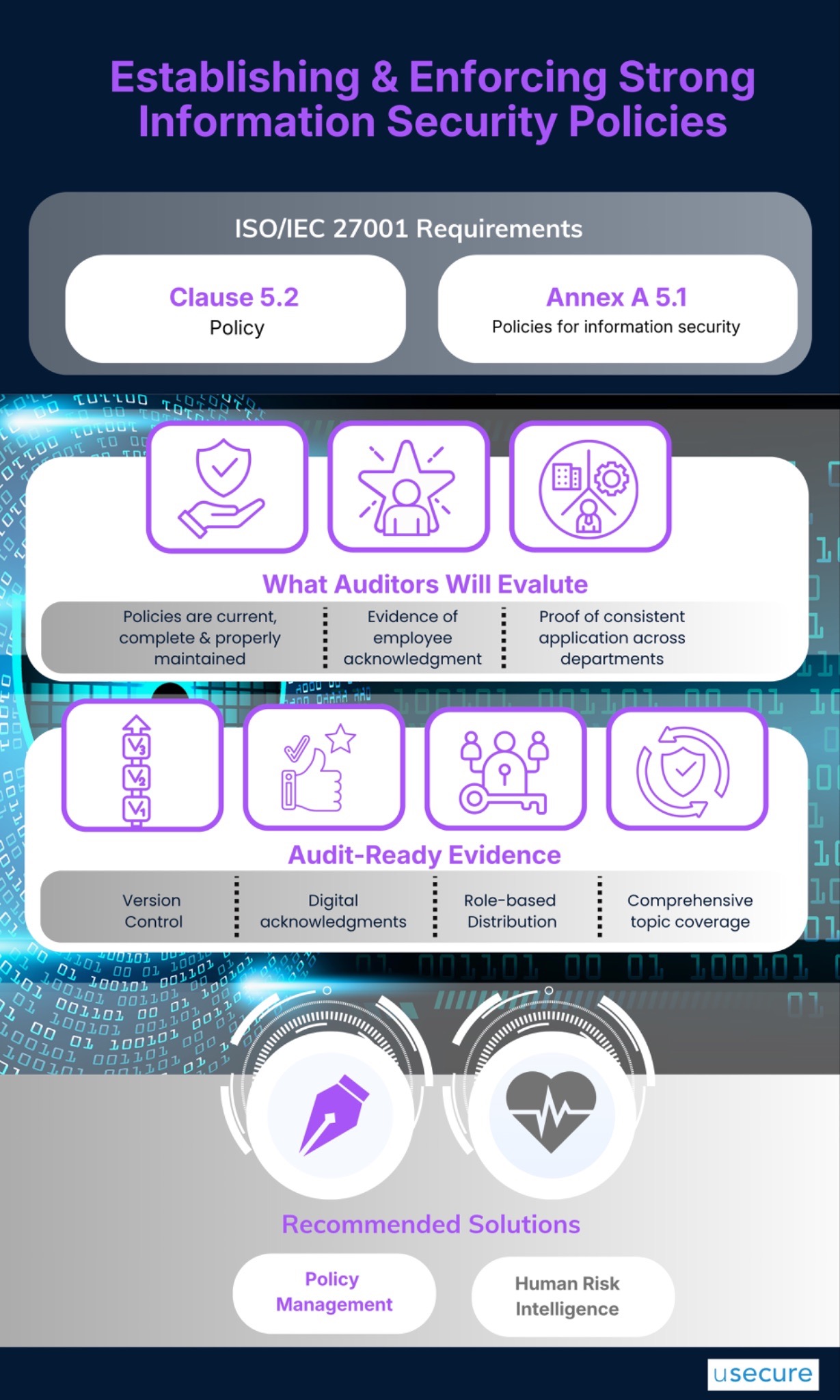
ISO/IEC 27001 Clause 5.2 (Policy) requires organizations to establish, maintain, and communicate an overarching information security policy. This policy defines the strategic direction of the ISMS and may contain sensitive details related to the organization’s operational and technical environment. As a result, access is typically restricted to senior management and relevant stakeholders.
In addition, Annex A 5.1 (Policies for Information Security) requires organizations to implement topic-specific policies that are:
- Formally approved by management
- Communicated effectively to relevant personnel
- Reviewed and updated at regular intervals
Policies should be distributed based on role and responsibility, ensuring employees receive only the information necessary for their function. Beyond distribution, organizations must ensure that policies are actively understood and applied in day-to-day operations.
During an audit, assessors will evaluate:
- Whether policies are current, complete, and properly maintained
- Evidence of employee acknowledgment (e.g., digital signatures, timestamps)
- Proof of consistent application across departments
Preparing Audit Evidence with Policy Management and HRI Solutions
To support effective policy governance and audit readiness, organizations should implement a centralized and well-managed policy management solution that enables them to:
- Create, update, and maintain policies efficiently throughout their lifecycle
- Access an extensive and continuously expanding template library containing pre-built security and compliance policies and guidelines
- Distribute policies to targeted user groups based on roles and responsibilities
- Maintain version control, policy history, and complete audit trails
- Generate audit-ready records of policy distribution, acceptance, and review activities
- Track employee acknowledgments and compliance status through digital signatures and timestamps
In addition, organizations should leverage HRI the following elements to strengthen visibility into policy-related human risk factors and compliance gaps:
- Identify users or departments with repeated policy non-compliance
- Detect high-risk behaviors associated with policy violations
- Correlate policy engagement data with broader human risk indicators
- Generate actionable remediation tasks and risk-based reporting
- Provide continuous visibility into policy adherence trends across the organization
Build a Stronger ISMS with HRI for ISO/IEC 27001
If you are preparing for ISO/IEC 27001 certification, or simply want to strengthen your people-centric controls, now is the time to move beyond traditional awareness training and static policies. Investing in HRI is one of the smartest decisions you can make for both compliance success and long-term cyber resilience.
Ready to transform how your organization manages human risk? Explore how the right combination of tools and intelligence can make your next audit smoother, your security stronger, and your people more confident defenders of your most valuable assets.
Ready to turn human risk into human resilience? Explore the demo hub to see our security awareness solution and the wider human risk suite in action.
BOOK A DEMO
See Human Risk Intelligence in action
A 30-minute walkthrough of how to cut human risk across your users, tailored to MSPs and IT teams.
Subscribe to newsletter

Discover how professional services firms reduce human risk with usecure
See how IT teams in professional services use usecure to protect sensitive client data, maintain compliance, and safeguard reputation — without disrupting billable work.
Related posts
Explore more insights, updates, and resources from usecure.

A comprehensive guide to understanding ISO/IEC 27001