From MSP to MIP: Why Managed Intelligence Needs Human Risk Intelligence (HRI)
.avif)
Subscribe to newsletter
The MSP market is shifting again and this time, the shift goes deeper than tooling.
Pax8 Beyond 2026 made the direction clear. The conversation has moved from MSP to MIP: Managed Intelligence Provider.
In that model, partners are not just managing devices, tickets, and licences. They are helping clients use intelligence safely, profitably, and with enough governance to avoid creating new problems.
That is a meaningful shift. But there is a risk of making it too narrow.
Managed intelligence is not only about agents, automations, and dashboards. It is about people.
The employees using AI tools. The users approving access. The teams handling data. The clients who need to know whether their security culture is improving, or quietly drifting.
That is where Human Risk Intelligence belongs.
The gap most MSPs are not filling
A lot of MSPs already deliver some form of security awareness training. Some run phishing simulations. Some report on course completion.
But those activities rarely give MSPs a full picture of where human risk is actually coming from.
To manage human risk properly, MSPs need visibility across four areas:
- Target: Which users, roles, or departments are most likely to be targeted or put the business at risk?
- Awareness: Who understands security expectations, engages with training, recognises threats, and improves over time?
- Hygiene: Which users have exposed credentials, repeat risky behaviours, or poor security habits that need attention?
- Access: Where are MFA gaps, account weaknesses, or identity-related risks increasing exposure?
%20Cycle%20%20.png)
For most MSPs and their clients, these answers are still unclear.
That is a problem. You cannot manage what you cannot see. If MSPs cannot see how risk is developing across users, behaviours, credentials, and access, a significant part of client risk remains invisible too.
What changes when MSPs move to the MIP model
The shift from MSP to MIP is not just a change in terminology. It changes what clients expect.
Traditional MSP value is built around uptime, support, and incident response. MIP value is built around insight, guidance, and measurable outcomes.
That changes the human risk conversation completely.
Instead of:
"We delivered security awareness training this quarter."
An MSP can say:
"We can show you which users are creating the most risk, where MFA gaps exist, how behaviour is changing across teams, and which accounts need immediate attention, tracked over time, across your whole business."
That is a fundamentally different conversation. One that moves MSPs from activity reporting to intelligence-led guidance.
What HRI actually gives MSPs
Human Risk Intelligence gives MSPs a practical way to understand and reduce risk from everyday user behaviour, identity exposure, and account-level security gaps.
%20-%20Assets%20(13).png)
That includes:
- Security awareness training results
- Phishing simulation performance
- Policy acknowledgement and completion
- Dark web and exposed credential alerts
- MFA gaps and identity-related weaknesses
- Repeat risky behaviour across users and teams
- User, role, department, and client-level risk trends
- Reports built for QBRs, renewals, and compliance conversations
This is where usecure leads the HRI conversation.
usecure helps MSPs manage the human side of cybersecurity through training, phishing simulation, policy management, breach monitoring, automation, and reporting.
More importantly, it connects user behaviour with identity-level risk, giving partners visibility into which users are most exposed, which accounts need attention, and how risk is changing across departments, roles, and clients over time.
That means clearer prioritisation. Provable progress. Client conversations built on evidence, not assumptions.
AI does not reduce human risk. It amplifies it.
There is a tempting idea that AI will eventually remove human risk from the equation. It will not.
In most cases, AI will make human risk faster, harder to spot, and more consequential. Employees will adopt new tools without guardrails. AI agents will act across workflows, accounts, and applications. Attackers will use AI to make phishing, impersonation, and social engineering more convincing than ever.
The human layer needs more visibility. Not less.
Clients will need help answering questions like:
- Are employees using AI safely?
- Do they understand what data they can and cannot share?
- Can they recognise AI-powered phishing attempts?
- Are security and acceptable-use policies being followed?
- Are accounts, permissions, and MFA configured to reduce risk?
- Can leadership see which users, teams, and identities present the highest risk?
These are not purely technical questions. They are human risk questions.
A category MSPs can build around
Human Risk Intelligence is not a feature. It is a service category.
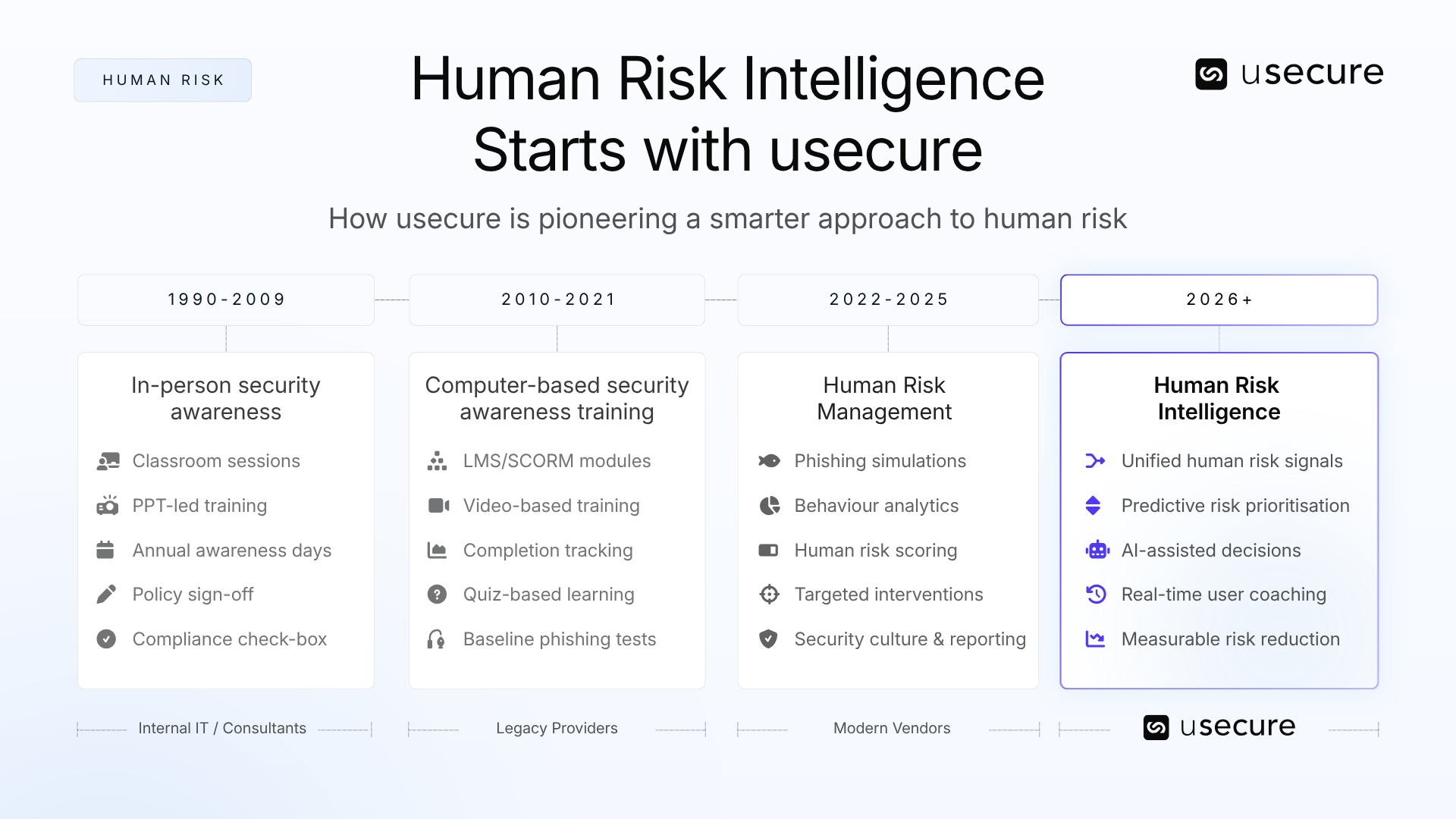
For MSPs moving toward the MIP model, it supports:
- Recurring revenue around human risk management
- Better QBRs and client reports
- Stronger compliance and governance conversations
- More targeted awareness training
- Client risk benchmarking
- Upsell conversations grounded in real data
- A stronger story for AI readiness and adoption
Every MSP will talk about AI. Fewer will be able to show how they are reducing the people-side and identity-side risk that comes with it.
That is the differentiator.
The bigger opportunity
Managed intelligence cannot just mean smarter tools.
It also needs smarter visibility into user behaviour, security culture, identity exposure, and client-level risk. As the channel moves toward the MIP model, Human Risk Intelligence gives MSPs a practical way to bring the human layer into that conversation — and turn it into measurable, managed, revenue-generating service.
That is the category usecure is building. And it starts with seeing what most partners are still missing.
BOOK A DEMO
See Human Risk Intelligence in action
A 30-minute walkthrough of how to cut human risk across your users, tailored to MSPs and IT teams.
Subscribe to newsletter

Related posts
Explore more insights, updates, and resources from usecure.
%20(1).png)
Human Risk Intelligence (HRI): What It Is and Why It Matters
%20(1).png)
%20(1).png)
See effortless human risk intelligence in action
Book a demo to see how usecure reduces human risk for IT teams and MSPs, or start a free trial to explore the platform yourself.

