Policy Management Isn’t a Compliance Checkbox — It’s a Human Risk Indicator

-2.avif)
Table of contents
Subscribe to newsletter
And It's Time We Treated It That Way
Policy management is rarely top of mind — until a breach happens, an audit fails, or an employee insists, “No one ever told me that was a policy.” Suddenly, it becomes urgent.
Despite heavy investment in cybersecurity infrastructure, many organizations still overlook one of the most fragile parts of their security ecosystem: how policies are written, updated, acknowledged, and enforced.
Nearly three-quarters of all data breaches involve the human element (2023 Verizon DBIR). Which means your employees are either your greatest vulnerability or your first line of defense.
The real question is this: Is your current policy management setup reducing that risk — or quietly increasing it?
In this blog, we’ll explore:
- The shift from procedural to strategic risk management
- Human Risk Management (HRM) and its connection to policy
- The role of policy in each phase of the HRM cycle
- Why rebuilding trust in policies matters
- The operational imperative for modernizing policy management
- What’s new in the Policy UI and how it supports compliance
From “Proof of Process” to Strategic Risk Management
In most organizations, policy management is a scattered mix of PDF uploads, all-staff emails, and well-intentioned Excel trackers. It works — until it doesn’t.
The typical policy experience:
- Policies exist, but version control doesn’t.
- Updates are sent out, but rarely read.
- Acknowledgements are requested, but not consistently captured.
And when the auditors arrive? You’ll need to show that every employee read and signed the right version of every relevant policy — without delay, without excuses, and in a way that stands up to scrutiny.
The good news? This is fixable. But only if we stop treating policy management as paperwork and start treating it as active, measurable risk management.
Why Policy Belongs at the Core of Human Risk Management
Human Risk Management (HRM) is not just another security acronym. It’s a structured approach to identifying, reducing, and monitoring the risks introduced by people — whether intentional or accidental.
The HRM cycle has four key stages:
- Identify risk patterns, behaviors, and exposure points.
- Train employees with tailored, risk-specific programs.
- Verify preparedness with simulations and acknowledgements.
- Monitor progress in real time and iterate continuously.
Policies are what make this cycle concrete. Training prepares people, but policy defines expectations. Without clear, acknowledged policies, HRM is weakened by ambiguity.
That’s why policy management isn’t a side-note to HRM — it’s the backbone.
The Role of Policy in the HRM Cycle
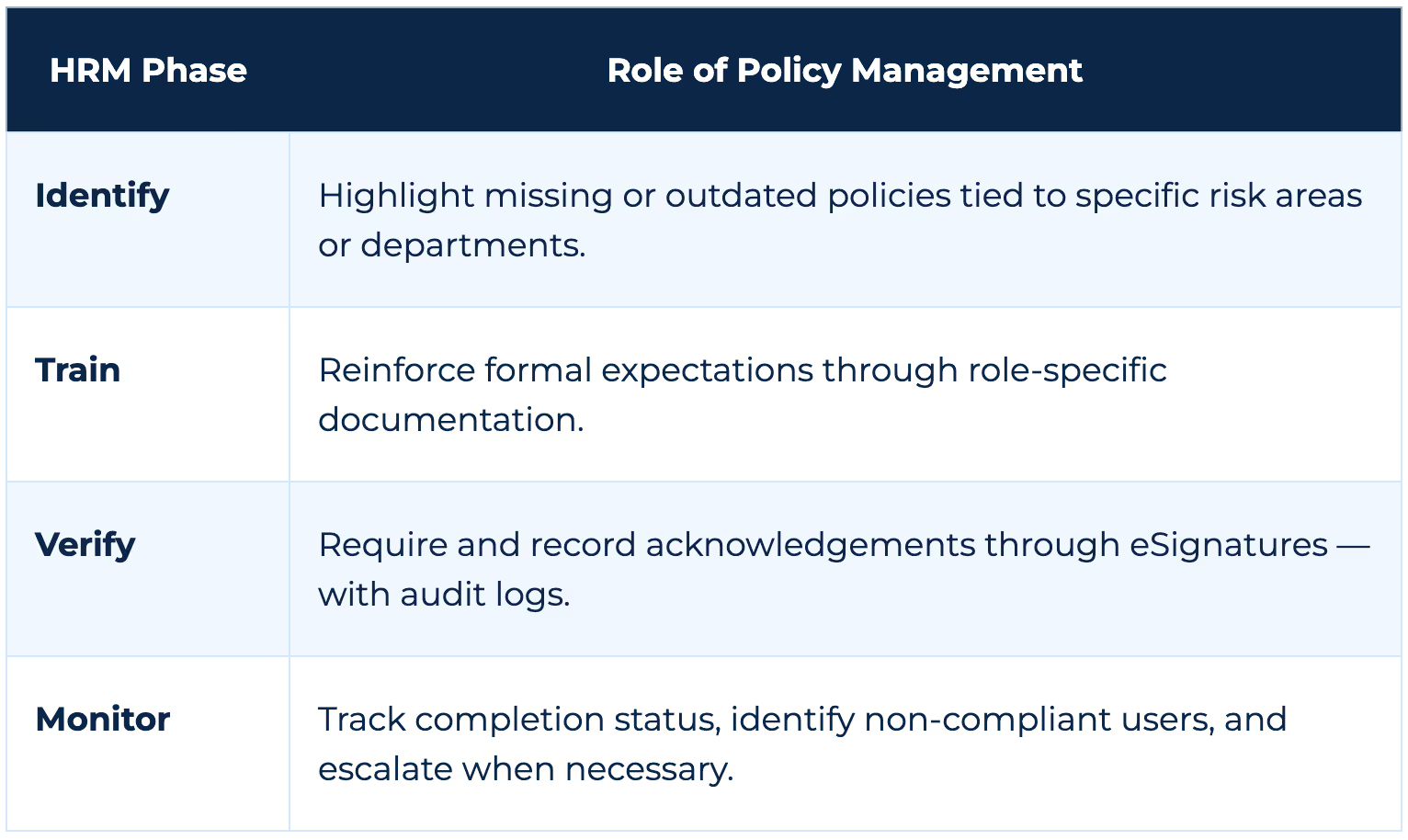
Example: Your finance team completes anti-phishing training. In the same workflow, they’re assigned an updated supplier verification policy. Acknowledgement is required, tracked, and logged. Any gaps are flagged automatically. Compliance evidence is generated instantly.
This is what proactive policy management looks like.
Rebuilding Trust in Policy Management
Here’s the uncomfortable truth: many employees don’t trust policies. They see them as red tape, legalese, or documents that get signed and forgotten. That’s dangerous — because trust is what turns a policy from words on a page into behavioural change.
Rebuilding that trust means:
- Clarity over complexity — plain language, not legal jargon.
- Consistency over chaos — one version, one process, no confusion.
- Accountability over assumption — acknowledgements backed by proof.
When employees know policies are relevant, clear, and consistently enforced, they’re more likely to follow them. And when leaders can prove acknowledgements with audit-ready reporting, regulators and customers trust them too.
Policy management isn’t just about compliance — it’s about credibility.
Modernizing Policy Management: The Operational Imperative
The shift from paper trails to platform-led compliance is not about convenience — it’s about survival.
A modern policy management platform must:
- Centralize policies with version control.
- Automate distribution and acknowledgements.
- Deliver audit-ready insights in real time.
- Scale across departments, sites, and contractors.
That’s the baseline. Anything less leaves you exposed.
What’s New: A Policy UI Built for Engagement
The updated Policy UI has been designed with one goal: reduce compliance fatigue and make it easy for employees to do the right thing.
Key enhancements include:
- Responsive design: Optimized for mobile, tablet, and desktop.
- Guided signing flows: Reduce drop-off during acknowledgement.
- Minimal, distraction-free PDF viewer: Keep focus on the policy itself.
- Instant visibility: Managers see who’s compliant — and who isn’t.
Policies that are easier to read and acknowledge are policies that actually work.
Preparing for Scrutiny — and Operating with Confidence
It’s not enough to “have” policies. You need to prove they were:
- Communicated
- Acknowledged
- Understood
Not in theory, but in practice — with audit trails and evidence that will stand up to a regulator, a customer, or even a courtroom.
When policy management is embedded within HRM:
- Compliance becomes continuous, not episodic.
- Investigations are faster, with evidence at hand.
- Employees are more accountable because expectations are clear.
- Security postures improve because people change their behaviour.
FAQs
Why do policy audits often fail?
Because acknowledgements are missing, outdated, or not tied to the correct version of a policy. Auditors need evidence, not assumptions.
How does HRM improve compliance?
HRM connects training, policy acknowledgement, and reporting into one cycle. This makes compliance measurable, defensible, and easier to maintain.
What’s the risk of weak policy management?
At best, wasted effort. At worst, a failed audit, regulatory fines, or a breach caused by unclear expectations.
A Final Word
Before you send that next company-wide policy update, ask yourself:
- Will this be read?
- Will it be acknowledged?
- Can we prove it, if asked?
If the answer isn’t yes to all three, the risk is real.
Modern policy management isn’t just documentation. It’s a commitment — to your people, to your regulators, and to the integrity of your business.
Ready to see how modern policy management works in practice?
👉 Rebuild trust in policies — and transform how you manage human risk. Book your demo today.
BOOK A DEMO
See Human Risk Intelligence in action
A 30-minute walkthrough of how to cut human risk across your users, tailored to MSPs and IT teams.
Subscribe to newsletter

Discover how professional services firms reduce human risk with usecure
See how IT teams in professional services use usecure to protect sensitive client data, maintain compliance, and safeguard reputation — without disrupting billable work.
Related posts
Explore more insights, updates, and resources from usecure.
What is a clean desk policy - and should my company have it?