Is Your MSP a HIPAA Business Associate? What MSPs and Healthcare Buyers Need to Know in 2027


Subscribe to newsletter
KEY TAKEAWAYS
- Business associate status: An IT provider is a business associate whenever it creates, receives, maintains, or transmits PHI on behalf of a covered entity or another business associate, regardless of whether it views patient records.
- Encryption: HHS guidance confirms that maintaining encrypted ePHI without the decryption key does not remove business associate status.
- Contractual requirements: A business associate agreement is mandatory and must flow down to every subcontractor in the chain.
- Training: Security awareness training for business associates is a Security Rule requirement, not a discretionary practice.
- Breach notification: A business associate must notify the covered entity without unreasonable delay and no later than 60 calendar days after discovery.
- Human risk: Privileged credentials, remote access tools, and help desk processes are the most common points of failure in business associate incidents.
Most managed service providers (MSPs) that support healthcare clients are HIPAA business associates, whether or not they view a patient record. This guide explains how HHS defines business associate status, why the conduit exception rarely applies to IT services, and what a business associate agreement must include. It examines enforcement actions, including the 2026 MMG Fusion and XTIUM settlements, and outlines breach notification deadlines and penalties. It shows why human risk, from privileged technicians to help desk staff, determines whether MSPs can demonstrate compliance, and how a Human Risk Intelligence approach turns training records into measurable evidence for clients and auditors.
What is a HIPAA business associate?
A HIPAA business associate is a person or organization that creates, receives, maintains, or transmits PHI in the course of performing a function or service for a covered entity or for another business associate. The definition is codified at 45 CFR 160.103 and was expanded by the HITECH Act and the 2013 Omnibus Rule, which also made business associates directly liable for their own HIPAA violations.
The test is functional rather than commercial. Whether a vendor positions itself as a healthcare company, the size of the contract, and whether its personnel ever review a patient record are not determinative. The deciding factor is whether the service requires access to PHI or to the systems that hold it.
Common examples of business associates
- Managed IT, cybersecurity, and help desk providers with access to clinical or billing systems
- Cloud hosting, backup, and disaster recovery providers that store ePHI
- Billing, coding, and revenue cycle management companies
- Electronic health record (EHR), practice management, and patient communication software vendors
- Accountants, attorneys, and consultants who receive PHI in the course of their work
- Shredding, records storage, and e-waste disposal companies
Who is not a business associate
A covered entity's own workforce members are not business associates. Nor are organizations with only incidental access to PHI, such as janitorial services, or providers of transmission-only services that qualify for the narrow "conduit" exception, such as the US Postal Service or an internet service provider that solely carries traffic. As the following sections explain, few managed IT services meet these exceptions.
Business associates are directly liable
Since 2013, OCR has had authority to investigate and penalize business associates directly. Business associates must comply fully with the HIPAA Security Rule, observe the Privacy Rule's use and disclosure limitations that apply to them, and meet Breach Notification Rule obligations. OCR's August 2025 settlement with accounting firm BST & Co. CPAs illustrates the breadth of the definition: a firm that received financial records containing a client's PHI paid $175,000 following a ransomware attack and agreed to two years of OCR monitoring.
Covered entity vs business associate
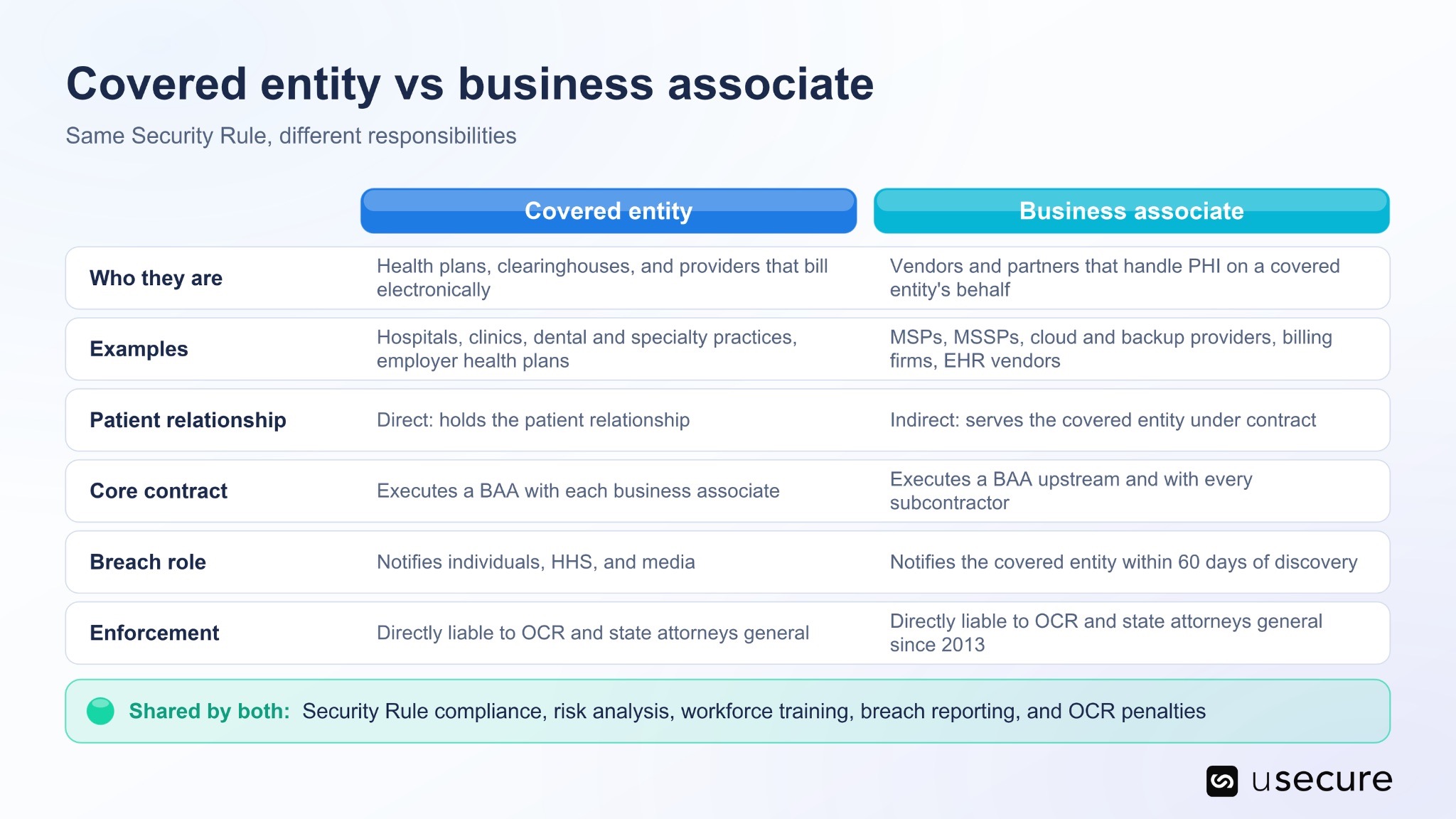
The distinction rests on which party holds the patient relationship and which party performs services on its behalf. Covered entities are health plans, healthcare clearinghouses, and healthcare providers that conduct standard electronic transactions. Business associates are the vendors and partners that handle PHI to support those covered entities' operations.
Both are subject to the Security Rule, both carry breach reporting obligations, and both are exposed to civil monetary penalties. Their obligations differ in direction: the covered entity is accountable to patients and regulators, while the business associate is accountable to the covered entity under contract and to OCR under federal law.
How responsibility is shared
The covered entity retains responsibility for patient-facing obligations, including the Notice of Privacy Practices, patient access requests, and, unless delegated, notification of individuals following a breach. The business associate is responsible for safeguarding the PHI it handles, limiting its use to the purposes the contract permits, reporting incidents to the covered entity, and extending equivalent protections to its own subcontractors.
Direct buyers should note that outsourcing IT functions does not transfer accountability. In the October 2026 settlement between the New York and Connecticut attorneys general, Boston Children's Health Physicians, and its IT provider XTIUM, regulators found that the health network had no vendor assessment program and had not defined which security services the IT provider was responsible for. Both organizations were party to the $2.7 million settlement.
Are MSPs and IT providers business associates?
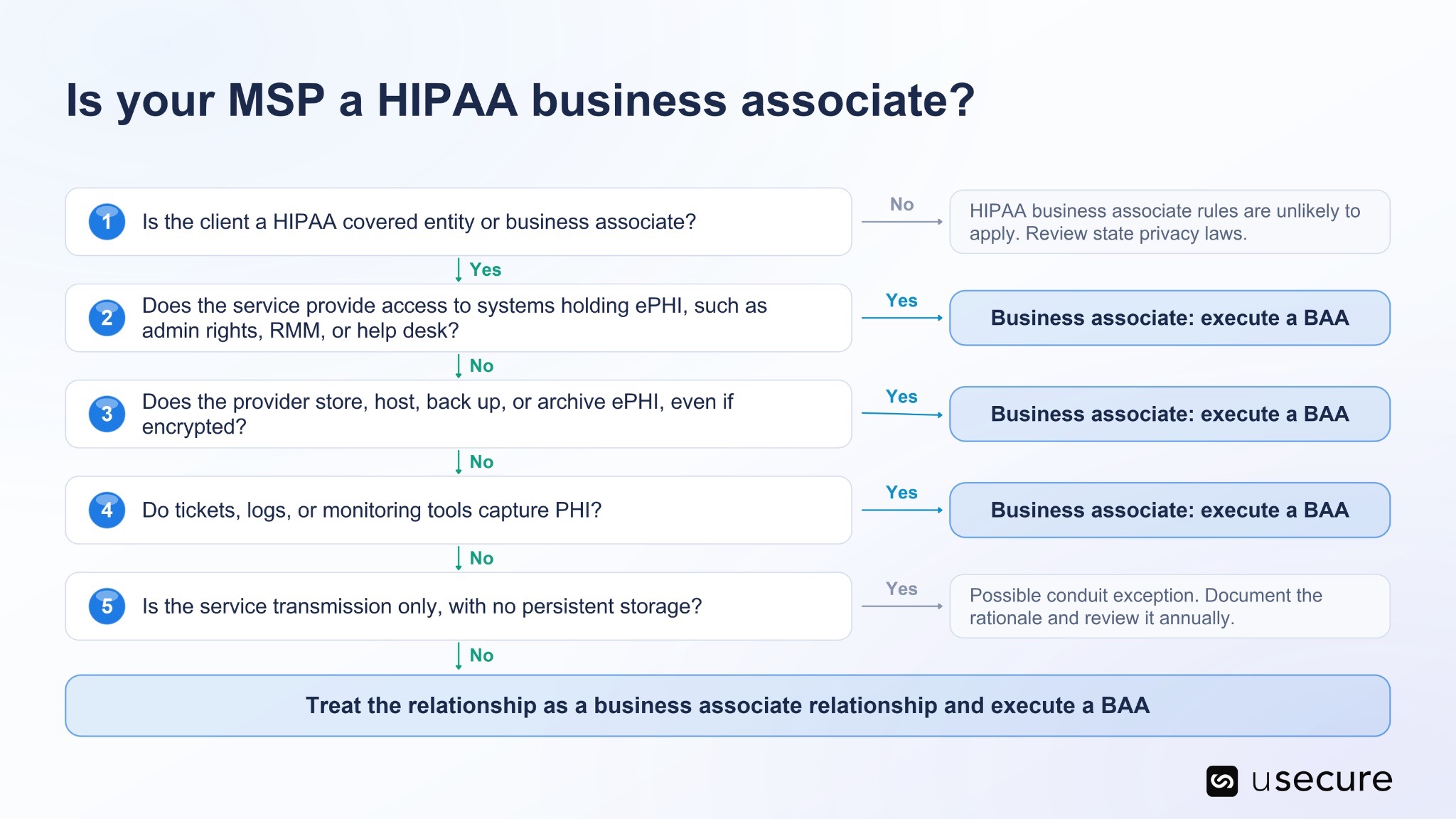
For the substantial majority of managed service relationships with healthcare clients, yes. An MSP that administers servers, manages Microsoft 365 or Google Workspace tenants, operates backups, monitors endpoints, or resets credentials for users who work with ePHI has persistent access to PHI or to the systems that hold it. That access, rather than intent, establishes business associate status.
Why the conduit exception rarely applies
IT providers frequently characterize their role as infrastructure only. HHS guidance does not support that position. It states that the conduit exception is limited to transmission-only services, with no more than temporary storage incidental to that transmission. A provider that stores or maintains ePHI has persistent access and is therefore a business associate, even if it never views the data.
Encryption does not change the answer
HHS has also addressed the argument that data which cannot be viewed falls outside HIPAA. A provider that maintains encrypted ePHI without holding the decryption key remains a business associate. Encryption reduces breach risk and may affect notification obligations, but it does not remove the requirement for a business associate agreement.
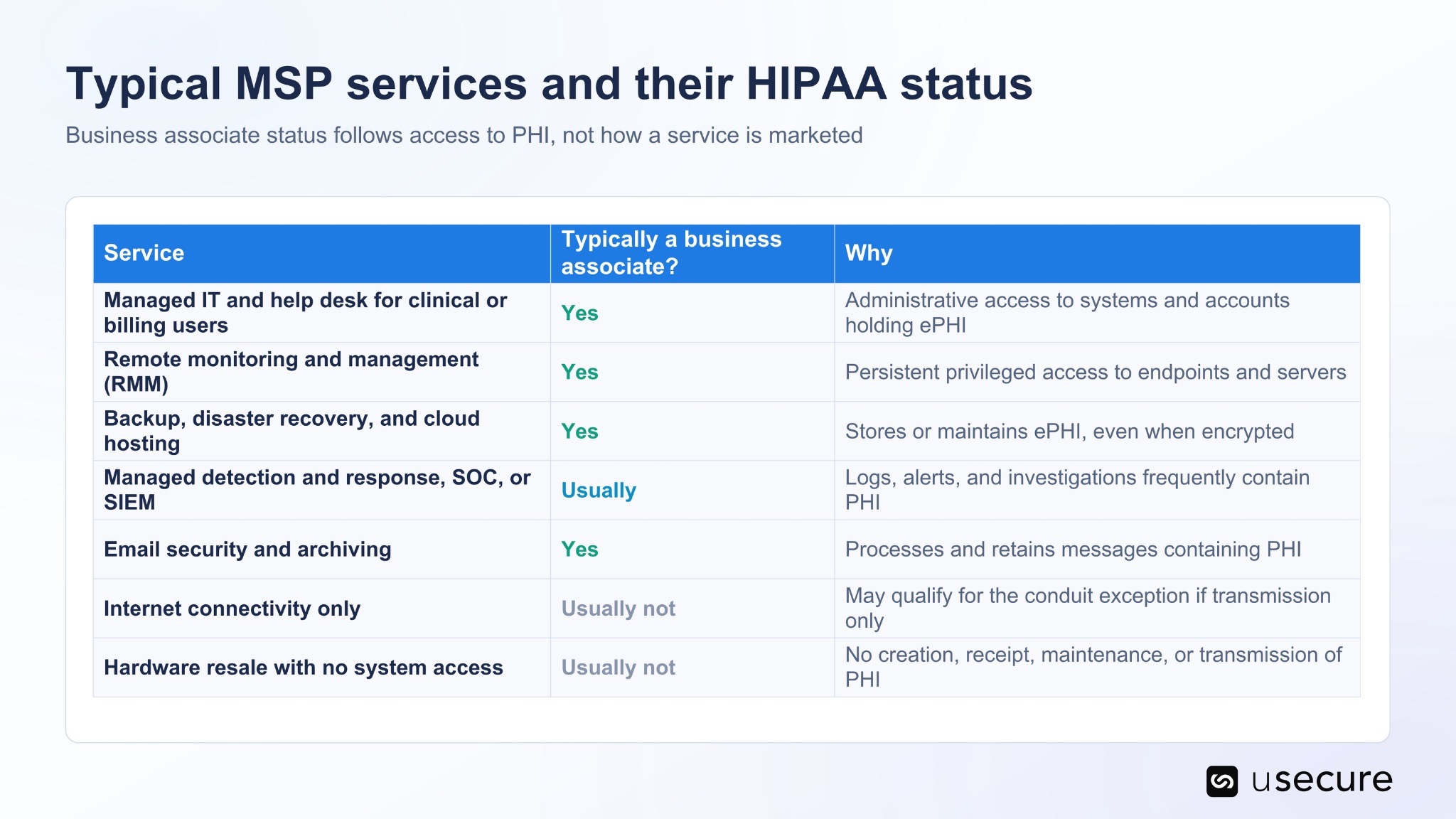
Typical MSP services and their HIPAA status
Business associate status attaches to the service delivered, not to the provider’s label or contract size. Most core managed services, including help desk support, remote monitoring, backup, and email security, involve persistent access to ePHI or the systems that hold it, and therefore require a business associate agreement. Only a narrow set of services, such as transmission-only connectivity or hardware resale without system access, typically fall outside HIPAA’s scope. The table below summarizes how common MSP services are usually classified, although each relationship should be assessed against the specific access the provider holds.
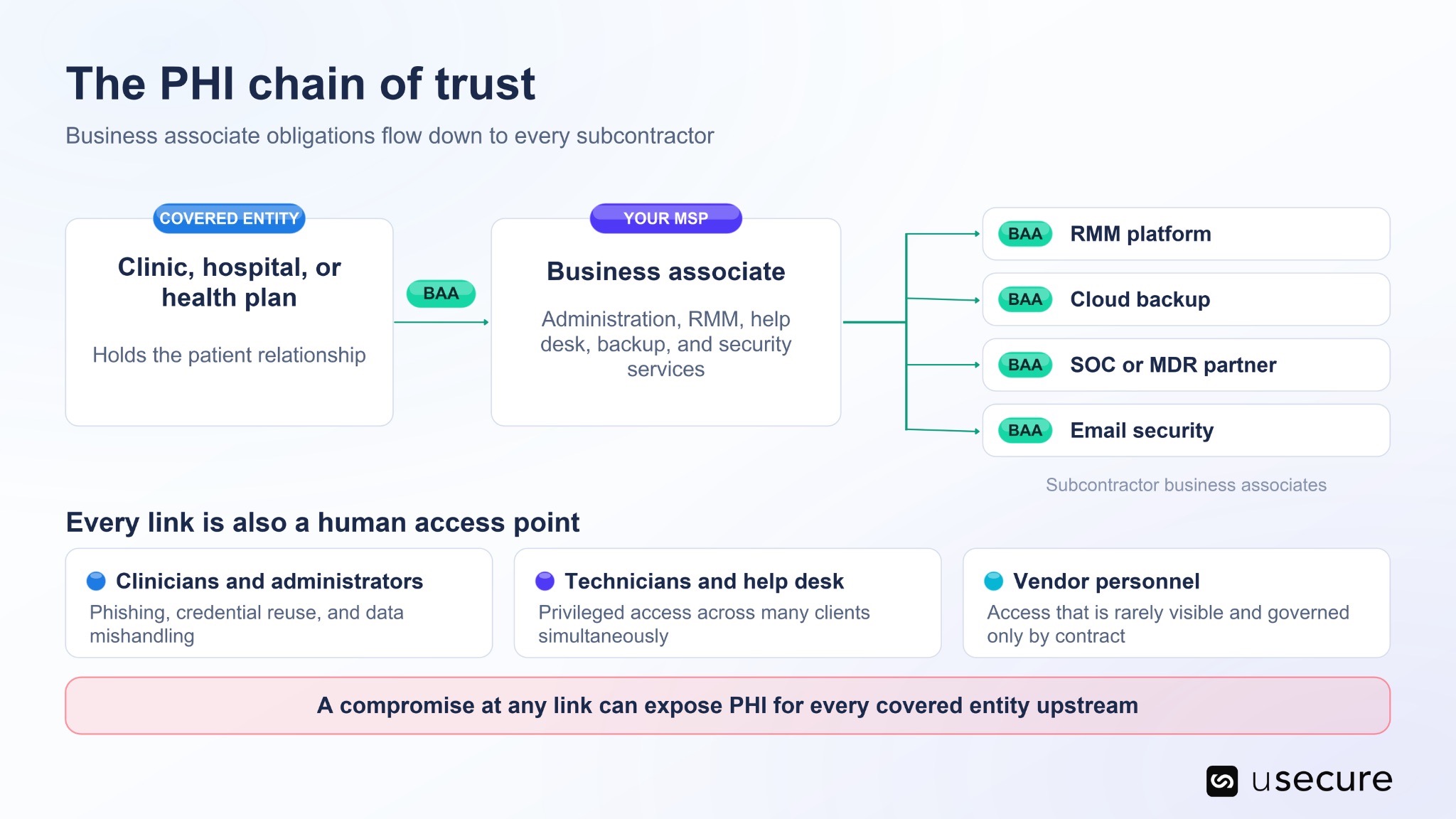
The subcontractor chain
When an MSP relies on its own vendors to serve a healthcare client, such as an RMM platform, a cloud backup provider, or an outsourced security operations center, those vendors become subcontractor business associates. The MSP must execute a business associate agreement with each of them, and each subcontractor must do the same with any vendor on which it relies. The same obligations apply at every link in the chain.
Why attackers target this chain
The chain of trust is also a chain of access, and threat actors have adapted accordingly. In 2025, the DragonForce ransomware group compromised an MSP and used its SimpleHelp RMM platform to deploy ransomware to the MSP's clients. In the XTIUM case, attackers who breached the IT provider in August 2024 reached 18 client networks and took records relating to approximately 888,000 individuals from one of them. Investigators cited insufficient logging and monitoring of a remote support tool account.
Software vendors face comparable exposure. In March 2026, OCR reached a settlement with MMG Fusion, a software company whose platform communicates directly with patients of its covered entity clients, after PHI relating to approximately 15 million individuals appeared on the dark web following an unreported security incident.
What a business associate agreement should include
A business associate agreement (BAA) is the contract HIPAA requires before a business associate may handle PHI. In its absence, the covered entity is noncompliant from the moment PHI is disclosed, and the business associate remains directly liable under the law. The required terms are set out in 45 CFR 164.504(e) and 164.314(a), and HHS publishes sample provisions as a reference point.
Terms HIPAA requires
- The permitted and required uses and disclosures of PHI by the business associate
- A commitment not to use or disclose PHI beyond what the contract or the law permits
- Appropriate administrative, physical, and technical safeguards, including full compliance with the Security Rule for ePHI
- Reporting of any unauthorized use or disclosure, security incidents, and breaches of unsecured PHI
- Flow-down of the same restrictions to every subcontractor through its own agreement
- Support for individual rights: access, amendment, and an accounting of disclosures
- Compliance with Privacy Rule duties the business associate performs on the covered entity's behalf
- Availability of internal practices, books, and records to HHS for compliance reviews
- Return or destruction of PHI at the end of the relationship, where feasible
- The covered entity's right to terminate if the business associate violates a material term
Terms MSP relationships should add
The regulatory minimum predates the widespread adoption of RMM platforms, shared cloud tenants, and AI assistants. Well-constructed agreements between healthcare organizations and their IT providers therefore extend further:
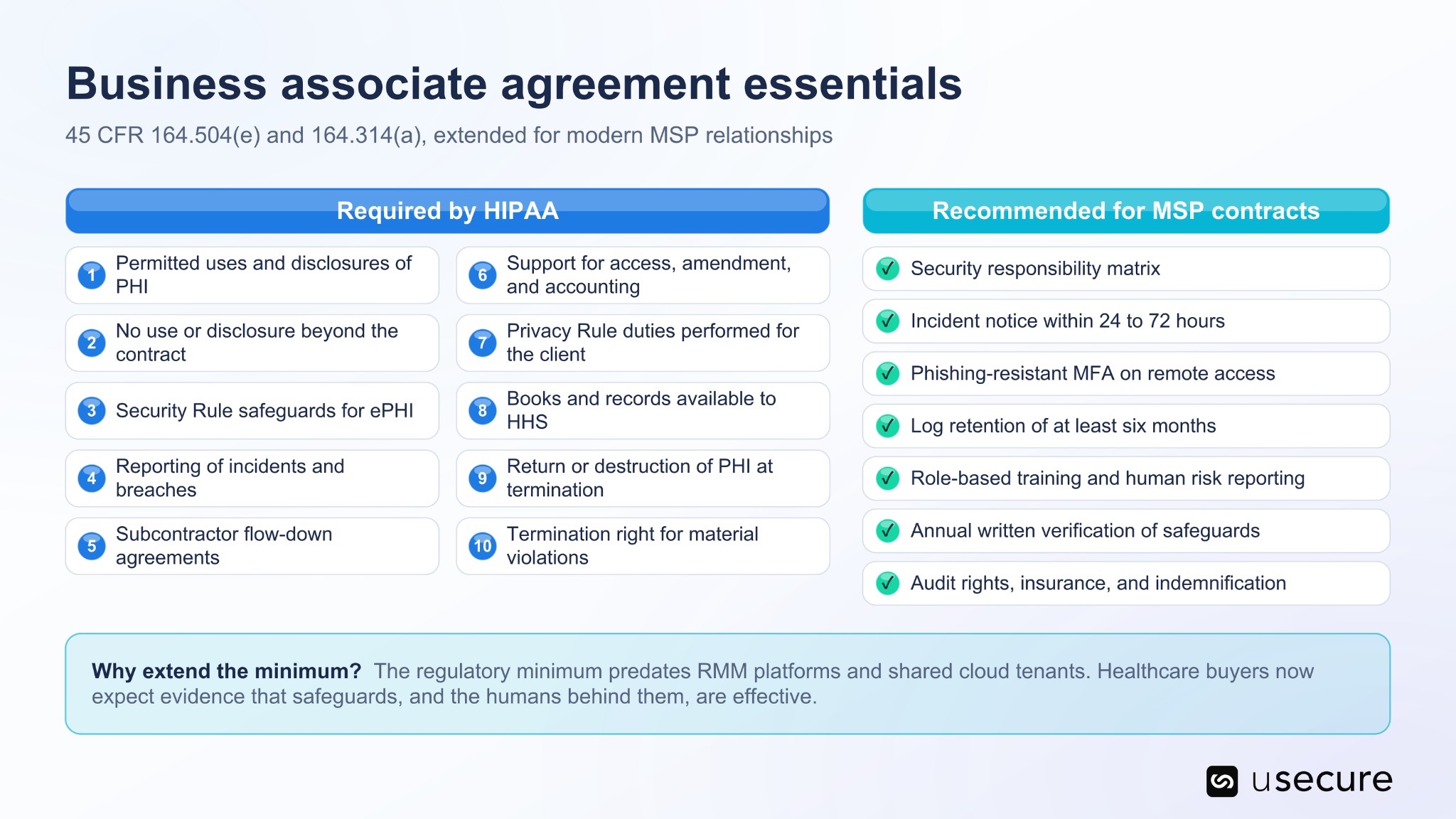
- A security responsibility matrix specifying which controls the MSP owns, which the client owns, and which are shared. The absence of this clarity was a material factor in the XTIUM case.
- Incident notification measured in hours. The legal maximum is 60 days; a contractual window of 24 to 72 hours for suspected incidents gives the covered entity time to respond. HHS has also proposed a 24-hour notice requirement for contingency plan activation.
- Remote access standards, including phishing-resistant multifactor authentication on every RMM, remote desktop, and administrative account.
- Log retention and monitoring. Joint CISA, NSA, and FBI guidance on MSP risk (AA22-131A) recommends retaining important logs for a minimum of six months.
- Workforce training and human risk reporting, supported by evidence that personnel with access to ePHI are trained, tested through phishing simulation, and bound by acknowledged policies.
- Annual written verification of safeguards, which the proposed Security Rule update would make mandatory.
- Audit rights, cyber insurance requirements, and indemnification proportionate to the volume of PHI involved.
A note on the proposed Security Rule update
OCR's proposed revision of the Security Rule would require business associates to provide annual written verification of technical safeguards and to notify covered entities within 24 hours of activating a contingency plan. The final rule has not been published, and federal regulators have deferred final action to July 2027. Healthcare buyers are nonetheless incorporating these expectations into contracts, and providers that adopt them in advance will be better positioned in procurement and vendor risk reviews.
What training business associates need
HIPAA training for business associates is a legal requirement, not a discretionary practice. The Security Rule's security awareness and training standard, 45 CFR 164.308(a)(5), applies to business associates exactly as it applies to covered entities. It requires a program for all workforce members, including management, that addresses security reminders, protection from malicious software, login monitoring, and password management.
HIPAA does not set a fixed frequency, but OCR's enforcement record provides clear direction. The corrective action plans in the BST & Co. CPAs and Top of the World Ranch settlements both require annual HIPAA training for workforce members with access to PHI, and OCR recommends training that is specific to the organization and to each person's job duties.
The limitations of annual compliance training
Current threat data indicates a persistent gap between training completion and secure behavior. The 2026 Verizon DBIR reports that the human element was present in 62% of breaches, a proportion that has remained largely unchanged across several years of awareness investment. IBM's 2026 Cost of a Data Breach study identified phishing, including voice and SMS phishing, as the most common initial access vector, accounting for 17% of breaches.
Within an MSP, the human attack surface is concentrated and highly privileged. A single technician with RMM access, a help desk analyst who resets multifactor authentication by telephone, or an engineer who reuses a password can create a pathway into every healthcare client simultaneously.
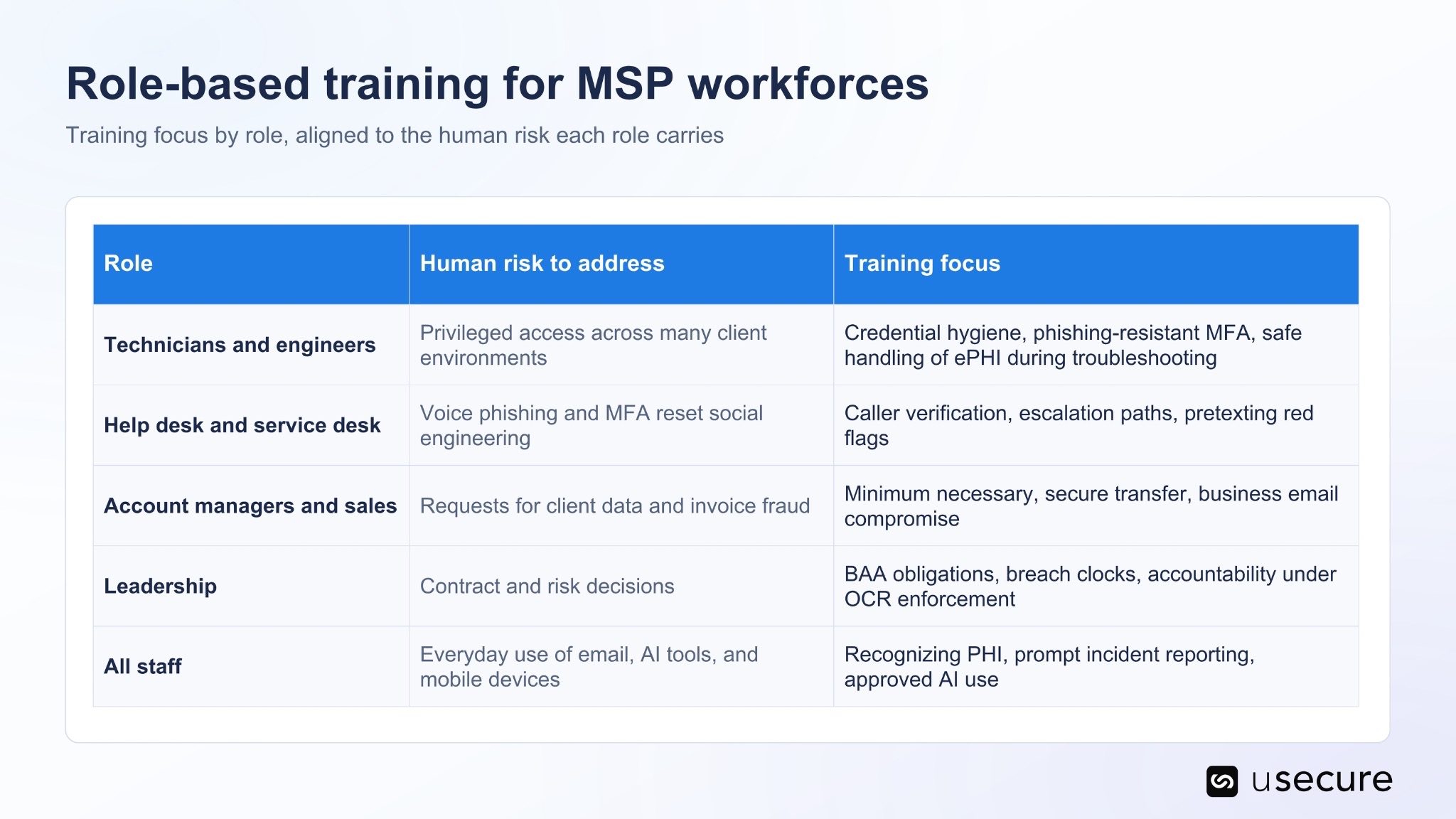
Role-based training for MSP workforces
Human risk within an MSP is not uniform. Technicians, help desk analysts, account managers, and leadership each hold different levels of access and face different attack techniques, so a single generic course leaves the highest-risk roles undertrained. Effective HIPAA training for business associates aligns content to each role’s exposure and prioritizes personnel with privileged access to client environments. The table below summarizes the human risk each role carries and the training focus that addresses it.
From training records to Human Risk Intelligence
Covered entities increasingly require business associates to demonstrate that training produces measurable behavioral change, an expectation the proposed annual verification requirement would reinforce. A Human Risk Intelligence approach answers it by managing the workforce as a measurable risk surface rather than a collection of completion records:
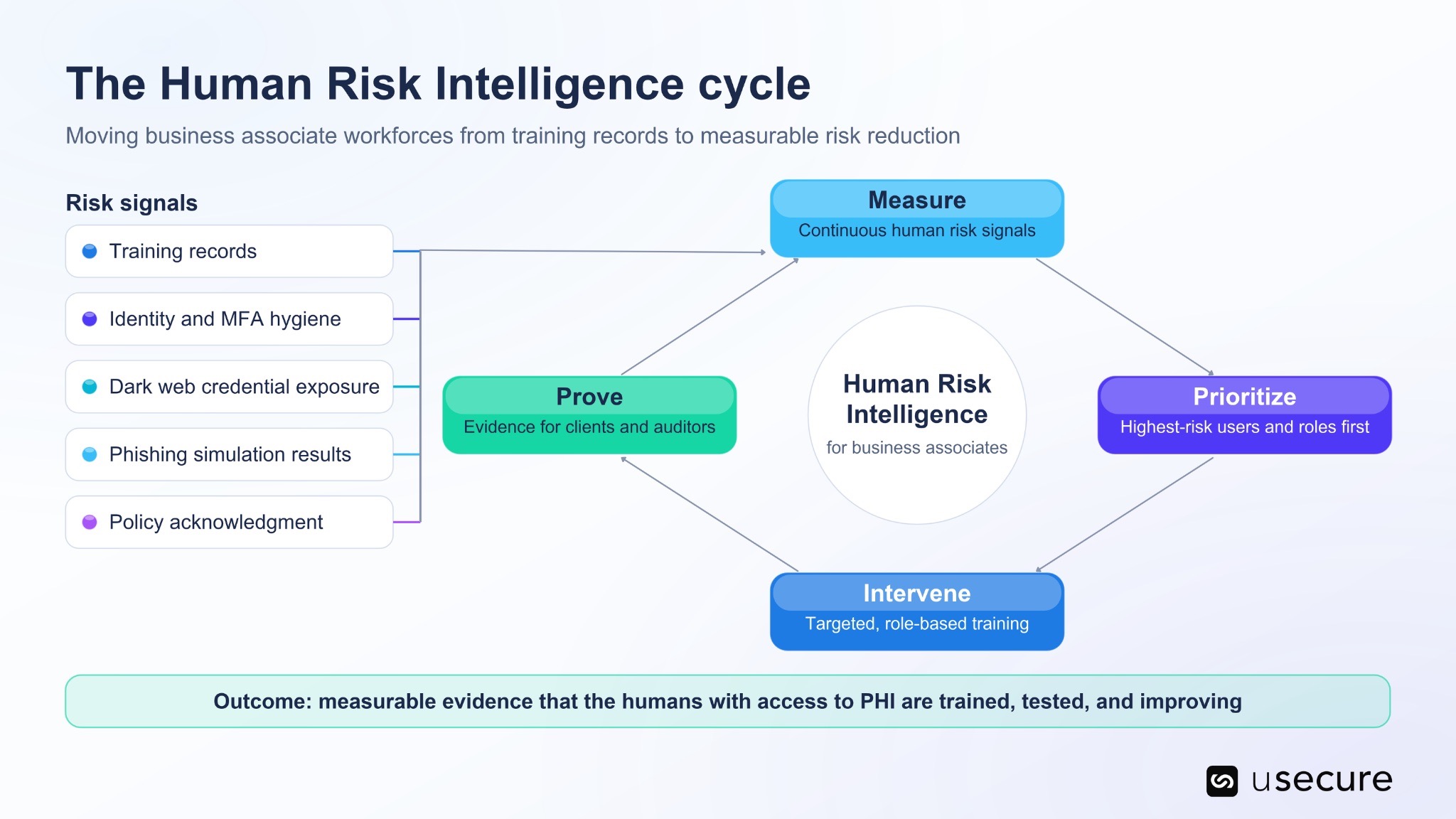
- Measure human risk continuously by bringing together signals that usually sit in separate tools: training records, identity and MFA hygiene, dark web credential exposure, phishing simulation results, and policy acknowledgment.
- Prioritize the individuals and roles with the highest combined risk, starting with privileged technicians and the help desk.
- Intervene with targeted, role-based training and policy refreshers instead of one generic annual course.
- Prove improvement with trend reporting that can be shared with healthcare clients and auditors as evidence of safeguards.
Identifying toxic combinations rather than isolated failures
Human risk is contextual. A technician who fails a single phishing simulation but uses phishing-resistant MFA and has no exposed credentials represents a manageable risk. The same technician with RMM administrator rights, MFA disabled on a legacy account, a password exposed in a third-party breach, and an account that has been dormant for months represents a toxic combination: multiple weaknesses reinforcing one another to create a direct path into every client environment.
The XTIUM case illustrates this form of exposure. A remote support tool account was misused, and insufficient logging prevented investigators from establishing how the attackers gained entry. A sustained reduction in toxic combinations across privileged accounts is among the most meaningful metrics a business associate can report to its healthcare clients.
What happens if a business associate has a breach
A breach at a business associate triggers three overlapping sets of consequences: regulatory notification on a fixed timeline, enforcement exposure for both parties, and commercial fallout under the BAA. The financial impact is significant. Healthcare has recorded the highest average breach cost of any industry for 13 consecutive years, at $6.64 million per incident in IBM's 2026 study.
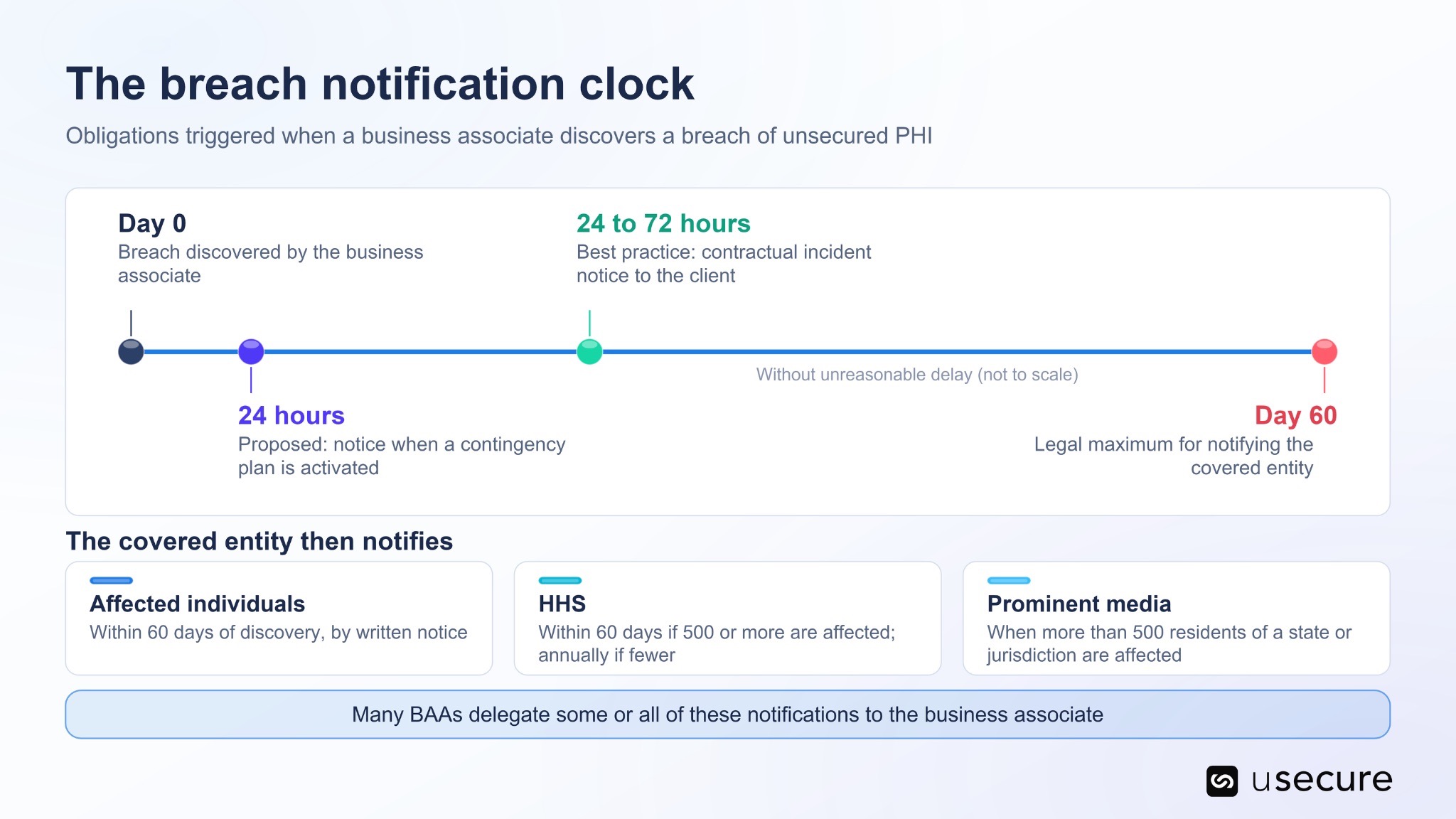
The notification clock
Under the Breach Notification Rule, a business associate must notify each affected covered entity without unreasonable delay and no later than 60 calendar days after discovering a breach of unsecured PHI. OCR restated this in its March 2026 MMG Fusion announcement. The notice should identify each affected individual and provide the information the covered entity needs to notify them.
The covered entity then notifies affected individuals within 60 days of discovery, notifies HHS (within 60 days for breaches affecting 500 or more people, or annually for smaller breaches), and notifies prominent media when more than 500 residents of a state or jurisdiction are affected. Many BAAs delegate some of these tasks to the business associate. A breach is treated as discovered on the first day it is known, or reasonably should have been known, to any workforce member other than the person who committed it.
Two considerations are particularly relevant for MSPs. First, 60 days is a maximum rather than a target, and OCR treats unexplained delay as a violation in its own right. Second, unreported incidents create independent liability: the MMG Fusion settlement followed a complaint concerning a security incident the company had not reported, after which PHI relating to approximately 15 million individuals was exposed on the dark web.
Enforcement exposure
OCR can pursue the business associate directly, the covered entity for failing to manage the relationship, or both. Civil monetary penalties are tiered by culpability and currently range from $145 to $2,190,294 per violation, with an annual cap of $2,190,294 for violations of an identical provision. HHS has confirmed that the 2025 penalty levels remain in effect for 2026.
Most OCR cases end in settlements with multiyear corrective action plans, and they typically cite the same deficiency: the absence of an accurate and thorough risk analysis. OCR's risk analysis initiative had produced 14 enforcement actions by June 2026, alongside its 20th ransomware enforcement action.
State attorneys general represent an additional enforcement channel. The October 2026 XTIUM settlement was brought by the New York and Connecticut attorneys general, and it bound the IT provider to stronger security measures alongside its healthcare client.
Commercial and reputational fallout
For an MSP, the commercial consequences frequently exceed the regulatory penalties. A breach can trigger BAA termination rights, indemnification claims, closer cyber insurance scrutiny, and the loss of healthcare clients across the portfolio. The underlying issue is scale: a single compromised provider can expose dozens of covered entities simultaneously. The 2024 Change Healthcare attack, which affected an estimated 192.7 million individuals, remains the clearest illustration of how one business associate incident can cascade across the healthcare system.
A Human Risk Intelligence action plan
Business associate compliance ultimately depends on one capability: demonstrating, with evidence, that the human users with access to PHI are managed as rigorously as the systems themselves. The following steps translate the requirements outlined above into actions for both parties to the relationship.
For MSPs and IT providers
- Map PHI exposure. Document every healthcare client, the systems the MSP accesses, the tools used to access them, and the subcontractors behind those tools.
- Close documentation gaps. Confirm an executed BAA with every healthcare client and a downstream BAA with every subcontractor that can reach ePHI.
- Complete an accurate and thorough risk analysis of the MSP's own environment. It is the first document OCR requests following an incident.
- Secure privileged access. Enforce phishing-resistant MFA on RMM, remote desktop, and administrative accounts, vault credentials by client, and log every session.
- Measure human risk continuously. Consolidate training records, identity hygiene, dark web credential exposure, phishing simulation results, and policy acknowledgment into a single view of the highest-risk users.
- Deliver role-based training. Prioritize technicians and help desk personnel, including structured exercises on MFA resets and caller verification.
- Test the breach notification process. Conduct a tabletop exercise to confirm that every affected client could be notified well within 60 days, and preferably within 24 hours.
- Prepare the evidence. Produce an annual safeguards summary for clients in advance of the proposed verification requirement.
For healthcare organizations buying IT services directly
- Inventory every vendor with access to ePHI or the systems that hold it, including subcontractors engaged by the MSP.
- Require an executed BAA before access is granted, including a security responsibility matrix and a defined incident notification window.
- Assess vendors throughout the contract term, not only at signing, and request evidence of risk analysis, MFA coverage, logging, and workforce training.
- Request human risk metrics. Phishing resilience, credential exposure, and role-based training completion provide a more reliable indication of a provider's posture than policy documentation alone.
- Extend Human Risk Intelligence to the internal workforce. Clinicians and administrators remain primary targets, irrespective of the controls an MSP maintains.
Assurance must now be demonstrated
For MSPs and IT providers, the central question is rarely whether they qualify as HIPAA business associates. It is whether they can demonstrate that they operate as one. Healthcare clients, regulators, and insurers increasingly expect evidence that every individual with privileged access is trained, tested, and monitored, and that incidents are escalated within hours rather than weeks. Providers that combine a robust business associate agreement with continuous Human Risk Intelligence will be best positioned to earn the trust of healthcare organizations and the patients they serve.
Frequently asked questions
- Is an IT provider a business associate under HIPAA? Yes, where the IT provider creates, receives, maintains, or transmits PHI on behalf of a covered entity or another business associate. Administrative access to systems holding ePHI, hosting or backup of ePHI, and security monitoring that captures PHI all meet the definition. Only transmission-only services and providers with no access to PHI fall outside it.
- What does HIPAA compliance require of MSPs? HIPAA for MSPs requires treating every healthcare client's data as regulated information. In practice, this means executing a BAA, complying with the Security Rule, training personnel, extending obligations to subcontractors, and reporting breaches within the required timeframe.
- Can a covered entity be penalized for its business associate's breach? Yes. A covered entity must obtain satisfactory assurances through a BAA and oversee the relationship on an ongoing basis. Regulators have taken action against covered entities that lacked adequate vendor oversight, as the 2026 XTIUM settlement demonstrates.
- How often do business associates need HIPAA training? The Security Rule requires an ongoing security awareness and training program without fixing a frequency. OCR corrective action plans consistently require annual training at a minimum, and best practice adds role-based training and continuous phishing simulation.
- How long does a business associate have to report a breach? A business associate must report without unreasonable delay and no later than 60 calendar days after discovery. Many BAAs specify a considerably shorter window, and the proposed Security Rule update would add a 24-hour notice requirement when a contingency plan is activated.
BOOK A DEMO
See Human Risk Intelligence in action
A 30-minute walkthrough of how to cut human risk across your users, tailored to MSPs and IT teams.
Subscribe to newsletter
Related posts
Explore more insights, updates, and resources from usecure.

HIPAA training requirements (2027): Who needs it, how often, and what to cover
What is PHI? A guide to protected health information, HIPAA identifiers, and key exclusions
FTC Safeguards Rule Training Requirements: Building a human-ready written information security plan
See effortless human risk intelligence in action
Book a demo to see how usecure reduces human risk for IT teams and MSPs, or start a free trial to explore the platform yourself.

