CCPA Employee Training Requirements: A complete guide to building a compliant workforce

Subscribe to newsletter
KEY TAKEAWAYS
- CCPA training is a legal requirement, not a best practice. Civil Code §1798.130(a)(6) and 11 CCR §7100 require that everyone who handles consumer privacy inquiries is informed of the law and how to direct consumers to exercise their rights.
- Employees are consumers too. Since January 1, 2023, employees, job applicants, and contractors have held full CCPA rights, which puts HR, recruiting, and payroll on the front line.
- Never verify an opt-out. At least 12 of the first 14 CCPA enforcement actions involved opt-out failures, including verification steps the law does not permit.
- 2026 broke every enforcement record. The three largest CCPA penalties on record were all announced this year, led by General Motors at $12.75 million.
- Compliance is decided at the human layer. 62% of breaches involve the human element, so effective training must be paired with continuous visibility into human risk.
What Is the CCPA?
The California Consumer Privacy Act (CCPA) is California's comprehensive consumer privacy statute. It grants California residents enforceable rights over the personal information that businesses collect about them and requires covered businesses to disclose, limit, and safeguard the use of that information. Enacted in 2018 and effective January 1, 2020, the CCPA was the first law of its kind in the United States and has served as a model for subsequent state privacy legislation.
The CCPA has developed in three phases, each of which has expanded the range of employees who require training:
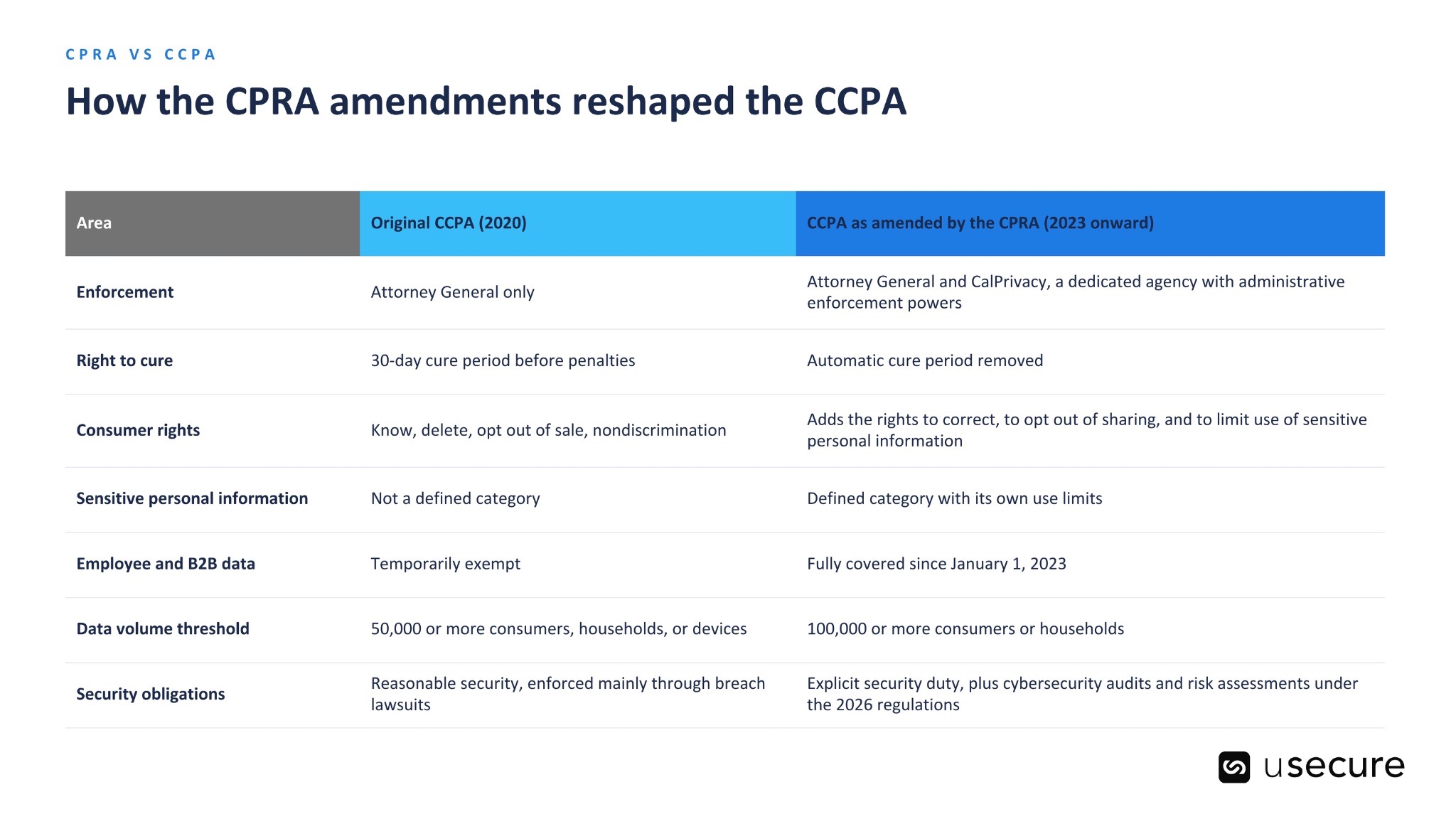
- 2020: the original CCPA. The California Attorney General enforced a core set of rights: the rights to know, to delete, to opt out of the sale of personal information, and to nondiscrimination.
- 2023: the CPRA amendments. The California Privacy Rights Act, approved by voters as Proposition 24, took effect on January 1, 2023. It introduced additional consumer rights, established the California Privacy Protection Agency (which now operates publicly as CalPrivacy), and ended the temporary exemptions for employee, job applicant, and business-to-business data.
- 2026: the updated regulations. New regulations governing cybersecurity audits, risk assessments, and automated decisionmaking technology (ADMT) took effect on January 1, 2026, with compliance deadlines phased in through 2030.
CPRA vs CCPA: Key Differences
The CPRA is not a standalone law. It amended the CCPA, and references to the CCPA now denote the law as amended. The principal differences between the original statute and the current law have direct implications for the design of training programs.
Who Does the CCPA Apply To?
The CCPA applies to any for-profit entity that does business in California, collects the personal information of California residents, and satisfies at least one of the following three thresholds. A business is covered if it:
- Had annual gross revenue above $26,625,000 in the preceding calendar year (the inflation-adjusted figure effective January 1, 2025, up from $25 million);
- Buys, sells, or shares the personal information of 100,000 or more California consumers or households a year; or
- Derives 50% or more of its annual revenue from selling or sharing California consumers' personal information.
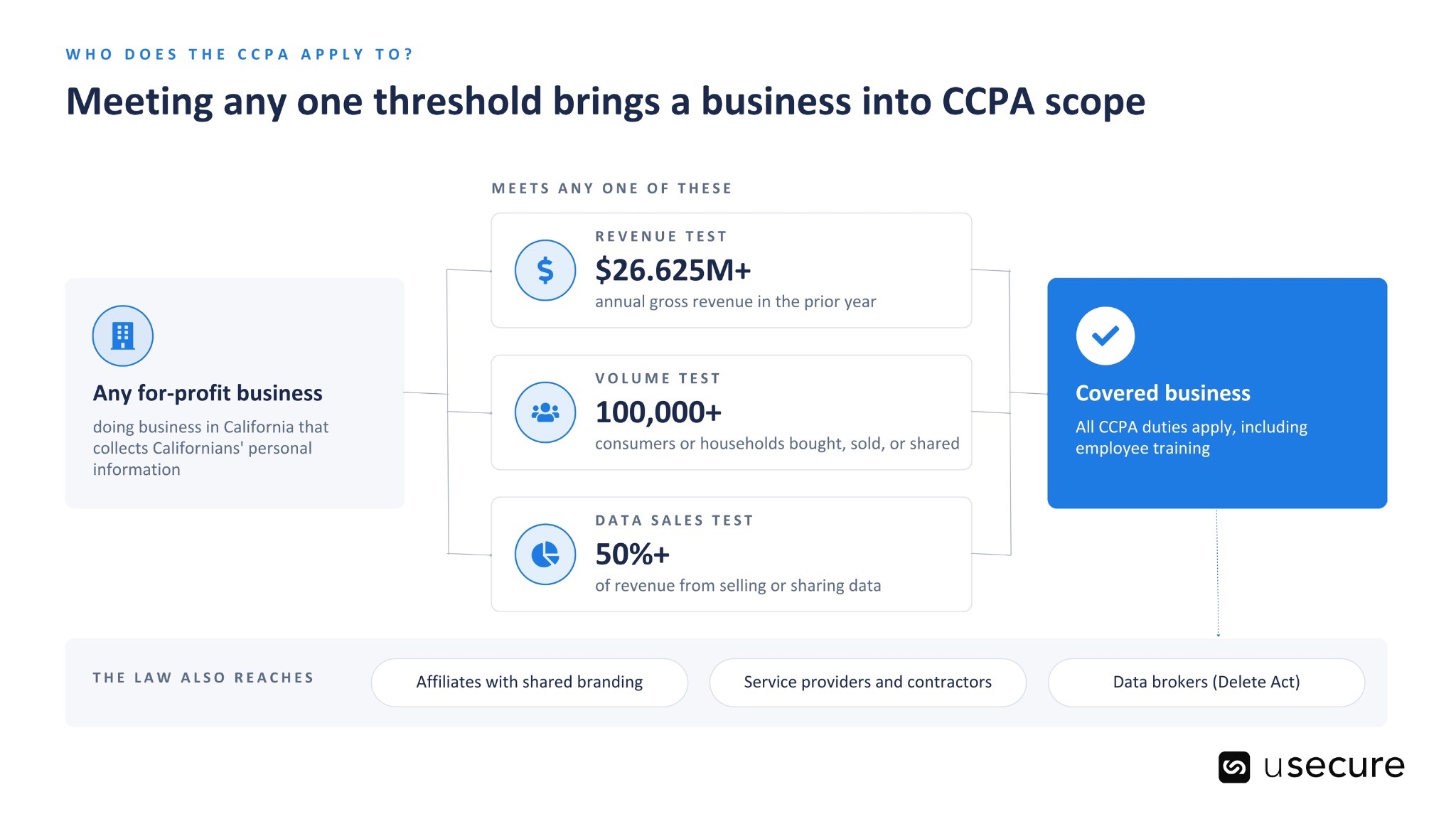
A business needs to meet only one threshold for the full CCPA, including its training duties, to apply.
The location of a company's headquarters does not determine applicability. An organization based in Texas, London, or Sydney falls within scope if it meets a threshold and processes the personal information of California residents. Revenue is assessed across the entire business, not solely its California operations.
The law's reach also extends beyond the covered business itself:
- Affiliates that control, or are controlled by, a covered business and share common branding may be treated as part of the same business.
- Service providers and contractors, including managed service providers that process personal information on behalf of clients, must operate under written contracts that restrict their use of that data. Regulators are scrutinizing these agreements closely; the absence of required contractual protections was one of four violations cited in the Tractor Supply decision.
- Data brokers are subject to additional registration and deletion obligations under California's Delete Act, administered through the Delete Request and Opt-out Platform (DROP).
Certain entities and categories of data fall outside the law. Nonprofit organizations and government agencies are generally exempt, and data already regulated under federal law, such as protected health information under HIPAA and financial information under the Gramm-Leach-Bliley Act, is excluded. These exemptions apply at the data level rather than the organizational level; a hospital or bank may therefore retain CCPA obligations for its marketing, website, and human resources data.
Organizations frequently underestimate one element of the definition: the term "consumer" encompasses any California resident. This includes employees, job applicants, independent contractors, and business contacts at customers and suppliers. A company that sells exclusively to other businesses nonetheless collects personal information about California residents whenever it hires an employee or adds a prospect to its customer relationship management system.
Does the CCPA Require Employee Training?
The CCPA establishes employee training as a legal requirement rather than a recommended practice, and the obligation now arises from three distinct sources.
- The statute. Civil Code §1798.130(a)(6) requires a business to ensure that all individuals responsible for handling consumer inquiries about its privacy practices, or for its compliance with the CCPA, are informed of the law's requirements and of how to direct consumers to exercise their rights.
- The regulations. Section 7100(a) of the CCPA regulations extends this obligation, requiring that such individuals be informed of all requirements in both the CCPA and its implementing regulations. Section 7100(b) adds a documentation requirement: a business that buys, receives, sells, or shares the personal information of 10,000,000 or more consumers in a calendar year must establish, document, and comply with a written training policy.
- The 2026 cybersecurity audit rules. Businesses whose processing presents a "significant risk" to consumers' security must complete annual independent cybersecurity audits. The 18 components that auditors assess include cybersecurity awareness, as well as cybersecurity education and training for every employee, contractor, and other individual with access to the business's information systems, delivered at onboarding, annually, and following a breach. The first audit certifications are due April 1, 2028, for businesses with annual revenue exceeding $100 million; the audit period for that deadline begins on January 1, 2027.
- Regulators are actively enforcing the training obligation. In its August 2026 action against LocateSmarter, CalPrivacy required the company to confirm the completion of updated CCPA training for all personnel who handle consumer requests.
Who Is Required to Take CCPA Training?
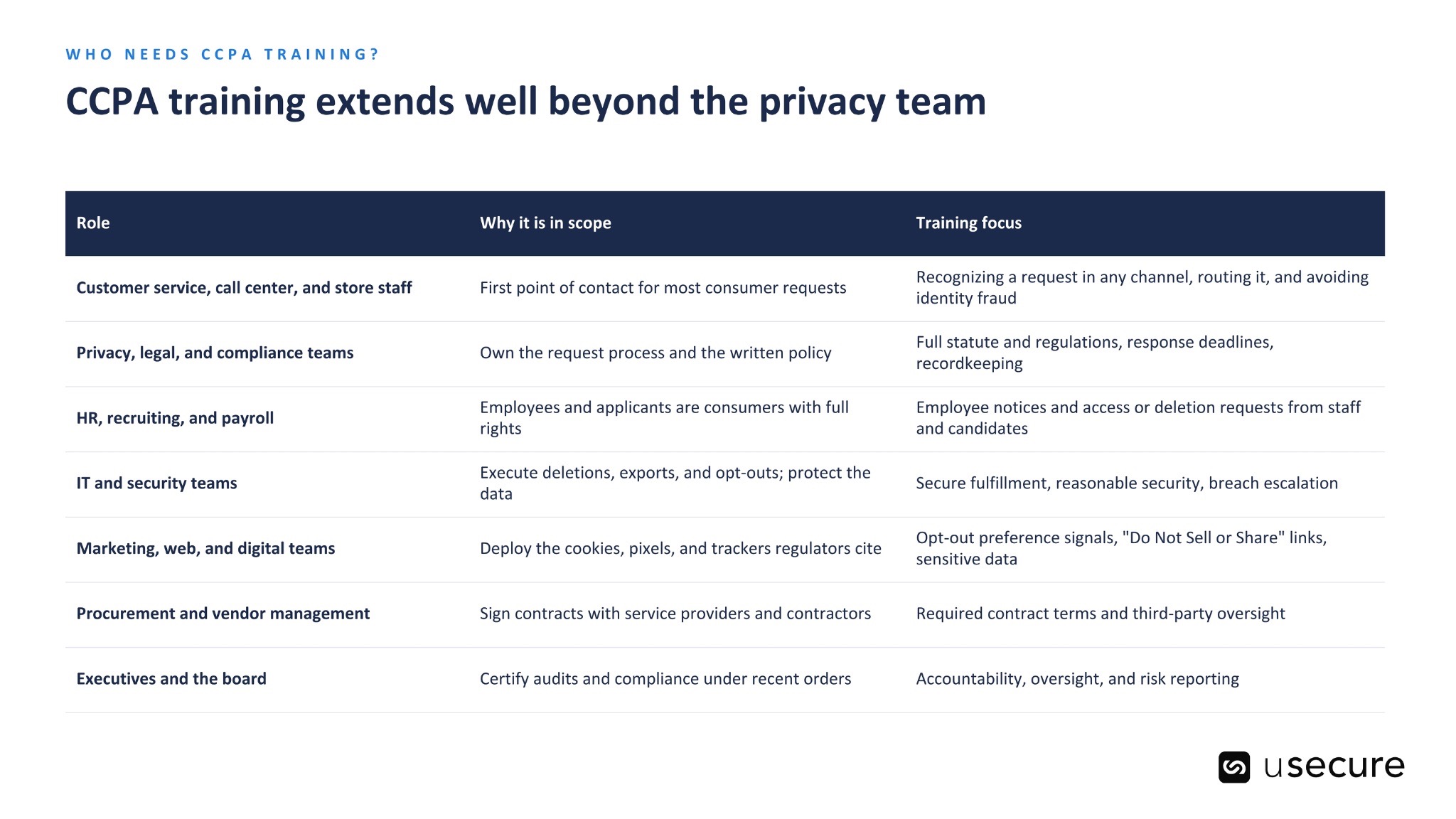
The regulation applies a functional test: any individual who handles consumer inquiries or influences compliance falls within scope, regardless of job title. In most organizations, this population extends well beyond the privacy function.
How Often Is CCPA Training Required?
The CCPA does not prescribe a training frequency. However, the cybersecurity audit standard contemplates training at onboarding, at least annually, and following a breach, and recent enforcement orders require retraining when procedures change. A defensible baseline therefore consists of role-based training upon hire, an annual refresher, and targeted updates whenever the law, the regulations, or internal request procedures change. Organizations should retain records of training completion by individual and date to satisfy audit and enforcement expectations.
Consumer Rights Staff Need to Know
The CCPA grants California residents seven core rights. Every employee who may receive a consumer request should be able to recognize each of them, including when a consumer does not use statutory terminology. The most consequential distinction for frontline staff is between rights that require identity verification and rights that must be honored without it.
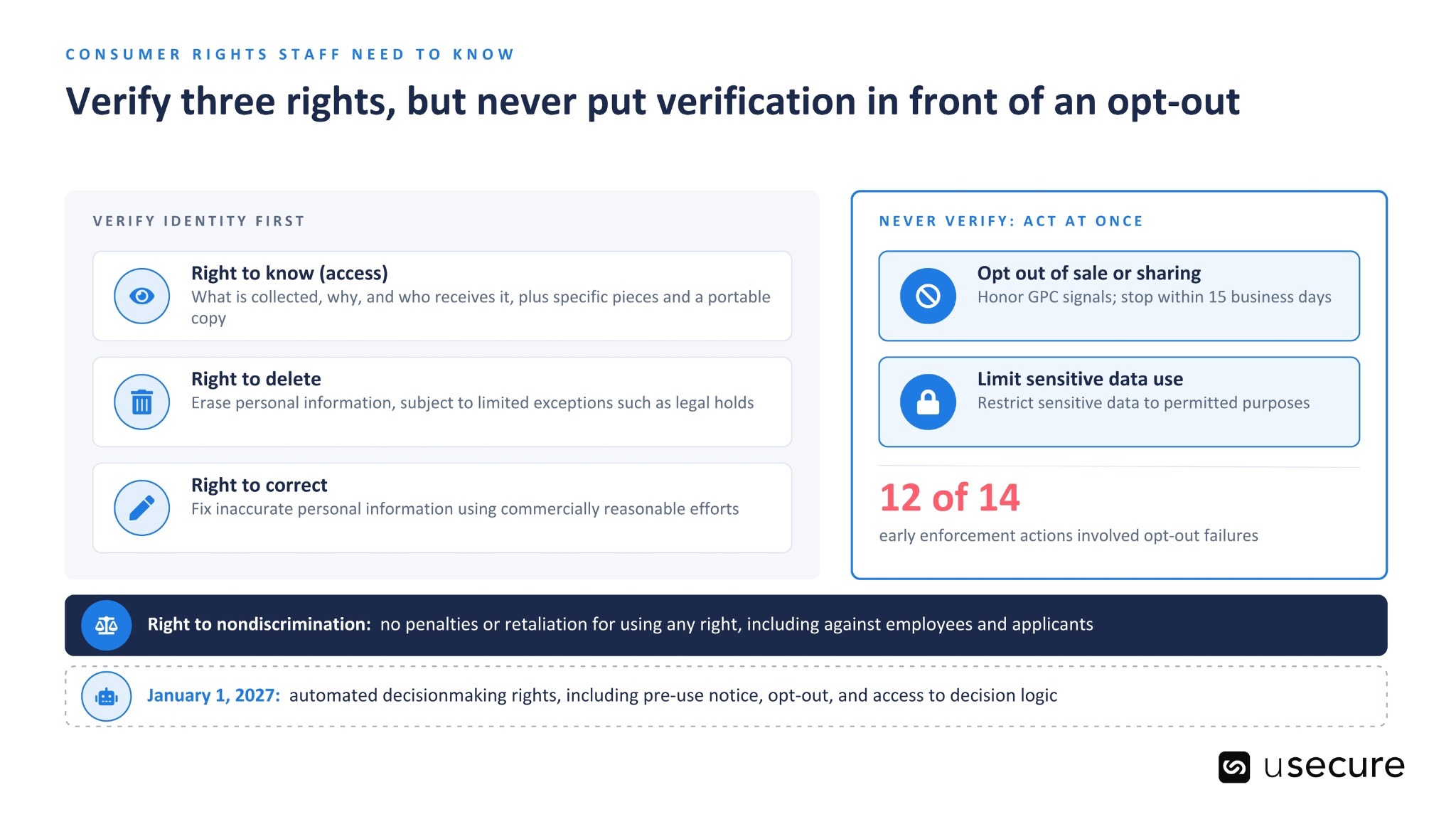
Requests to know, delete, and correct require identity verification proportionate to the sensitivity of the data; opt-out and limit requests must be honored without verification.
Three principles warrant particular emphasis in any CCPA employee training program:
- A valid request need not use statutory language. A customer who writes "please stop selling my information," or an employee who asks human resources what records are held about them, has submitted a valid request. Staff must be trained to recognize the intent of a request rather than its wording.
- Opt-out requests must not be obstructed. Requests to opt out of sale or sharing, and requests to limit the use of sensitive personal information, are not verifiable requests. Recent enforcement actions turned on precisely this error: Ford was fined $375,703 in March 2026 for requiring email verification before processing opt-outs, and LocateSmarter was penalized for requiring the last four digits of a Social Security number. Opt-out preference signals, such as Global Privacy Control, also constitute valid opt-out requests and must be honored automatically.
- Employees and applicants hold the same rights. The Tractor Supply decision was the first to address the privacy rights of job applicants, finding that the retailer failed to inform California applicants of their rights or of how to exercise them. Retaliation against an employee for exercising a CCPA right is prohibited.
Beginning January 1, 2027, businesses that use automated decisionmaking technology for significant decisions, such as those concerning employment, lending, or housing, must also provide pre-use notices, opt-out mechanisms in covered cases, and access to information about how those decisions were reached. Teams that operate automated screening or scoring tools should complete training before that date.
Handling Consumer Requests
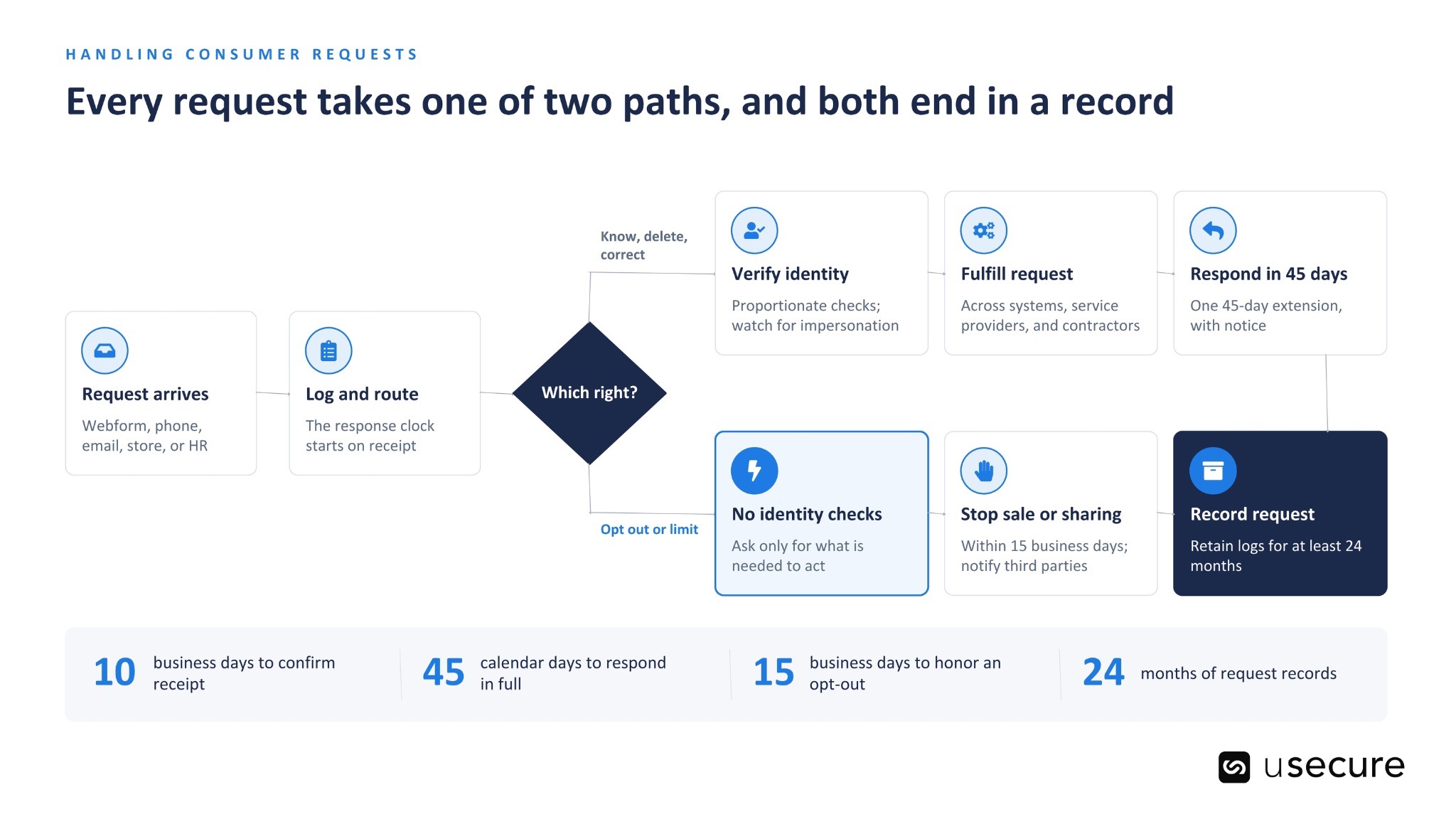
A compliant CCPA request process operates within fixed regulatory deadlines. Businesses must confirm receipt of a request to know, delete, or correct within 10 business days and respond in full within 45 calendar days, with a single 45-day extension available if the consumer is notified. The sale or sharing of personal information must cease within 15 business days of an opt-out request, and records of every request and response must be retained for at least 24 months. Each of these deadlines depends on an employee correctly identifying the request and advancing it.
The Five Stages of Request Handling
- Receipt. Requests arrive through designated methods, typically a webform and, for most businesses, a toll-free telephone number. They also arrive through retail locations, social media, email, and human resources inboxes. When a request is submitted through a non-designated channel, staff must either process it or explain how to submit it through a designated method.
- Logging and routing. Each request must be time-stamped and routed to its owner immediately, as the response period begins upon receipt rather than when the privacy team becomes aware of it.
- Verification, where required. Requests to know, delete, or correct require verification proportionate to the sensitivity of the data involved. Opt-out and limit requests must not be subject to verification. Authorized agents acting on behalf of a consumer may be asked to provide signed permission.
- Fulfillment. Personal information must be located across all relevant systems, including those of service providers and contractors, who must be notified to act on deletion and opt-out requests.
- Response and recordkeeping. The consumer receives a clear response, including the basis for any denial, and the request is documented for audit and enforcement purposes.
The Request Channel as an Attack Surface
The process designed to protect privacy can also be exploited to undermine it. A request to know is, by design, a mechanism for releasing a complete copy of an individual's personal information. An attacker who persuades a support agent that they are the consumer can use this mechanism to obtain the same data a breach would expose, without triggering a security alert.
Help desk and support functions have become primary targets for this type of attack:
- In April 2026, Carnival Corporation detected that an attacker had used social engineering to deceive an employee and gain access to part of its IT environment. The company subsequently notified 5,995,277 customers that their personal information had been copied.
- IBM's Cost of a Data Breach Report 2026 found that social engineering techniques such as help desk impersonation were used in 13% of attacks, at an average cost of $5.23 million per breach.
- Verizon's 2026 Data Breach Investigations Report found that mobile social engineering, including fraudulent text messages and voice calls, succeeds at a rate 40% higher than traditional email phishing.
These dynamics create tension for frontline teams. Regulators penalize businesses that demand excessive information, as the Honda, Ford, and LocateSmarter actions demonstrate, while attackers exploit businesses that verify too little. Navigating this tension requires informed judgment, and developing that judgment is a central objective of CCPA employee training.
CCPA Fines and Enforcement
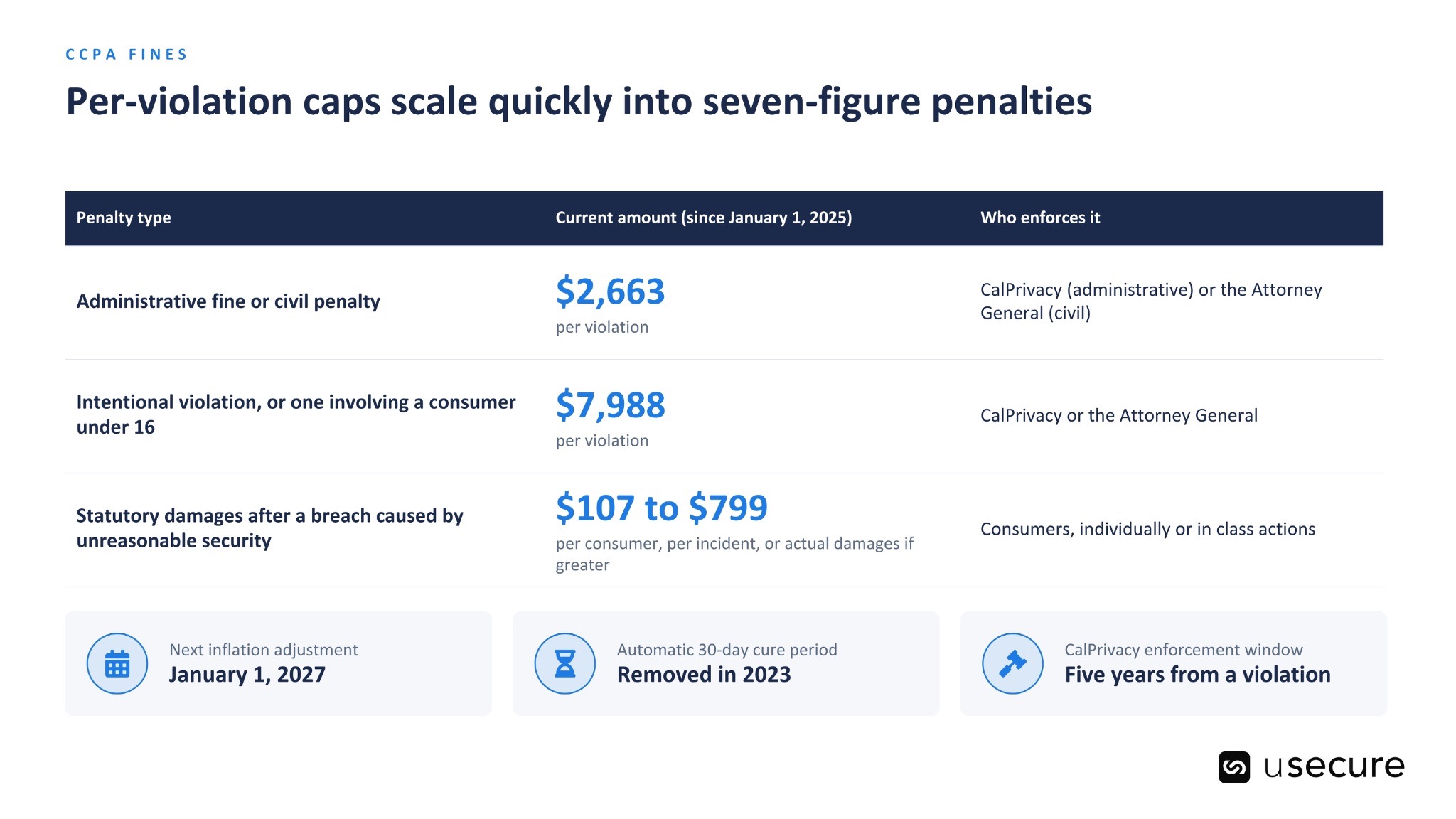
Administrative fines and civil penalties under the CCPA are capped at $2,663 per violation, or $7,988 per intentional violation or violation involving a consumer known to be under 16 years of age. Because each affected consumer may constitute a separate violation, these per-violation amounts can aggregate into seven- and eight-figure penalties.
Enforcement Activity Is Accelerating
California regulators have announced 15 public CCPA enforcement actions since 2022, and both the frequency and the magnitude of penalties have increased substantially. Regulators announced one action in 2022 and none in 2023, compared with six in 2025 and six in 2026 to date. The three largest penalties on record were all announced in 2026.
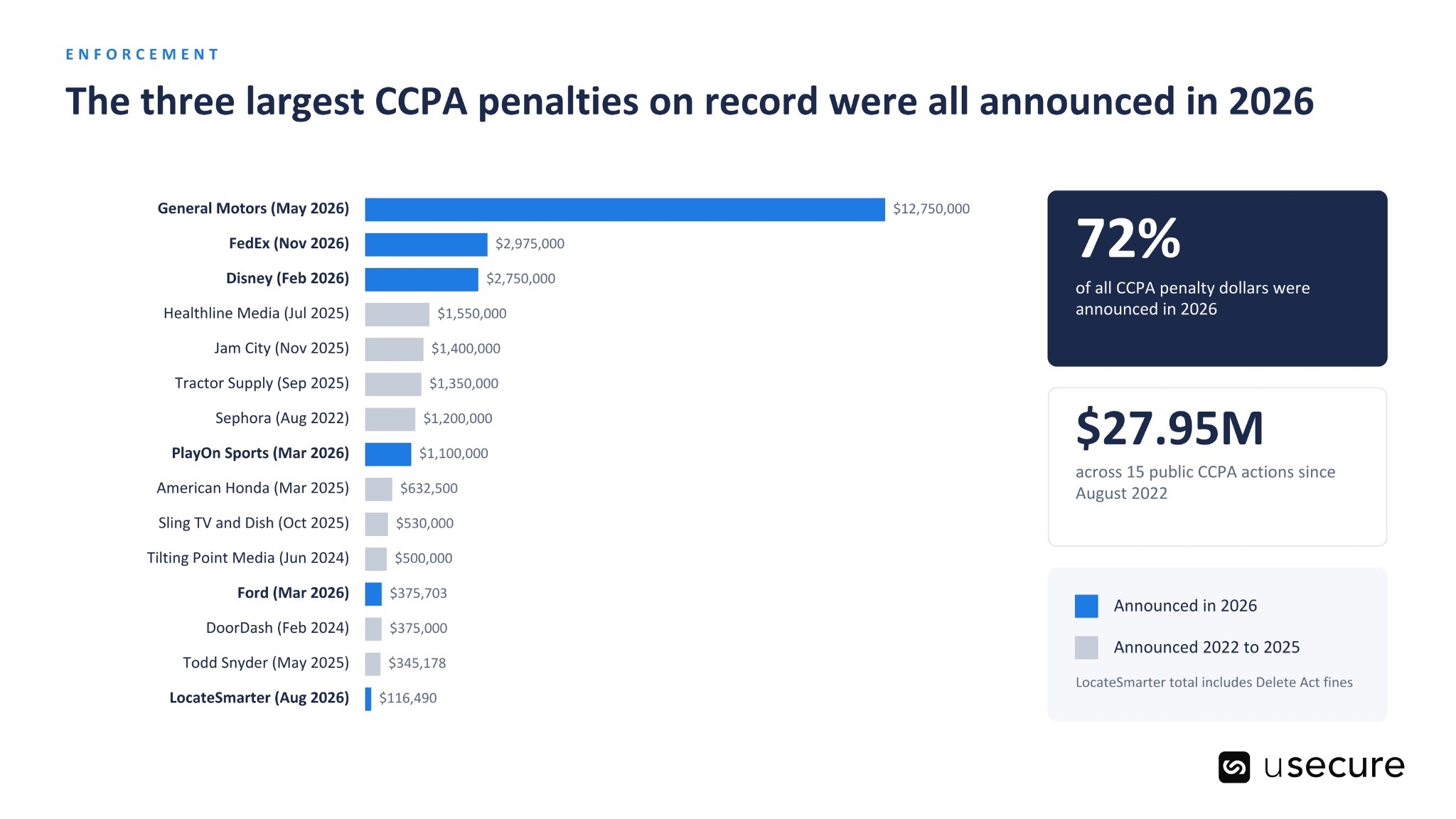
The General Motors settlement alone exceeds the combined value of the next seven penalties, and nearly three quarters of all CCPA penalty amounts to date were announced in 2026.
- General Motors, $12.75 million (May 2026). The largest CCPA penalty to date resolved allegations that General Motors sold the driving data of hundreds of thousands of California motorists to data brokers without consent. It was also California's first enforcement action under the CCPA's data minimization requirements.
- FedEx, $2.975 million (November 2026). CalPrivacy determined that FedEx represented that it did not sell or share personal information while participating in cross-context behavioral advertising, failed to honor opt-out preference signals, and maintained cookie controls that did not function properly. The order requires quarterly testing of opt-out mechanisms and request methods.
- Tractor Supply, $1.35 million (September 2025). The first decision to address the privacy rights of job applicants, this action also requires a corporate officer or director to certify compliance annually for four years.
- Todd Snyder, $345,178 (May 2025). Opt-out requests remained unprocessed for 40 days because the company's privacy portal was not properly configured or overseen.
These cases reveal a consistent pattern. Of the first 14 actions, at least 12 involved an opt-out mechanism that was missing, defective, ignored, or obstructed by a verification step the law does not permit. None of these failures required advanced technology to prevent. Each required personnel who understood the requirements, tested the controls, and identified when those controls ceased to function.
Breach Liability Beyond Regulatory Fines
Regulatory penalties represent only part of the financial exposure. Under §1798.150, consumers may bring legal action when their personal information is exposed as a result of a business's failure to maintain reasonable security, and breaches in the United States are already the most costly in the world. IBM's Cost of a Data Breach Report 2026 places the average US breach cost at $11.5 million, more than double the global average of $4.99 million, while Verizon's 2026 DBIR found that 62% of breaches involved the human element.
Why CCPA Compliance Is a Human Risk Problem
CCPA compliance is ultimately determined at the human layer. Each enforcement action described above originated in a human decision: a verification step added to an opt-out process, a consent tool that was never tested, a request portal without an assigned owner, or a hiring process that omitted applicant privacy notices. Data breaches that expose California residents' information to litigation typically originate in the same way, with an individual who clicks a link, responds to a request, or approves an action that should have been declined.
Traditional compliance training measures activity. It confirms that an employee has completed a module, but it cannot indicate whether that employee is susceptible to manipulation by a convincing caller requesting consumer data. Human Risk Intelligence is designed to close this gap.
From Completion Rates to Human Risk Visibility
Human Risk Intelligence is an approach that aggregates behavioral, identity, and threat signals into a continuous, individual-level view of human risk. For CCPA programs, it delivers three principal benefits.
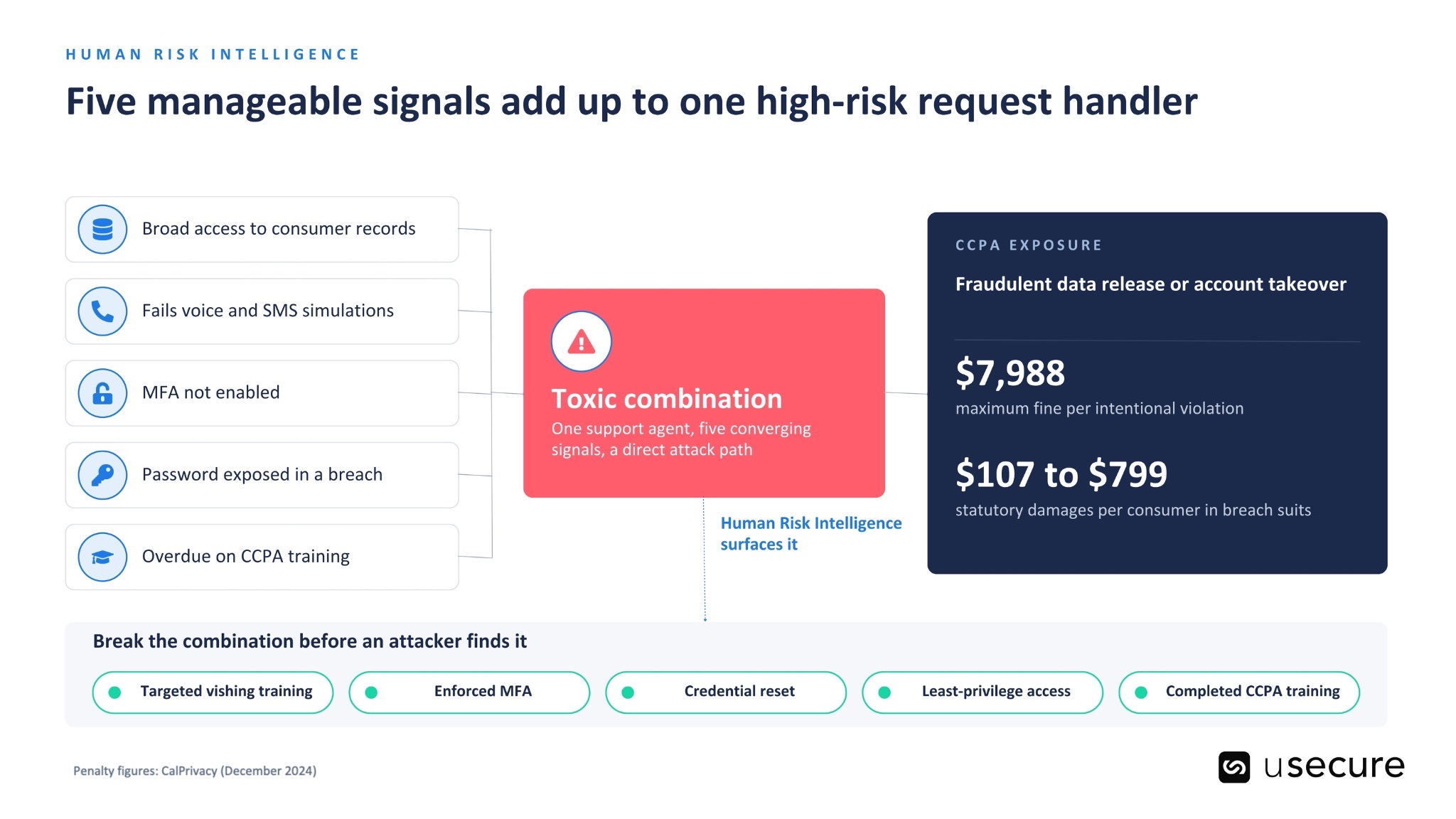
- It unifies signals that typically reside in silos. Most organizations already hold the necessary data: training completion records, phishing simulation results, multi-factor authentication (MFA) status, dark web credential exposure, and policy acknowledgments. Because these data sets reside in separate systems, few organizations maintain a complete view of the individuals who handle consumer requests.
- It identifies toxic combinations. Risk escalates when individual signals converge. A support agent who occasionally fails a phishing simulation represents moderate risk. The same agent with broad access to consumer records, no MFA, and a password exposed in a third-party breach represents a high-probability, high-impact path to a reportable breach and associated CCPA litigation. Each factor appears manageable in isolation; in combination, they describe precisely the profile that attackers seek.
- It converts training into evidence. The 2026 cybersecurity audit rules direct auditors to assess whether awareness and training controls are effective, not merely whether they exist. Tracking whether human risk is declining across request-handling teams, by role and over time, provides executives with a defensible basis for certification.
Applied to the CCPA, Human Risk Intelligence addresses the questions that regulators and auditors are most likely to raise: which individuals handle consumer requests, whether they have been trained on current requirements, whether they are being targeted, and whether their risk is decreasing.
Best Practices for CCPA Employee Training
Effective CCPA employee training is role-based, continuous, documented, and evaluated by measurable reductions in human risk. The following eight practices reflect the requirements of the statute, the 2026 regulations, and recent enforcement orders.
- Identify every role that handles consumer data or requests. Apply the regulation's functional test rather than relying on job titles, and include human resources, recruiting, retail staff, outsourced contact centers, and the personnel who manage website tracking technologies and vendor contracts.
- Develop role-based training modules. A support agent must recognize and route requests; a marketing manager must understand opt-out preference signals and tracking technologies; a human resources partner must manage employee and applicant rights. A single generic course seldom meets the needs of any of these roles.
- Train staff to recognize requests in every form. Use realistic examples of informal requests received by telephone, chat, email, social media, and in person, and emphasize that the response period begins upon receipt.
- Develop verification judgment alongside verification procedures. Staff should understand that opt-out and limit requests must never be verified, that requests to know, delete, and correct require proportionate verification, and which indicators suggest an impersonation attempt, including urgency, pressure to change communication channels, and requests to send data to a new email address or telephone number.
- Simulate the attacks that request handlers encounter. Extend phishing simulations to voice and SMS scenarios and to fraudulent consumer requests, particularly in light of Verizon's 2026 DBIR finding that mobile social engineering succeeds at a rate 40% higher than email phishing.
- Integrate training with identity hygiene. Enforce MFA and least-privilege access for every individual able to export or delete consumer records, monitor for exposure of their credentials, and review dormant or overprivileged accounts. Training cannot offset the risk posed by an account that has already been compromised.
- Test the controls on which staff rely. The FedEx order mandates quarterly testing of opt-out mechanisms and request methods. Organizations should adopt the same discipline, confirming that forms are submitted correctly, preference signals are honored, and portals are monitored, so that staff are not trained on processes that fail without notice.
- Document, measure, and report. Maintain a written training policy (mandatory for businesses that process the data of 10 million or more consumers and advisable for all others), training completion records, and request logs retained for at least 24 months. Report trends in human risk for request-handling teams to senior leadership, rather than completion rates alone.
Training should be delivered at onboarding, at least annually, following any breach, and whenever requirements change. Several changes are already scheduled: the next inflation adjustment to thresholds and penalties and the ADMT requirements both take effect on January 1, 2027, the same date on which the first cybersecurity audit period begins for the largest businesses.
CCPA Compliance Depends on the Human Layer
The CCPA training requirements are explicit: every individual responsible for handling consumer privacy inquiries, or for the business's compliance with the law, must understand the CCPA, its implementing regulations, and the procedures through which consumers exercise their rights. With the 2026 regulations introducing cybersecurity audits that assess awareness and training, and with regulators announcing the three largest CCPA penalties on record this year, this obligation now carries substantial financial consequences.
The enforcement record supports a clear conclusion. CCPA violations seldom result from an absence of policy. They result from personnel who have not been trained on current requirements, controls that have not been tested, and request channels that attackers have learned to exploit. Organizations that approach CCPA compliance as a human risk challenge, integrating training, behavioral, identity, and threat data into a single continuous view, will be best positioned to protect California residents' data and to demonstrate that protection to regulators, auditors, and the board.
FAQs
- Does the CCPA apply to employee data? Yes. Since January 1, 2023, employees, job applicants, and independent contractors have held the same CCPA rights as other California consumers. Human resources, recruiting, and payroll teams must be able to recognize and process their requests, and covered businesses must provide privacy notices to applicants and employees.
- Does CCPA training apply to businesses outside California? Yes, provided the business meets a CCPA threshold and collects the personal information of California residents. Applicability is determined by the residency of the data subjects rather than the location of the business, so the training requirement extends to every in-scope employee regardless of work location.
- How long should CCPA training records be kept? The CCPA does not specify a retention period for training records. However, consumer request records must be retained for at least 24 months, and cybersecurity audit documentation for five years. Retaining training records for a minimum of five years ensures their availability for any audit or investigation.
- Can a service provider or contractor be fined under the CCPA? Yes. The CCPA's penalty provisions apply to any business, service provider, contractor, or other person that violates the law. Service providers and contractors, including managed service providers, should train their personnel on the contractual restrictions governing the use of client data.
- Does CCPA training cover other state privacy laws? In part. Many state privacy laws share core rights, including access, deletion, correction, and opt-out, and as of July 1, 2026, fourteen states require businesses that sell or share personal information to honor opt-out preference signals in at least some circumstances. A robust CCPA program provides a strong foundation, but deadlines, thresholds, and definitions vary by state and should be addressed where they differ.
BOOK A DEMO
See Human Risk Intelligence in action
A 30-minute walkthrough of how to cut human risk across your users, tailored to MSPs and IT teams.
Subscribe to newsletter

Related posts
Explore more insights, updates, and resources from usecure.
FTC Safeguards Rule training requirements: Building a human-ready written information security plan

HIPAA training requirements (2026): Who needs it, how often, and what to cover
What is PHI? A guide to protected health information, HIPAA identifiers, and key exclusions
See effortless human risk intelligence in action
Book a demo to see how usecure reduces human risk for IT teams and MSPs, or start a free trial to explore the platform yourself.

