2025 SAT Benchmark Report: How 4,000+ Organisations Are Reducing Human Risk

Subscribe to newsletter
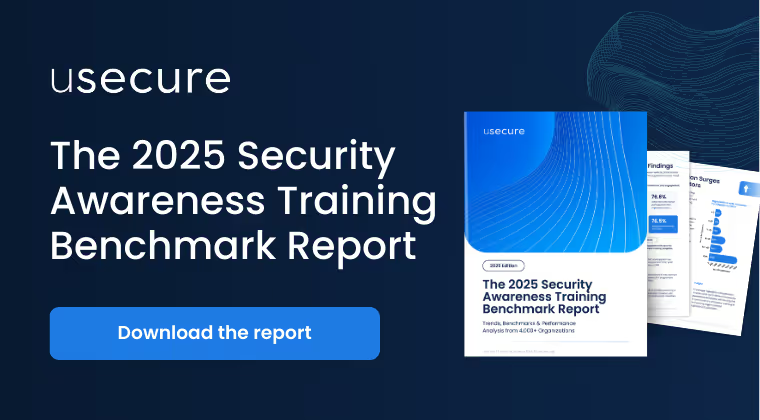
As cyber threats grow more sophisticated, one thing remains constant: your people are still your first line of defence. But are they ready?
That’s the question our new 2025 Security Awareness Training (SAT) Benchmark Report set out to answer.
Based on anonymised, real-world data from over 4,200 organisations across industries and regions, the report reveals how businesses are evolving their human risk strategies — and the results are impossible to ignore.
What the Security Awareness Training Data Tells Us About Human Risk (2025)
This year’s findings confirm what security leaders already know: training that is consistent, relevant, and well-executed drives measurable outcomes.
Here’s a snapshot of what the 2025 data shows:
- 88% of organisations increased SAT participation
- 85.7% improved their security training scores
- 76.6% saw improvements in both engagement and performance
- 70% growth in completed sessions year-over-year
- Monthly training remains the most effective delivery model
Whether you're managing internal IT or delivering services as an MSP, these insights can help sharpen your SAT strategy — and build a more resilient workforce
From Checkbox to Culture: SAT as a Human Risk Strategy
The biggest takeaway from this year’s report? SAT is no longer a checkbox — it’s a core part of cybersecurity culture.
More organisations are moving away from one-off campaigns and toward long-term, embedded training. The result? Better engagement, better outcomes, and a clearer return on investment.
Top trends we uncovered:
- Record-breaking adoption: Thousands of new users joined training programs in 2024
- Relevance drives results: Modern, scenario-based content boosts both completion rates and user retention
- Monthly beats quarterly: Teams running monthly SAT saw the highest security improvements
- Widespread score gains: Over 85% of orgs saw measurable improvement — with some hitting score jumps of up to 80.8%
What SAT Success Looks Like: Measurable Human Risk Reduction
Some of the standout stories in the report prove that commitment pays off:
- One organisation delivered 33,947 training sessions in a single year
- Another boosted their SAT score by 80.8% through a monthly training model
These aren’t just big numbers — they’re evidence that consistent training reduces human risk, strengthens compliance posture, and builds lasting behavioural change.
Why This SAT Benchmark Matters for Human Risk Management
This isn’t just a data set. It’s a blueprint for building a smarter, more effective awareness programme — whatever stage you’re at.
Inside, you’ll find:
- Benchmark data to see how your organisation compares
- Evidence-based strategies for increasing engagement and improving outcomes
- Actionable insights for building a defensible, high-impact SAT programme
Whether you’re designing a programme from scratch or looking to optimise what you already have, this report gives you the numbers — and the confidence — to move forward strategically.
See How You Stack Up: SAT Benchmarks & Human Risk Trends
Thousands of organisations are turning their people into a resilient line of defence. Want to know how your programme compares?
Download the report and get access to the insights that are reshaping security awareness — one user at a time.
Download the 2025 SAT Benchmark Report
BOOK A DEMO
See Human Risk Intelligence in action
A 30-minute walkthrough of how to cut human risk across your users, tailored to MSPs and IT teams.
Subscribe to newsletter

FAQs
Ein Human Risk Score ist eine Kennzahl, mit der Unternehmen das menschliche Cyberrisiko anhand von Signalen wie Schulungsleistung, Verhalten in Phishing-Simulationen und bekannten offengelegten Zugangsdaten bewerten. Er dient als Maßstab, um Schwachstellen zu erkennen und Veränderungen im Zeitverlauf zu verfolgen.
Vergleichen Sie im Zeitverlauf den Abschluss von Schulungen, die Ergebnisse von Wissenstests, die Resultate von Phishing-Simulationen, das Meldeverhalten und die Entwicklung des menschlichen Risikos. Zusammen liefern diese Kennzahlen deutlich mehr Kontext als die Abschlussquote allein.
Der etablierte Human Risk Score von usecure kombiniert Schulungsleistung, Ergebnisse von Phishing-Simulationen und bekannte offengelegte Zugangsdaten. uHealth ergänzt dies um eine separate, auf Intelligence basierende Bewertung entlang von Target Value, Awareness, Hygiene und Access. So wird sichtbar, wo die Gefährdung über die Identitäten hinweg liegt und welche Probleme zuerst angegangen werden sollten.
Ja. usecure bietet Demos für Unternehmen und MSPs an, die sich für die Funktionen für Human Risk Management und Human Risk Intelligence interessieren. In einer Demo lernen Sie vor dem Kauf die Plattform und die für Sie relevanten Workflows kennen und können Ihre Anforderungen besprechen.
Related posts
Explore more insights, updates, and resources from usecure.
The New End User Portal Is Now Live

Cybersecurity Compliance Standards for the UK Nuclear Energy Sector

See effortless human risk intelligence in action
Book a demo to see how usecure reduces human risk for IT teams and MSPs, or start a free trial to explore the platform yourself.

